Overblog Tous les blogs Top blogs Entreprises & Marques Tous les blogs Entreprises & Marques
Suivre ce blog Administration + Créer mon blog
MENU
1 octobre 2012 1 01 /10 /octobre /2012 07:55

MV-22 Ospreys


MOSCOW, October 1 (RIA Novosti)


U.S. Marine Corps MV-22 Osprey tiltrotor aircraft were deployed on Monday to the U.S. Futenma airbase in southern Japan’s Okinawa Prefecture despite strong public opposition, the Kyodo news agency reported.


The first tiltrotor transport aircraft arrived at the Marine Corps' Futenma base from a base in southwestern Japan.


Six Ospreys departed from the Marines' Iwakuni air base in Yamaguchi Prefecture in the morning, a day after Japanese police cleared cars left by protesters to block the roads to Futenma on Sunday, in protest against the basing of 12 Bell-Boeing MV-22 tiltrotor aircraft there on Monday, according to Kyodo.


In September, the Japanese and U.S. governments agreed to a plan for the basing of the tiltrotors in Japan, after a study by the Japanese concluded the aircraft did not pose special risks to local people. MV-22 flights will be limited to a minimum ceiling of 500 feet (150 meters) and they will not be allowed over populated areas.


Up to 24 MV-22s will be based at Futenma by 2014.


The V-22 Osprey family has had a troubled history, with several fatal crashes during its development. An MV-22 crashed during the African Lion military exercise in Morocco in April this year, prompting the Japanese to ask the United States for guarantees about the safety of the deployment in Okinawa.

Partager cet article
Repost0
1 octobre 2012 1 01 /10 /octobre /2012 07:50

Devil-Killer-UAV.JPG

Korea Aerospace Industries


28 Sep 2012 By  Greg Waldron - FG


Korea Aerospace Industries (KAI) is developing a new long-range guided weapon that can cruise to a location and subsequently, loiter and attack when a target is identified.


The system is called "Devil Killer" and has a maximum speed that ranges between 350-400km/h (189-216kt), says KAI. It navigates using GPS and a data link, and the company refers to it as a "suicide combat unmanned air vehicle".


"After [the Devil Killer] moves to the target point along the pre-programmed route, which is designated with navigation points, the operator can identify targets through the forward-looking camera image and then commence either a manual or automatic strike," says KAI.


The system is powered by an electric motor and weighs 25kg (55lb), with a length of 1.5m (4.92ft). Details of its explosive payload, endurance and range are confidential.


If a target is not identified, the system can be retrieved and re-used. At present, the company is focusing on a surface-launched version, but eventually, it hopes to develop an air-launched variant.


The company aims to pitch the system to the South Korean armed forces and foreign buyers.


kai devil killer

Korea Aerospace Industries

Partager cet article
Repost0
1 octobre 2012 1 01 /10 /octobre /2012 07:50

air f-35a aa-1 flight top lg-source DefenceWatch


28 September 2012 PacificSentinel 


Richmond, Australia - BAE Systems Australia has been awarded a contract from the New Air Combat Capability (NACC) Program to develop an operational model to integrate the Joint Strike Fighter (JSF) into the Australian Defence Environment.

Under the nine month contract BAE Systems will work closely with the Australian Defence Force and NACC to develop a model that outlines all requirements for JSF operations and sustainment including maintenance, supply, training needs and fleet asset management.

Director Aerospace John Monaghan said: “This contract will play a critical role in ensuring that Defence, industry and our ADF men and women are ready and prepared for a smooth transition when the JSF comes into service.

“Our team will work to define the processes and information that will be required to ensure that the aircraft achieves its maximum operational effectiveness in any deployed environment.”

The company has leveraged its global experience and appointed an employee from the UK JSF team to lead the project. F-35 Tech Specialist Dave Harrison has more than 10 years experience with the aircraft and played a pivotal role working with the British Joint Combat Air Project to support the integration of the aircraft into the UK defence force.

The project also requires plans for follow-on phases that will support the continued integration of the aircraft through to achievement of its Initial Operating Capability in 2019/20.

Partager cet article
Repost0
1 octobre 2012 1 01 /10 /octobre /2012 07:45

F-35 Joint Strike Fighter source defpro.com


28 Sep 2012By  Greg Waldron - FG


Singapore - BAE Systems Australia has won a nine-month contract to develop operational models for the integration of the Lockheed Martin F-35 into the Australian defence environment.


The company will work with the Australian Defence Force (ADF) to create a model that covers all aspects of the F-35 sustainment including maintenance, supply, training and fleet asset management.


"This contract will play a critical role in ensuring that Defence [Force], industry and our ADF men and women are ready and prepared for a smooth transition when the Joint Strike Fighter [JSF] comes into service," says John Managhan, director aerospace at BAE Systems Australia.


"Our team will work to define the processes and information that will be required to ensure that the aircraft achieves its maximum operational effectiveness in any deployed environment."


An industrial partner in the F-35 programme, Australia could obtain up to 100 examples of the type.

Partager cet article
Repost0
1 octobre 2012 1 01 /10 /octobre /2012 07:45

http://3.bp.blogspot.com/-KZ7hhWsJEkA/TnmzMpJ5yTI/AAAAAAAAAXY/wP2pMLbtAUU/s1600/Warships_at_Sea.jpg


29 September 2012 By John Valceanu / American Forces Press Service - PacificSentinel


WASHINGTON, Sept. 28, 2012 – The U.S. 7th Fleet has played a key role in American foreign policy and has had a major positive impact in Asia since being stood up during World War II, a historian told an audience of military service members and Defense Department civilian employees at the Pentagon.

Edward J. Marolda, author of “Ready Seapower: A History of the U.S. Seventh Fleet,” outlined the contributions made by the fleet over the past half century. Marolda teaches at Georgetown University and is a former senior historian at the U.S. Naval History and Heritage command. He has authored, coauthored or edited 12 books on U.S. naval history.

“The U.S. 7th Fleet has had a dramatic and lasting influence promoting and protecting U.S. interests in the Far East,” Marolda said. “It’s been a major factor in bringing stability to the region, enabling countries relying on us to prosper economically. By the same token, it’s helped our friends in the region to develop democratic governing systems and universal human rights ideas.”

The historian described the fleet’s trial by fire during its early years in World War II, mainly under the leadership of Vice Adm. Thomas C. Kinkaid. Marolda touched on Kinkaid’s sometimes contentious relationship with Army Gen. Douglas MacArthur, who was the higher-level commander in the South West Pacific Area.

“The most stellar accomplishment of the fleet” in World War II was the Battle of Leyte Gulf, Marolda said, calling it “a key turning point” in the war. The battle took place from Oct. 20 to Dec. 31, 1944, and launched the Allied campaign to recapture the Philippine Archipelago and liberate it from the Japanese.

After World War II, the 7th Fleet became a permanent forward-deployed force based in Asia. Marolda said that presence became an important political presence in the Pacific region, helping to deter aggression among states.

“When all else is quiet, and there are no wars going on, deterrence is still a big part of the mission,” Marolda said. As an example, he cited the China-Taiwan crises of 1954-55, 1958, 1963 and 1995-1996, in which China threatened military action against Taiwan.

“Our naval presence really did stop them from taking any action,” Marolda said. “It gave them pause and cause for caution.”

Marolda quoted Mao Zedong, who led the People’s Republic of China from 1949 to 1976, as saying, “the 7th is the biggest fleet, and it surrounds us.”
In addition to deterrence of aggression, Marolda said the 7th Fleet also helped maintain the freedom of the seas for trade and shipping by suppressing pirates. In doing so, it enabled economic prosperity to flourish.

Allied nations like Japan, South Korea, the Philippines, Australia and New Zealand all benefited from the 7th Fleet’s efforts, he said, as did even the People’s Republic of China, which took advantage of reduced piracy and free seas to expand its international trading activities. The results have been a much more stable region and a proliferation of more democratic governments.

“It has been one of the primary instruments of U.S. foreign policy in Asia,” Marolda said. “Behind the shield of the U.S. Navy, economic and political prosperity were able to occur in the region. By protecting our maritime allies, the fleet was able to counter both Marxist-Leninist and radical Islamist movements.”

Along with deterrence, Marolda said the 7th Fleet used “soft power” to show nations in the region that the U.S. wanted to do the right things and shared in their values. Examples include refugee evacuations, disaster relief and humanitarian operations.

The fleet helped in various ways over the years, including working with North Vietnamese refugees escaping by boat during the Vietnam War and providing disaster relief during the 1991 volcanic eruption of Mount Pinatubo in the Philippines and the 2004 earthquake and tsunami in the Indian Ocean, Marolda said.

Though these are missions for the fleet, the most important reason for its existence is the ability to fight wars, Marolda said, and the 7th is the only U.S. fleet to have been involved in every major conflict since World War II. During the Korean and Vietnam wars, the fleet’s ability to control the sea was critical.

“Both in Korea and Vietnam, naval power was absolutely vital to whatever success we had,” Marolda said, noting that the fleet was able to deny the use of the seas to adversaries, thereby preventing the movement of supplies and personnel.
“We could not have fought those wars the way we did without being able to control the seas,” he said.

Marolda’s book is available for download from the U.S. Navy’s Naval History and Heritage Command site, and it may be purchased in book form through the U.S. Government Printing Office. The presentation was sponsored by the Historical Office of the Office of the Secretary of Defense as part of its History Speaker Series.

Partager cet article
Repost0
1 octobre 2012 1 01 /10 /octobre /2012 07:35

J-11B Fighter


September 30, 2012 China Military News


2012-09-30 — China’s first aircraft carrier, the Liaoning, is over 300 meters long and over 70 meters wide. The distance from the keel to the top of the mainmast is over 60 meters. There are 10 decks below the main deck, and nine levels of island-style superstructures above the main deck, making the aircraft carrier look like a 20-story building. The Liaoning has a normal displacement of more than 50,000 tons.


Aircraft carriers top all other types of large ships in tonnage, size, and operational capability, and are hailed as “floating airports.” The island-style superstructures at the starboard side of an aircraft carrier are the command center for flight-deck operations, as well as the ship as a whole.


Modern carrier-based aircraft take off in mainly three ways: catapult assisted takeoff, ski-jump takeoff, and vertical takeoff. The Liaoning can carry fixed-wing aircraft and helicopters as designed.


Although there are no carrier-based aircraft on the flight deck of the Liaoning, the aircraft carrier is fully equipped for aircraft takeoff and landing.


The modern aircraft carrier is widely referred to as a “city at sea,” and living on an aircraft carrier is like living in a small society. There are restaurants, supermarket, post office, laundry room, gym, garbage disposal station, and both noisy and quiet bars on the Liaoning, offering the crew a relatively convenient living environment.


Military expert Li Li said in an interview with the CCTV that in the short term, the Liaoning will be mainly used for scientific research and the training of aircraft carrier pilots.


Li added that a new generation of carrier pilots and excellent military officers will be trained on the Liaoning aircraft carrier, which will be the cradle of China’s naval talent.


Li Jie, a researcher at the Naval Military Art Studies Institute, previously said that there are mainly two ways to train pilots. The first way is conducting most training directly on aircraft carriers using aircraft from primary through advanced training aircraft, which is adopted by the United States. The other way is conducting training on land for some time and then on board, which is adopted by China and many other countries.


There has been a lot of speculation about the aircraft, which will be deployed on the Liaoning. Military expert Yin Zhuo said in an interview with the CCTV that the type of the carrier-based aircraft has already been determined. It will take off from a ski-jump runway. It is a heavy-duty aircraft, and has an operational capability comparable to that of the Jian-11BS and Su-30 fighter aircraft.


Du Wenlong, a researcher at the PLA Academy of Military Sciences, said the aircraft deployed on China’s first aircraft carrier must be an upgraded version of domestic J-11 fighters.

Partager cet article
Repost0
1 octobre 2012 1 01 /10 /octobre /2012 07:30

National Emblem of the People's Republic of China.svg


September 30, 2012 China Military News


2012-09-29  — The Saturday edition of the People’s Daily, the flagship newspaper of the Communist Party of China (CPC), published a commentary asserting that China has never engaged in any form of arms race and will not do so.


After China’s first aircraft carrier was delivered and commissioned to the People’s Liberation Army (PLA) Navy on Sept. 25, some overseas media were inclined to discuss a possible military threat posed by China, the commentary said.


“It is nothing but a vain attempt to spread rumors about China starting an arms race or to lure China into engaging in an arms race,” it added.


The commentary argued that it is not inappropriate for China to have its own carrier, as it was the last of the permanent members of the UN Security Council to acquire one and is only the 10th country in the world to do so.


Although China has grown stronger, it will never bully the weak, the commentary said.


“China was once bullied by foreign invaders equipped with bombs and fleets. It has always been the fervent hope of the Chinese to build up the country’s defenses and to safeguard its territory and sovereignty,” it said.


“Countries that are keen on flexing their military muscle and waging wars against weak countries are in no position to point fingers at China,” it said.


A strong Chinese navy will not only serve the interest of maintaining peace in the Asia-Pacific region, but will also benefit world peace and stability, the commentary argued.


China has a long coastline and vast ocean territory that needs to be defended by a strong navy, the commentary said, adding that regional conflicts, natural disasters and terrorism pose a challenge for China to defend itself and honor its international obligation to preserve peace and security.


The commentary argued that China has proven itself as a responsible international power by participating in naval escort missions near Somalia in recent years.


Developing the economy and improving the lives of Chinese remains the government’s primary goal, the commentary said.


China’s possession of a carrier will not shift the regional strategic balance, or will it affect China’s development strategy, the commentary said.

Partager cet article
Repost0
1 octobre 2012 1 01 /10 /octobre /2012 07:30

China Carrier (Liaoning)


September 27, 2012 by Ritu Sharma - defenceeXpress


The Chinese Navy has inducted its aircraft carrier earlier this week (September 25). The Indian Navy, which claims an edge over its Chinese counterpart owing to its long maritime legs and long history of seamanship, is closely watching the development.


The PLA Navy has been planning to enter the Indian Ocean Region (IOR) sometime in 2015 only. However, the increased piracy in the Gulf of Aden provided it with an opportunity to deploy its warships for longer durations in the international water and learn the international best practices by closely coordinating with the foreign navies. Buoyed by this the Chinese Navy inducted its first aircraft carrier named Liaoning in its fleet. The announcement was finally made by the Defence Ministry of China through website of PLA.


The Soviet-vintage aircraft carrier has been named after a northeast province of China. PLA navy has indicated that the ship is likely to be used for training purposes only.


"The entry into the ranks of this aircraft carrier will raise the level of modernization of China's overall naval operational forces," defence ministry said. The Liaoning will help "effectively protect national sovereignty, security and development interests" it was officially announced.


The Indian Navy is monitoring the situation, but maintains there is nothing alarming in it. As put by the skipper of the Indian Navy's lone aircraft carrier INS Viraat: "See you cannot reach a great power status in 10-15 days. Navies are made over centuries. You have to keep building them for over years and they are a costly proposition. So any navy aspiring to operate carriers will be envious of countries operating them. Naval aviation is a great skill and it takes 25 years to hone it. Once you build this capability you cannot do away with it."


However, what worries the Indian Navy is the unforeseen delay in the Indigenous Aircraft Carrier indigenous aircraft carrier programme followed by trial problem in the Russian-built Admiral Gorshkov. In both the cases the delivery dates have been pushed back, which by conservative estimates mean that India will get its new aircraft carrier only by early 2014.


The voyage of Varyag - the written off Soviet Navy aircraft carrier from the 1980s - to the Chinese Navy's Liaoning is one that of a determination of the eastern neighbour to find its maritime legs at the earliest. The construction of Varyag had started in 1980s and its construction stopped in 1992 after the disintegration of the USSR. It remained in the Ukrainian shipyard unfinished until 1998 when a Macau-based Chinese company bought it for US$20 million. In March 2002, the vessel was towed to the Dalian Shipyard in northern China after an arduous sea voyage spanning months. Since then the warship has been stationed there for refurbishment.

Partager cet article
Repost0
1 octobre 2012 1 01 /10 /octobre /2012 07:25

AH-64D photo US Army


Sep. 28, 2012 - By WENDELL MINNICK Defense News


TAIPEI — The U.S. Defense Security Cooperation Agency (DSCA) announced on Sept. 25 two potential attack helicopter sales to South Korea.


The first, worth $2.6 billion, is for 36 AH-1Z Cobra attack helicopters.


Prime contractors will be Bell-Textron Corporation and General Electric.


The second, worth $3.6 billion, is for 36 AH-64D Apache Longbow Block III attack helicopters. Prime contractors will be Boeing, Lockheed Martin and General Electric.


Both sales will be administered under the Foreign Military Sales (FMS) program under the DSCA, said a DSCA news release.


Three helicopters are competing for Korea’s AHX competition.


The two U.S. attack helicopters are competing against the T129B (AW729) attack helicopter jointly developed by Turkish Aerospace Industries and AgustaWestland for the Turkish military.


AHX bids were submitted to the South Korean Defense Acquisition Program Administration in May, and a decision is expected by the end of this year.


According to the DSCA news release, the Cobra deal will include 84 T-700 GE 401C Engines (72 installed and 12 spares), 288 AGM-114K3 Hellfire Missiles, 72 AIM-9M-8 Sidewinder air-to-air missiles, AN/AAQ-30 Target Sighting Systems and AN/ALQ-136 Radar Frequency Jammers. The electronic warfare systems include the AN/AAR-47 Missile Warning System, AN/ALQ-144 Infrared Jammer, and APX-123 Identify Friend or Foe Mode 4.


The Apache deal will include 84 T-700-GE-701D Engines (72 installed and 12 spares), 42 Modernized Target Acquisition and Designation Sight/Modernized Pilot Night Vision Sensors, 36 AN/APG-78 Fire Control Radar, 36 AN/APR-48A Radar Frequency Interferometers, 42 AN/APR-39 Radar Signal Detecting Sets, 45 AN/AVR-2B Laser Warning Sets, 43 AAR-57(V) 3/5 Common Missile Warning Systems, 38 30mm Automatic Chain Guns, 90 AN/ARC-201E SINCGARS Radios, 80 M299 Hellfire Missile Launchers, 400 AGM-114R1 Hellfire Missiles Semi-Active Lasers, 438 Stinger Block I 92H Missiles, and 11,020 Hydra unguided rockets.


Indonesia Seeks Apaches


In related news, the DSCA released U.S. congressional notifications on a possible FMS sale of eight AH-64D Apache Block III Longbow attack helicopters to Indonesia.


The estimated $1.42 billion deal, announced on Sept. 21, will include 19 T-700-GE-701D Engines (16 installed and 3 spares), 9 Modernized Target Acquisition and Designation Sight/Modernized Pilot Night Vision Sensors, 4 AN/APG-78 Fire Control Radars, 4 AN/APR-48A Radar Frequency Interferometers, 10 AAR-57(V) 3/5 Common Missile Warning Systems, 10 AN/AVR-2B Laser Detecting Sets, 10 AN/APR-39A(V)4 Radar Signal Detecting Sets, 24 Integrated Helmet and Display Sight Systems, 32 M299A1 Hellfire Missile Launchers, and 140 Hellfire AGM-114R3 Missiles.


“The proposed sale provides the Government of Indonesia with assets vital to protect and deter both external and other potential threats. Indonesia will use these Apache helicopters to defend its borders, conduct counterterrorism and counter-piracy operations, and control the free flow of shipping through the Strait of Malacca. The materiel and services under this program will enable Indonesia to become a more capable defensive force and will also provide key elements required for interoperability with U.S. forces,” said a DSCA news release.

Partager cet article
Repost0
1 octobre 2012 1 01 /10 /octobre /2012 07:20

missile-unit-kpa-korea-kim-il-sung-square-pyongyang-afp-lg


28 September 2012 By Axel Berkofsky for the ISN - PacificSentinel


Recent satellite images suggest that North Korea is modernizing its nuclear facilities. This not only suggests that its determination to acquire nuclear weapons is now irreversible, it may also require the international community to rethink how it entices Pyongyang back to the negotiation table, or so argues Axel Berkofsky.

Does North Korea want the bomb? The answer to this question is ‘most probably yes’, especially if it supports Pyongyang’s commitment to defend the country against ‘US imperialists’ and South Korea’s ‘puppet regime’. Indeed, the most disconcerting evidence to date of North Korea’s determination to develop nuclear weapons came in 2006 and 2009 when it detonated plutonium devices in underground tests. However, more recent reports and satellite imagery suggest that North Korea has made significant progress in the development of its nuclear weapons program over the last 12 – 18 months. Today, North Korea’s new leader, Kim Jong-Un, presides over a program that no longer focuses on graphite moderated reactors and plutonium production, but instead on more complex and sophisticated light water reactors (LWR) and uranium enrichment. This, in turn, suggests that – technical problems and financial bottlenecks aside – Pyongyang’s determination to develop and deploy nuclear weapons is now all but irreversible.

Mixed signals (again)

This has not stopped North Korea from continuing to send out mixed signals to the international community regarding the true purpose and capabilities of its nuclear program. In February 2012, for example, Kim Jong-Un announced plans to terminate uranium enrichment and allow international inspectors to verify and monitor the country’s nuclear facilities. In return, Washington promised to ship much-needed food aid to North Korea. Pyongyang also agreed on a moratorium on the launch of long-range missiles and declared itself willing to resume the Six-Party Talks (after its de facto suspension in 2009).

However, North Korea reverted back to type in April when Pyongyang not only renounced US food and humanitarian aid but also conducted a rocket launch. Despite Pyongyang’s claim that the objective of the launch was to place a weather satellite into orbit, the United States and others were quick to label it a test of long-range missile technology. Indeed, while the rocket eventually crashed into the Yellow Sea, it also reaffirmed beliefs that North Korea now has the limited capability to launch missile technologies and keep them in flight.

Olli Heinonen, former Deputy Director General of the International Atomic Energy Agency (IAEA), also writes that even if inspectors were allowed to monitor North Korea’s nuclear facilities, it would most likely be the sites to which the IAEA was granted access under the 2007 agreement reached at the Six-Party Talks. Accordingly, inspectors would have been limited to verifying whether the so-called Uranium Enrichment Workshop (UEW) (operative since 2009) has been shut down (which it has not). There would have been no inspections of Pyongyang’s inventory of low enriched uranium (LEU) or visits to installations that are thought to be part of the conversion and enrichment process.

One bomb per year

Stanford University’s Siegfried Hecker - who visited the North’s Yongbyon nuclear complex in November 2010 - nevertheless argues that North Korea’s enrichment facilities could be converted to produce highly enriched uranium (HEU). He further maintains that the light water reactor at Yongbyon (PDF) could be also developed to produce weapons-grade plutonium. Hecker was also shown a small-scale industrial uranium enrichment facility, which he described as "astonishingly modern (PDF)” and comparable with modern American counterparts.

Indeed, Olli Heinonen adds further substance to Hecker’s observations by confirming that North Korea’s reprocessing plant at Yongbyon could also be easily modified to facilitate plutonium separation. Pyongyang’s current plutonium stocks are estimated to be between 12 and 40 kilograms, an amount sufficient for up to six nuclear weapons. When the Yongbyon light water reactor is fully operational, Heinonen further estimates that it could annually produce up to 12 kilograms of plutonium. This would provide North Korea with enough fissile material to develop one nuclear bomb per year.

Testing times?

And while concerns that Kim Jong-Un would mark his rise to power by conducting a nuclear test turned out to be alarmist, it nevertheless remains an option. To be sure, a third nuclear test would use up the most of plutonium stocks that Pyongyang has invested significant time and resources into developing. What’s more, a further test would inevitably lead to the termination of bilateral food and humanitarian assistance from the United States, Japan and South Korea. Even China - North Korea’s only remaining sponsor and financier of note – might decide to halt energy, economic and financial aid to Pyongyang should it decide to undertake a third nuclear test.

Accordingly, Pyongyang may decide to save its plutonium for ‘later’ and instead conduct a uranium bomb test. However, to undertake such a test, not only would North Korea need to demonstrate that it has produced a sufficient amount of highly enriched uranium, it would also need to show that it has developed a suitable bomb design. Currently, little is known about North Korea’s ability to undertake either project. Finally, Pyongyang may opt not to test anything at all but instead speed up the production of highly enriched uranium. This would save plutonium while still demonstrating the country’s determination to develop nuclear weapons.

And it may well be the case that North Korea is currently playing for time. In June 2012, Pyongyang announced that it does not have any plans to conduct another nuclear test ‘at present’. The announcement followed the publication of satellite images that suggest that the Tonghae Satellite Launching Ground - also referred to as Musudan-ri rocket launch site – is undergoing a major upgrade. Other satellite images show that North Korea has also resumed work on its new experimental light water reactor (ELWR), which Pyongyang claims will produce energy for civilian use. The pictures also suggest that Pyongyang has made significant progress towards completion of the light water reactor containment building. Reports suggest that the next step in construction involves the loading of heavy components, such as the pressure vessel, steam generator, and pressurizer (which could take up to a year).

More recent satellite images show that North Korea has also placed a dome on a light water reactor at Yongbyon. Experts believe that the reactor could be used to produce plutonium and – subject to alterations – highly enriched uranium. The construction also reflects that, despite agreeing in 2007 to dismantle its plutonium program, North Korea was secretly working on a parallel light water reactor (LWR) program. The covert program aimed to develop an experimental 100 megawatt of thermal capacity (MWth) reactor and a ‘Uranium Enrichment Workshop’ (‘UEW’) (which was built in 2009). And while some analysts suggest that it may still be more than several years before the site is operational, others regard the emplacement of the dome as a significant development.

No turning back?

Differences in expert opinion also extend to questions regarding Pyongyang’s ability to solve one of the major challenges confronting North Korea’s nuclear weapons program: manufacturing a warhead small enough to fit atop a missile. While exploding a nuclear device underground is relatively simple, manufacturing and mounting a warhead onto a missile is an altogether different proposition. And given the level of secrecy surrounding Pyongyang’s nuclear program, it remains difficult to verify how close the country is to mastering the technology necessary to mount a warhead onto a missile.

However, the recent advancements made by North Korea suggest that negotiating an end to the country’s nuclear program could become even more difficult in the months and years ahead. The more time passes without progress, the less relevant the Six-Party Talks become, at least as far as Pyongyang is concerned. After North Korea all but indefinitely suspended its participation in the talks in the wake of its second nuclear test in 2009, Pyongyang has yet to agree to return to the negotiation table. And while Pyongyang announced in July that it was ‘ready’ to resume talks, past experience suggests that the international community should keep an open mind. Indeed, in light of the recent satellite images, the resumption of the Six-Party Talks might be the last thing that North Korea actually wants. Instead, the only way to get Pyongyang back to the negotiating table might be to transform the Six-Party talks into a multilateral donor forum that provides North Korea with aid in return for the dismantling of its nuclear weapons programs.

Smart or dumb?

Given past experience, the continued production of highly enriched uranium could in the months ahead be accompanied by all-too-familiar episodes of North Korean nuclear brinkmanship and blackmail. As a country with little else than missile and nuclear programs to bargain with, Pyongyang may be tempted to seek economic and financial concessions out of interested parties, most notably the United States, South Korea and Japan. However, the carrot-and-stick policies employed by Washington, Seoul and Tokyo are by no means as irresistible as they were at the turn of the century. That said, Pyongyang’s ‘all-or-nothing’ strategy of accelerating its nuclear weapons program in order to grab international attention will likely pay dividends even throughout periods of economic hardship. It may also vindicate analysts and scholars who warn against labeling North Korea’s ruling elite as ‘erratic’ or ‘confused’. Brinkmanship may, instead, be the ‘smartest’ policy option that North Korea has at its disposal.
Axel Berkofsky is Professor at the University of Pavia, Italy and Senior Associate Research Fellow at the Milan-based Istituto per gli Studi di Politica Internazionale (ISPI). 

This Article first appeared on ISN

Partager cet article
Repost0
1 octobre 2012 1 01 /10 /octobre /2012 07:15

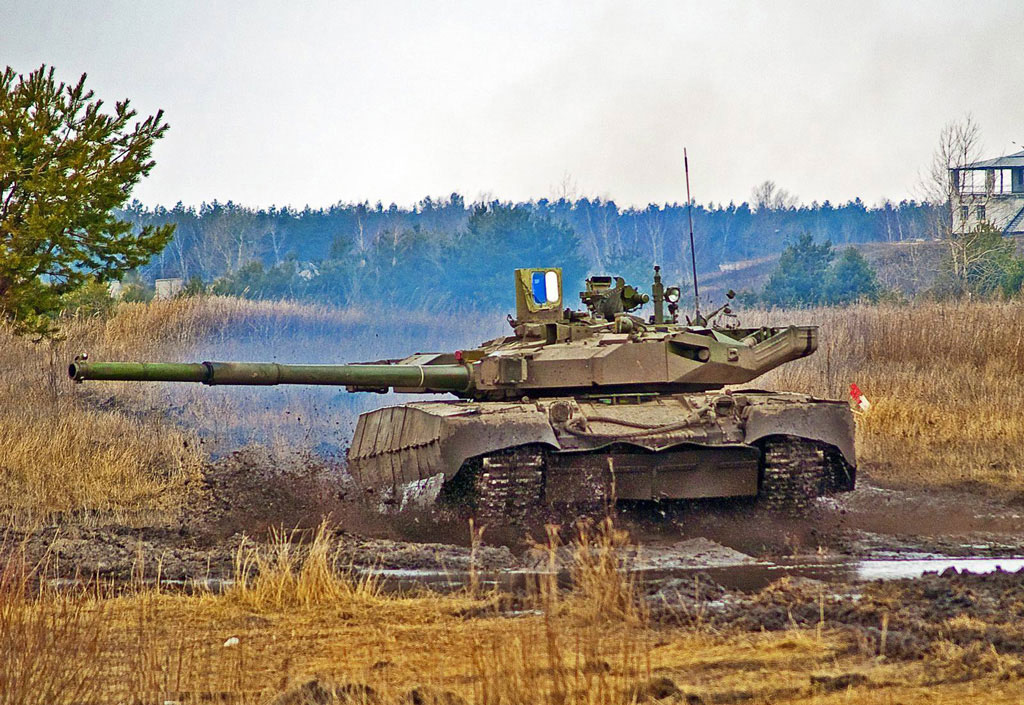
http://2.bp.blogspot.com/-VGVTjf8fwJA/UGRfcrLwxxI/AAAAAAAARPo/0z9PPBj-FFM/s1600/T84M.jpg

T-84 Oplot Main Battle Tank

(photo : Militaryphotos)


26.09.20112 DEFENSE STUDIES


KYIV/UKRINFORM/. The Kharkiv-based Malyshev Plant announced plans to produce by the end of the year the first batch of five Oplot tanks for the Thai Army. Overall, under the contract the Ukrainian company will make 49 tanks worth over USD 200 million, Volodymyr Mazin, a representative of the Ukroboronprom SE's director general, told UKRINFORM on Friday.
"Under the contract with Thailand, this year we produce five Oplot tanks. "The contract is designed for 2 years. We must do, they take, and the shipment will be later, for example, in January," he said.
A reminder that Ukraine's state-controlled arms exporter Ukrspecexport signed the contract with Thailand for the supply of 49 Kharkiv tanks in September 2011.

Partager cet article
Repost0
1 octobre 2012 1 01 /10 /octobre /2012 07:10

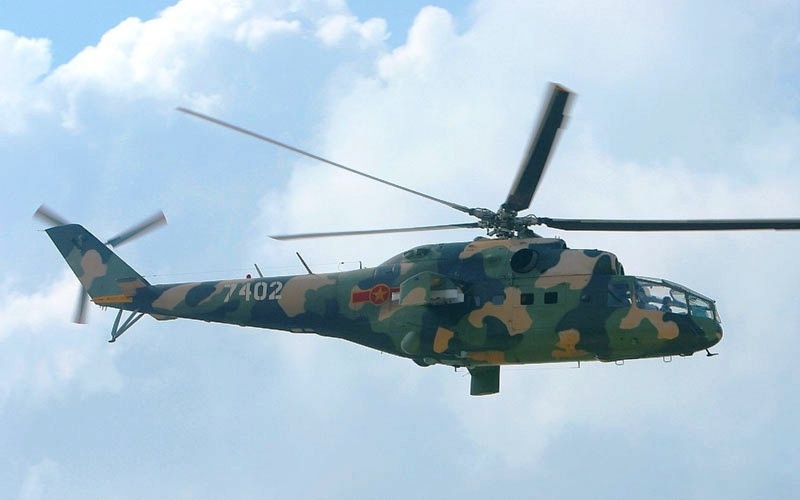
http://2.bp.blogspot.com/-gMhZK98PTEw/UGRCSIaFOFI/AAAAAAAAROU/PJbtHFkLKwA/s1600/Mi-24-004.jpg


Mi-24 of the Vietnam People's Air Force (photo : toquoctrongtoi)


27.09.2012 DEFENSE STUDIES


(ĐVO) The improvement in order to meet the requirements for helicopters Mi-24 weapons crackdown on the remnants of the Khmer Rouge in Cambodia,

Mi-24 attack helicopter developed by the Soviet Union and put into use in the early 1970s. This is the helicopter gunships "one of a kind" has been equipped with heavy duty weapons fire support to the ground, destroy armored tanks, and, military passenger compartment contain up to 8 soldiers.

The late 1970s, Soviet aid a small number of Mi-24 attack helicopters for the Vietnam People's Air Force. In 1980, the Air Vietnam Air Force squadron officially established the first Mi-24 helicopters of the 916th Regiment.

Mi-24 of the Vietnam People's Air Force (photo : Hoangsa)

The Mi-24 that you aid to Vietnam under the Mi-24A variant - the first generation of the helicopter. Mi-24A compared to the Mi-24D and the modern variant the main difference is in the type of cabin.
Mi-24A cockpit 3 with control arms in front of officers, pilots and navigators in parallel in the back seat. Variations Mi-24 or later to use style cockpit "double bubble" with the arms in front of officers and pilots behind.
Body thick armored Mi-24A aircraft can withstand the force of impact from the bullets of 12.7 mm. Mi-24A equipped with two turbine engines Isotov axis TV3-117 allows a top speed of 335km / h, range 450km, ceiling 4.500m.
Weapons, Mi-24 mounted 12.7 mm machine guns in the nose and 4 rocket launchers clusters (8-16 tubes) with 4 anti-tank guided missiles, AT-2 on three pylons located in the 2 small wings body.

Mi-24 of the Vietnam People's Air Force (photo : xairforces)

Mi-24A fleet Vietnam People's Air Force during a trip sorties mopping up the remnants of the Khmer Rouge. 
In the years used Mi-24A and assist our troops fire mopping up the remnants of the Khmer Rouge (*). Aeronautical engineer officers in Vietnam, there are small improvements to U.S. rocket bullet style helicopter Russia serves battlefield.
As the number of rocket fire U.S. military aid to South Vietnam so much, we can leverage to bring the means to fight the Soviet Union (Russia).
But, to solve this problem is not simple, because the rockets of the Soviet Union against the United States is not the same size, can not arbitrarily put American rocket bullet cluster Soviet rocket launchers. If used rocket launchers cluster America, bottom to hook into the bracket on the Mi-24 does not fit. Moreover this launch pad clusters can not be used more than once.

Mi-24 of the Vietnam People's Air Force (photo : jetphotos)

Under these circumstances, the young staff weapons Vietnamese airlines have found a special plan to put American rocket to equip helicopter Mi-24.
"We take rocket tubes of reconnaissance aircraft U-17 is used to fire rockets smoke goals. Then, we use two belt bundled into a cluster (8-16 tubes), on a long-term appropriate size hook to hook into bracket helicopters Mi-24, to ensure balance.


With this, secured a U.S. rocket launch on a Russian helicopter, can be reused many times, "Colonel Nguyen Kim Khoi-air weapons officer (Air Defense Air Force) directly involved improvement in the work to American-made rockets to shoot on Mi-24 helicopter of the Soviet Union shared.

The process of testing the use of cluster homemade catapult was a great success and make sure all the technical requirements involved combat.

(BaoDatViet)

Partager cet article
Repost0
1 octobre 2012 1 01 /10 /octobre /2012 07:10

Taiwan Patriot Advanced Capability-3 (PAC-2) missile launch


September 28, 2012: Strategy Page


The U.S. has agreed to ship back Pac 2 Patriot anti-aircraft missiles Taiwan sent to the United States for upgrades in 2008. These were to have been sent back in 2009 but were delayed for three years by, well, no one will admit exactly what the reason was. Might have had something to do with China pressuring the United States to not send weapons to Taiwan.


Taiwan has been trying to upgrade its Patriot anti-missile systems for a decade, but the U.S. support for this effort has been somewhat half-hearted. Last year Taiwan received its first Configuration-3 radars for its Patriot anti-aircraft missile systems. This upgrade enables Patriot to fire Pac-3 anti-missile missiles. The PAC 3 is smaller than the anti-aircraft version (PAC 2), thus a Patriot launcher can hold sixteen PAC 3 missiles, versus four PAC 2s. A PAC 2 missile weighs about a ton, a PAC 3 weighs about a third of that. The PAC 3 has a shorter range (about 20 kilometers) versus 70 kilometers for the anti-aircraft version.


Three years ago, despite vague Chinese promises that it might remove some of the thousand ballistic missiles aimed at it (which never happened), Taiwan signed a $154 million contract with a U.S. firm to upgrade the island nation's Patriot missile systems. These hardware and software changes will make the Taiwanese Patriot batteries equal in performance to those used by the U.S. Army. That is, the Taiwanese Patriot systems will be able to fire the PAC-3 anti-missile missile and also station the Patriot launchers many kilometers from the system radars. Taiwan has also ordered hundreds of PAC-3 missiles. Meanwhile, China now has 1,600 ballistic missiles aimed at Taiwan.


Increasingly anxious about China's military buildup, Taiwan has been increasing its defense spending. China still spends over five times as much on defense, to support about two million troops. Taiwan has only 350,000 troops and a population of 23 million, compared to 1.3 billion on the mainland. Taiwan's GDP is less than six percent of Chinas. Thus the per capita income of Taiwan is more than three times that of the mainland. Taiwan's military is based on the American model, with an emphasis on quality. China based its military on the Soviet model (where quantity has a quality all its own), although for decades the emphasis was on mobilizing a huge force of guerillas. Now China is trying to develop a force that can fight on Western terms (high tech gear operated by well-trained troops).


While many Taiwanese still see the United States as the ultimate guarantor of Taiwanese independence, they see China as increasingly capable of grabbing the island before the U.S. can intervene. So while the Taiwanese don't have to be strong enough to defeat a Chinese invasion, they do have to be strong enough to hold the Chinese back until American reinforcements can show up.

Partager cet article
Repost0
1 octobre 2012 1 01 /10 /octobre /2012 07:05

C-130J Super Hercules photo Lockheed Martin


28 Sep 2012 By Greg Waldron – FG


Singapore - Australian composites maker Quickstep has received a $12 million purchase order from Lockheed Martin to produce wing flaps for 24 C-130J Hercules aircraft.


Deliveries are set to commence in late 2013 with the company producing two sets of flaps monthly, says Quickstep.


"Each set of wing flaps comprises four parts with an aluminium structure and skins of carbon fibre composite, providing light, strong components capable of great endurance and longevity," it adds.


The order is the company's largest one to date. Quickstep also produces parts for the F-35 programme.

Partager cet article
Repost0
1 octobre 2012 1 01 /10 /octobre /2012 07:05

http://upload.wikimedia.org/wikipedia/en/thumb/4/41/Flag_of_India.svg/800px-Flag_of_India.svg.png


Sept. 28, 2012 defense-aerospace.com

(Source: Institute for Defence Studies and Analyses; issued Sept. 28, 2012)


In end August 2012, the Swedish defence and security company Saab Technology signed a Memorandum of Understanding (MoU) with the Indian private-sector company Pipavav Defence and Offshore Engineering Company Limited. Saab, with total sales of US $3,582 million in 2011, holds a vital role in Sweden’s defence industry. Partly as a result of changing economic conditions, the firm’s strategy is now directed towards international cooperation, with greater focus on investments in Asia in general and India in particular.


This commentary will take a closer look at the characteristics of Saab’s recent investments as well as the prospect and challenges for current and future Swedish-Indian collaboration in the defence industrial sector.


Saab in India


Swedish defence industry is internationally renowned for its high quality of competence and its top-edge and sophisticated technology. A broad-spectrum, advanced military-industrial base in Sweden developed during World War II without much influence from foreign interests or investments, as part of the country’s ‘neutrality politics’. Saab, being one outcome of this development, is the number one company within its sector in Sweden today.


With the recent MoU, Saab commits to strategic investments in Pipavav to a value of $38 million1 - investments that will mainly be focused on enhancing Pipavav’s infrastructure capability, maintenance and building of military hardware for the Indian army as well as for export purposes.2 Additionally, the two companies have signed a technical partnership agreement, securing the continuation of an already ongoing cooperation and an extension of Saab’s engagement in Pipavav.


Saab is involved in partnerships with several large Indian companies, i.e. Bharat Electronics Limited (BEL), Hindustan Aeronautics Limited (HAL), The Mahindra Group, Wipro, Samtel, FFV Services and S.M Creative Electronics.3 As of now, Saab’s business base encompasses ground combat systems, coastal surveillance systems, signature management, electronic warfare systems as well as communication equipment and avionics. The company’s recent investments, however, reveal an interest in expanding the product line to other segments of the defence and security industry.


Saab’s commitment to the Indian defence industry is characterised by several incentives to support and develop an indigenous Indian defence industry, to contribute to research and development, facilitate knowledge- and technology transfers, and generate customized solutions to the Indian market. Two examples of such attempts are the Saab India Technology Center in Hyderabad - a research centre and development facility in cooperation with Mahindra Satyam, and a sourcing office in Bangalore with focus on supplier development.


Opportunities in India


Saab’s increased interest in the Indian defence industry can be understood as part of a larger structural change in the international geo-economic context. The Asian region, with sales amounting to SEK (Swedish Krona) 5,176 million for 2011, is Saab’s second largest market. On the other hand, Sweden, and large parts of Europe, are struggling with economic instabilities, distressed markets, and diminished political and public support for retaining a strong defence industry.


This can be seen, for instance, in the decrease in Swedish military expenditure by 18 per cent during the past ten years - a fall from 2 to 1.3-percentage points of GDP. In India, however, the trend has proceeded in the opposite direction, with military expenditure increasing by 78 per cent, to $46,086 million, for the same time-period.4 In addition, India is also the largest arms import nation in the world - making the country a ‘hub’ of potential for foreign investors.5


Saab intends to make India its new home market, which is explained by India’s strategic position in Asia, its emerging industrial capacities, democratic political and social foundation, and a comparably lenient regulation on their defence industry in relation to other major Asian nations such as China and South Korea.6 With its presence in India, Saab will have a prime position in the expanding Indian market for defence and security products as well as earning a more direct access to the rest of the emerging Asian economies.


Saab is still a small player in relation to some of the giant defence and security firms, which makes it even more important for the company to establish a trustful relationship with the Indian industries and be a responsible partner. The company’s strategy to sustain its competitive advantage is to contribute to capacity building and transfer of technological know-how for local partners, commitment to the development of an independent defence base and an enhanced civil security, and social development. India should value such an approach and support smaller scale collaborations with similar actors.


What Indian markets provide and how the relationship can be strengthened?

Scholars and expert committees have raised concerns about the deficiencies in India’s defence industrial sector.7 The defence and security industry is under heavy policy and export constraints, making innovation and structural improvements difficult.


India has thus to reconstruct its policy towards foreign investors if the country is to have a strong defence profile and safeguard its increasingly important role in the region. Despite these impediments, some advances have been made to attract foreign expertise, one of which is giving Indian private firms the chance to participate in the defence sector. The benefit of this initiative for foreign investors, like Saab, is that partnering with private firms is much easier compared to public sector companies.


Entering into a Joint Venture (JV) also provides the foreign investor greater chances of winning contracts than by acting independently. Furthermore, as a JV is free to engage in offshore production, the foreign stakeholder will, by locating parts of its operations in its home country, have the opportunity for supporting the domestic industry and labour force. However, the most recent FDI policy allows foreign firms a 26 per cent stake in JVs with Indian companies – a level considered too low to attract relevant and sufficient technologies and expertise from abroad. A raise in the FDI cap to 49 per cent has been suggested, which would provide greater incentives for foreign investments as well as making the JVs more competitive in the domestic and export markets.8


In the recent MoU between Saab and Pipavav, the companies stated how they would be targeting global markets, besides meeting Indian and Swedish requirement for specific military segments.9 Hence, these types of partnership, or JVs, will aid Indian firms in accessing new European markets. As a result, there will be opportunities for increasing procurement from Indian companies, providing India a reversed role in the current arms trade market.


There are, however, still some holdbacks to improved and increased partnerships with foreign companies, which stem from offset policies. If India is to enhance its defence industrial capabilities and attract advanced military technologies through foreign participation from nations such as Sweden, offset policies must continue to meet the interests of foreign investors. The 2008 provision of ‘banking of offset credits’, which allows foreign vendors to accumulate credit for discharging their future obligations, attempts to obtain long-term engagement by the supplying firm and is a sign of an economic policy more open to international economic influences.


However, the current two-and-a-half year’s validity period for banking of offsets is not a strong enough enticement for foreign investors. A longer banking period, along with further incentives to enable private participation and foreign partnerships, would be necessary for India to attract the right military technology and competences for its defence industry. Furthermore, the Ministry of Defence must make the requirements for future use of the accumulated credits more explicit, and be pragmatic about the areas in which new investments should be placed to benefit the Indian industry in the best way possible.


Conclusion


The Indian defence industry provides great investment opportunities for Swedish firms. Simultaneously, investments by Saab and other companies can speed up the development of an indigenous and modernized Indian defence. These opportunities, however, do not come without challenges. An assessment of the future of the Swedish-Indian industrial collaboration in the defence sector needs to be made by taking into account the prospects for bilateral cooperation in future political, economic, and security issues.


Apart from the recommendations put forth here, further collaboration between Swedish and Indian firms necessitates an intensified bilateral political engagement to deal with the offsets and export restrictions on the defence industry.

Partager cet article
Repost0
1 octobre 2012 1 01 /10 /octobre /2012 07:00

http://2.bp.blogspot.com/-cvyK6Tm04zI/UGUElRY96cI/AAAAAAAARR4/_o8s3NB9UEQ/s1600/airship_chorchangsinging.jpg


The airship has been unable to fly since its delivery about two years ago.
(photo : chorcharsinging)

28.09.2012 DEFENSE STUDIES

The army has agreed to pay 50 million baht more to an American airship producer to make its 350-million-baht airship fly for the first time since its procurement.

An army source said the army signed a contract with Aria International Inc on Sept 20 to make the surveillance airship stay up in the air.

The company was originally hired to provide the airship, which has not flown since its arrival in the country.
Army chief Gen Prayuth Chan-ocha ordered the contract because he does not want the airship to rest in its hangar in Pattani province any longer.

The contractor is confident it can make the airship fly by November.

The airship has been unable to fly since its delivery about two years ago. The army formally accepted the airship in July last year. Since then it has had to pay for its maintenance.

The army has paid 200,000-300,000 baht a month to refill the airship with helium, to help the airship keep its shape and avoid leaks. The army has paid about 25 million baht altogether for refills in the past year.

The airship was ordered during the tenure of former army chief Anupong Paochinda who hoped it would help deter threats in the three southern border provinces. However, it was criticised for being unsuitable for security missions in the far South, as it could be shot down with ease.

Poor storage caused multiple leaks, and the supplier repaired it once. The cameras of the airship and their video streaming system are also out of order.

Partager cet article
Repost0
30 septembre 2012 7 30 /09 /septembre /2012 18:50

http://www.corlobe.tk/IMG/jpg/arihant2012.jpg


A new satellite image appears to show part of India’s new SSBN partly concealed at the Visakhapatnam naval base on the Indian east coast (17°42’38.06″N, 83°16’4.90″E).


30 septembre 2012 Par Rédacteur en chef. PORTAIL DES SOUS-MARINS


Une nouvelle image prise en mars dernier par un satellite pourrait montrer une petite partie du 1er sous-marin nucléaire lanceur d’engins indien, l’Arihant.


Cette image, prise le 18 mars 2012, et publiée sur Google Earth, montre ce qui semble être le kiosque d’un sous-marin au travers d’un trou dans le toit d’un hangar, toit destiné à le cacher dans la base navale de Visakhapatnam, sur la côte est de l’Inde.


L’image semble montrer une coupée menant au quai ainsi que la coque du sous-marin derrière le kiosque. On peut aussi deviner ce qui pourrait être 2 barres de plongée horizontales de chaque côté du kiosque.


Sur la gauche, on peut voir le bâtiment où le sous-marin a été assemblé. Son déplacement vers ce nouveau dock flottant, semble indiquer que le sous-marin est entré dans une nouvelle phase d’armement.


Référence : FAS Strategic Security Project (Etats-Unis)

Partager cet article
Repost0
30 septembre 2012 7 30 /09 /septembre /2012 18:48

China SUV 200 photo Dennis Fetters


September 30, 2012 china-defense-mashup.com


2012-09-30 — China’s Sunward Tech Star-lite SVU200 vertical take-off and landing unmanned aerial vehicle has conducted its maiden flight.


The aircraft conducted several short test flights before conducting a 20-minute flight, said Dennis Fetters, the SVU200′s designer, in a statement.


“The demonstration included multiple take-offs, landings, turns, sideways manoeuvres, quick-stops, backward flying and forward-cruise flights,” said Fetters. “A lifting demonstration of 200kg (441 lbs) was also performed.”


The SVU200 has a conventional helicopter layout, with a large main rotor and smaller tail rotor. Following the flights, the president of Sunward Tech, He Qing Hua, approved “full autonomous flight testing”.


At the Aviation Expo/China 2011 last September in Beijing, Fetters told Flightglobal the aircraft has a 78hp (58kW) engine, and an endurance of up to 2.6h at its cruising speed of 177kmh. Fetters is a freelance American UAV designer who resides in China.


Fetters said the aircraft was designed to monitor powerlines, but SVU200 promotional material depicts it equipped with 18 rocket tubes and a chin-mounted electro optical/infrared sensor. Sunward said the SVU200 has a “maximum useful load” of 244kg.


Sunward plans to sell two units and a ground control station for yuan (CNY) 10 million ($1.6 million). The aircraft can carry a range of weapons and sensors and has two small internal storage compartments.


At the Beijing show a number of of indigenous VTOL UAVs were displayed, most of them developed by Chinese technical institutions, ostensibly for commercial purposes. One of the UAVs at the show, the YOTAISC X200, was also on static display at the exhibition hall of the Singapore Airshow 2012.


The X200 has a maximum payload of 100kg and two contra-rotating main rotors.

Partager cet article
Repost0
30 septembre 2012 7 30 /09 /septembre /2012 17:05

China Carrier (Liaoning)


28.09.2012


As I’m sure you all know by now, the formerly known Varyag Aircraft Carrier was commissioned into PLAN as Liaoning and given the Type 001 class AC with pennant number of 16. I haven’t spent as much time looking into this development, but it’s quite clear that there is a lot of excitement on Chinese military forum over Liaoning class. This news has already eclipsed the exciting unveiling of Shenyang AC’s 4th generation fighter jet (I’m using generation by Chinese standard) and the unveiling of the 052D class destroyers. The only news that has caused more stir in the recent years is the unveiling of J-20. On the English forum that I moderate, some of the fellow members have been waiting for 7 to 8 years for this moment. A few years ago, I had all but given up on Liaoning ever becoming a big part of PLAN’s blue water plans. This was even after Liaoning had been painted with PLAN colours in 2006. Now, it appears that Liaoning has a bigger role in PLAN than many people have expected.

For me, I haven’t been as excited about this development. I was quite excited when 054A and 056 came out. I was also excited when we saw that new mysterious large diesel submarine from WuChang shipyard in 2010. I was really excited when 052D came out. I couldn’t stop looking for more photos on it. I suppose I have already spent too much time looking at Liaoning from when it was first dragged to Dalian to when it was first painted to when it got the non-skid layers to when it was taken to dry docks to when work started on Island to when it made its first sea trials. The more exciting moments will still come in the future when we see J-15s take off and land on it. And after that, it will be interesting to see how PLAN intends to use this training carrier. I read a really great article by Andrew Erickson today, where he talked about how Liaoning will not be that useful in the immediate time facing US or Japan, but could be quite useful in South China Sea. When Liu Huaqing first envisioned a carrier in PLAN, he wanted a medium sized carrier that PLAN can use to dominate South China Sea rather than a super carrier to compete against USN. Of course, this was also back in the late 80s when PLAN had those skirmishes with Vietnam where it had no air cover against Vietnam’s Su-22s. Even as PLAN is still learning carrier op in these early years, Liaoning could make quite a difference in any South China Sea scenarios.

When I was going through articles on the commissioning of Liaoning, I think one of the more interesting parts is where someone from PLAN stated that this shows China can build a carrier. While he conceded the hull was built in Russia, he stated strongly that everything inside the ship and on the ship was designed and built in China. I would imagine that whatever the Russians are doing for the INS Vikramaditya is what China had to do for the former Varyag. It certainly explains why they took this many years to finally launch the ship. Thinking about that, it’s interested that China has managed to restore and modernize a larger ship faster than the Russians despite having to learn the entire structure of the ship from scratch. Reading an interviewed piece from the ship, it certainly sounded like the interior of the ship has been completely changed to the modern PLAN standards. It was stated to have a 24 hours cafeteria with two bars (one loud and one quiet). It was has a supermarket, a post office, a gym (probably also basketball court), a laundromart and a garbage treatment station. Sailors can communicate with family at home through computers and can even use their cell phones. I would imagine the condition to be similar to those pictures we’ve seen of the interiors of the No. 88 life style ship and the Type 071 LPD. PLAN has made a serious effort in the recent years to improve the living conditions of these newer ships as they strive to become blue water navy. So far, we’ve already seen the latest of Chinese sensors and close in weapon systems installed on Liaoning. We’ve also seen the living quarters of the sailors revamped and modernized to be similar to other new PLAN ships. I can only imagine that the navigation control, command area and carrier operations control rooms will also be upgraded to the latest and best PLAN could offer. Liaoning should have much more modern weapon systems on board than any previously Russia/Soviet built carriers. It should also be much more powerful than the refitted and modernized Vikramaditya. Once J-15 joins service, it should also theoretically be much more advanced and capable than any previous naval aircraft that operated off a Russia/Soviet built carrier. Now that they have the hardware that the Soviet navy never had, the much longer process of developing the software (training people and pilots for carrier ops) is about to start.

A while ago, I was asked about when I think a Chinese carrier will enter Persian Gulf. And I think this is a good place to put what I thought at that time. Eventually, a China carrier will leave the safety of the South China Sea and then the second chain of islands. It will move past Malacca straits to protect its energy routes from Africa and the Persian Gulf. I have the following thoughts for when that will happen:

First, we have to think about economics and political situation in China. If we have a serious political or economic problem in China, that would slow down all military procurement. So, let's for the sake of argument, assume that this will not be an issue; and the navy will continue to see 10% increase in its budget every year.

Secondly, China doesn't currently have any real oversea base. And I think they would need oversea base close to the Persian Gulf first before they can really enter into Persian Gulf. They already have some supply points or network of places to support their current operations in the Gulf of Aden. Good article to read is here. In order for China to enter the Persian Gulf, I'd imagine it would need an oversea base close to the Persian Gulf. The location talked about so far are Pakistan, Seychelles, Burma, Sri Lanka and any number of African countries friendly to China. This won't happen right away, but I think it will eventually happen by the end of this decade. I think that Gwadar, Pakistan and somewhere in Burma probably make the most sense. In the former case, that base could be protected by Pakistan army and air force. In the latter case, Burma would also be within range of Chinese air force (with refueling).

Third, what would be the carrier entering into the Persian Gulf? I can't imagine it will be Liaoning, which should serve in the role I mentioned up top. Aside from that, Liaoning is still using steam turbines. If we look at all of the recent PLAN deployments, there have been very few long range ones using steam turbines. Even now, none of the Sov destroyers have been to Gulf of Aden. So, that means it would have to be a domestically built carrier. If the first carrier is under construction in JN shipyard right now as I've been led to believe, the earliest it would enter service is toward the end of this decade.

After that, we have to look at the rest of the carrier group. The current generation of AAW and ASW ships (052C/D and 054A) is sufficient to escort something like Liaoning. The first domestic carriers will be expected to make longer deployments, which would require the next generation of escorts. They would also need something like 095, because the current nuclear subs are way too noisy. Even 095 is still expected to be at least one generation behind Virginia class, so they would probably need something that’s a generation better (like a 097 class). They would need larger AAW and ASW ships that have the propulsion to keep up with the carrier. Aside from the 097 class, everything else (including a new generation of AORs) should already be commissioned by the time the first domestic carrier is ready, so escorts will not be a limiting factor.

The part that will slow things down is the development of the air wing and learning of carrier operations. The first generation of air wing will probably achieve IOC by 2015. By then, the J-15 fighter jet, JJ-9 trainer and Z-8 helicopters should have had some experience on takeoff and landing on Liaoning. For PLAN to feel comfortable sending its carrier into the Persian Gulf and keep it there, it will probably want the second generation of naval air wing. It will probably comprise of a naval version of the new SAC fighter jet, Z-8/Z-15 helicopters for ASW/SAR and other missions, different variants of naval flanker playing the role of E/FA-18E/F/G/H, Y-7 AEW and next generation of naval trainer. Now, most of this is already in development, so optimistically speaking they will probably achieve IOC by 2025. And then, PLAN would probably like to operate it a couple of years before giving it an extensive deployment to Persian Gulf. So, I think it would take until the end of the next decade before PLAN can make a meaningful entrance. By then, they would have almost 2 decades of carrier operations and multiple aircraft carriers.

Partager cet article
Repost0
30 septembre 2012 7 30 /09 /septembre /2012 16:30

Australia DoD


Canberra, Australia (UPI) Sep 28, 2012 Spacewar.com


Australian military scientists successfully completed another test flight of an experimental hypersonic vehicle, this time at the Andoya Rocket Range in Norway.


A test vehicle reached an apogee of nearly 218 miles and then achieved speeds of up to Mach 8 -- about 6,100 mph -- on descent.


The two-stage vehicle performed its nominal, sub-orbital space flight powered by a VS-30/Orion rocket, a Brazilian sounding, or research, rocket consisting of one Sonda stage and one U.S.-built Orion stage.


All sensor and telemetry systems worked perfectly, Australia's Defense Science and Technology Organization said.


The DST gave no details of the test vehicle.


Scientists say the launch could be a major step forward in the quest for hypersonic flight, the DSTO said in a statement on its website.


The experimental flight was undertaken as part of the joint Hypersonic International Flight Research Experimentation program by DSTO and the U.S. Air Force Research Laboratory.


The launch was the fifth in a series of up to nine planned experimental flights being conducted as part of the HIFiRE program, the DSTO, part of Australia's Department of Defense, said.


The test facility is around four miles from the Norway's Andoya Air Force Base, next to the village of Andenes, nearly 200 miles north of the Arctic Circle. The base has the country's second longest runway, capable of landing large freight planes such as the Antonov An 124-100.


Australia's successful test comes after last month's failed test for Boeing's experimental X-51A WaveRider aircraft. The technically troubled WaveRider, which looks like a small rocket with a flattened nose, can travel more than five times the speed of sound.


The WaveRider successfully launched from the wing of a B-52 bomber but after 16 seconds the test vehicle developed a problem with a control fin.


The test was terminated before the WaveRider's scramjet engine was ignited and the vehicle crashed into the Pacific Ocean, a report by Wired's Danger Room defense news website said.


The failure was the third for WaveRider, the Wired report said.


"All our data showed we had created the right conditions for engine ignition and we were very hopeful to meet our test objectives," U.S. Air Force Program Manager Charlie Brink said.


Technical issues surround getting the test vehicle, with its own scramjet engine, to high speeds using an attached conventional rocket. The scramjet engine needs the compressed air at super high speeds to operate efficiently and is ignited when high enough speeds are reached.


Boeing's X-51A scramjet first flew with some success in May 2010 off the coast of California, Wired reported.


The flight lasted 200 seconds and the vehicle reached Mach 5, about 3,800 mph.


During the thrust phase everything worked perfectly, but telemetry was lost toward the end of the flight and the craft was destroyed on command, Wired said.

Partager cet article
Repost0
30 septembre 2012 7 30 /09 /septembre /2012 12:00

http://www.bharat-rakshak.com/IAF/Images/3400-2/AVROS.jpg

source bharat-rakshak.com


September 28, 2012 Saurabh Joshi - stratpost.com


The program was for the procurement of 56 aircraft of which 16 would be delivered off the shelf by a foreign manufacturer and 40 were to have been manufactured in India. Indian industry has found the order to be too small to justify the capital expenditure.


The Indian Air Force (IAF) program to replace its Hawker Siddeley 748M Avro transport aircraft with one manufactured by domestic private industry is proving to be a non-starter.


After more than a year of discussion, it now appears that Indian industry has decided not to step up with bids to build the replacement aircraft, in partnership with foreign manufacturers, because of the financial infeasibility of the project.


The program envisages the procurement of 56 aircraft of which 16 would be delivered off the shelf by a foreign manufacturer and 40 were to have been manufactured in India. The procurement was stipulated to have been under the ‘Buy and Make Indian’ channel under the Defense Procurement Procedure (DPP), for which only Indian companies could be the lead bidders, in collaboration with foreign manufacturers. The idea was also to encourage domestic private industry to get involved in the program, to the exclusion of Hindustan Aeronautics Limited (HAL).


In fact, at one point there was also a plan to form an Indian industry consortium for the purpose, with the Tata Group nominated to lead as the Production Agency.


But after scrutiny, Indian industry has found the order to be too small to justify the capital expenditure they would incur in setting up a line in India. Over the past couple of months, StratPost has heard the desired minimum order to number from a low of at least 120 aircraft to around 200, between two and a half to almost four times the present requirement.


At present, the capital expenditure required of Indian industry for the order expected to be worth USD 2 billion is between USD 200 million to USD 250 million. They figure that at the completion of the order, their EBITDA (Earnings Before Interest, Taxes, Depreciation and Amortization) would come to only about USD 150 million. Back of the envelope calculations, keeping in mind margins of 20 to 30 percent, indicate an ultimate revenue of around USD 80 million.


This, they feel, is too small a figure to justify the expenditure and a bid, especially in the absence of any clarity on how the domestic manufacturing line would be employed after the completion of the delivery of the order for the 56 aircraft.


Now, with Indian industry failing to see the business case for the program, it is likely that the IAF and the Ministry of Defense would make the program ‘Buy and Make Global’ and throw open the tender to foreign manufacturers to bid, something that is expected to take place over the next month or so.


Some of the aircraft that were under consideration for the replacement of the Hawker Siddeley 748M Avro fleet include the EADS CASA C-295, the Alenia Aeronautica C-27J Spartan and the Saab 2000.

Partager cet article
Repost0
30 septembre 2012 7 30 /09 /septembre /2012 11:30

http://1.bp.blogspot.com/-b35nKBuWZIM/UGWSWKJ_I4I/AAAAAAAARUI/wm75c7nc-mw/s1600/classic-hornet_townville+bulletin.jpg

RAAF F/A-18 Classic Hornet (photo : Townsville Bulletin)

28.09.2012 DEFENSE STUDIES

THE Royal Australian Air Force has been warned to scale back the use of its ageing fleet of F/A-18 "classic" Hornet fighters to avert structural fatigue concerns.

The 71 fighter jets, brought into service in the mid-1980s, may need to keep flying beyond 2020 because of delays in acquiring the new Joint Strike Fighter, the Australian National Audit Office said yesterday.

It warned to expect a big increase in annual maintenance costs of the old Hornet fleet from $118 million since 2001 to $170m today, with costs expected to blow out to $214m a year by 2018. The report found all but nine of the Hornet fleet had "experienced structure fatigue above that expected for the airframe hours".

The ANAO's upkeep concerns are directed at the "classic" Hornets and not the newer fleet of 24 F/A-18F Super Hornets delivered to RAAF Amberley between 2010 and last year.

"The key risks to the F/A-18 fleets' fulfilment of their operational requirements until their replacement by the F-35A Lightning (JSF) revolve around Defence's ability to maintain the present levels of Hornet sustainment and structural-integrity management," the report said.

Keeping the old Hornet fleet flying beyond 2020 would incur an extensive increase in sustainment costs, ANAO said.
It "may well require the fleet to undergo an expanded, and hence more costly, safety-by-inspection regime, structural modifications program and capability upgrades".

The government has indicated it will buy 100 new Lockheed Martin-built F-35 Joint Strike Fighters, to replace the Hornet fleet in a deal worth $13.2 billion.

So far, it has committed to buy only two JSFs and in May announced plans to defer for two years the next acquisition of 12 of the stealthy, multi-role strike aircraft.

The audit report noted problems with the JSF program, including that it was progressing "more slowly and at greater cost than first estimated".

"At the time of the audit, almost 80 per cent of the F-35 test and evaluation program was yet to be completed, so significant F-35 key performance parameters had not been fully validated," the report warned.

Latest 2012 price estimates for individual JSF war planes were $US131.4m ($126.2m), projected to fall slightly next year and reach $US83.4m in 2019 when aircraft production is scheduled to increase.

RAAF's first two JSFs are scheduled for delivery in 2014 and will remain in the US for flight tests and evaluation.
Australia is one of nine partner nations involved in the JSF program, which has delivered more than $300m in contracts to Australian aerospace suppliers.

To bridge a looming capability gap following the retirement of the 1970s vintage F-111 fighter-bombers, the Howard government ordered 24 F/A-18F Super Hornets -- themselves due to be replaced by the F-35 (JSF) Lightnings by 2025.
On a plus note, the ANAO said recent initiatives to improve performance of the JSF program "are starting to show results".

Partager cet article
Repost0
30 septembre 2012 7 30 /09 /septembre /2012 07:20

http://upload.wikimedia.org/wikipedia/commons/thumb/1/18/IAF_Crest.svg/302px-IAF_Crest.svg.png


September 29, 2012  by Sudhi Ranjan Sen, Edited by Shamik Ghosh - ndtv.com


New Delhi: Every officer of the Indian Air Force (IAF) will now have to sign a declaration that they will not save or view any official document on personal computers. Failure to adhere to this directive will lead to a court marshal and prosecution.


The recent directive from the IAF headquarters to all its formations across the country comes after repeated leaks of sensitive documents - some of which are of operational and sensitive in nature - from personal computers of officers and men.


In a recent case, operational documents were found on the personal computer of a young pilot posted at an airbase in Tamil Nadu. A court of inquiry has been initiated.


In another incident this July, it was found that classified data regarding Indian Naval operations were transmitted to IP addresses in China. Later, inquiries revealed that a few naval officers had, against the rules, taken copies of the plans in pen drives from a naval computer, to study. The Chinese-made pen drives allegedly had malwares which transmitted the data back to IP addresses in China once they were used on computers connected to the internet.


Earlier last year, a major with the Indian Army posted in the crucial Andaman and Nicobar Command was investigated by the Intelligence Bureau (IB) and the National Investigative Agency (NIA) when classified Army plans and other sensitive operational data stored in his personal computer reached Pakistan's Inter-Services Intelligence Agency (ISI). The inquiry revealed that the Major was preparing for a course, and had taken copies of presentations and plans in his personal computer, which was subsequently hacked by malware originating from Pakistan.


In almost every case of cyber leak, subsequent inquiries have revealed that officers wanting to study the documents at leisure copied the data from the official systems into their personal computers, and the data later found its way into the cyberspace.


Over the years, cyberspace has emerged as a critical frontier for espionage as the use of computers and dependence on the internet has grown. Thus, document security has emerged as one of critical areas of concern for the government. It is perhaps alluding to these increasing instances of the cyberspace being used by foreign agencies to collect critical information. Prime Minister Manmohan Singh, while addressing top cops of the country at the annual security conference hosted by the Intelligence Bureau earlier this month, said, "Our country's vulnerability to cybercrime is escalating... Large-scale computer attacks on our critical infrastructure and economy can have potentially devastating results. The government is working on a robust cyber security structure."


The Indian armed forces are considering a joint cyber command to deal with document security and hackers, many of whom are funded and used by foreign governments searching for sensitive and strategic information. The Indian Navy has come up with an exclusive Information Technology brigade to be deployed on warships and various sensitive establishments on shore to manage and secure the network and data.


As a general rule, computers in which sensitive information are stored or prepared are never connected to the internet. "The IAF internal communication network, for instance, is not only a stand-alone network with no connection to the net, but also has the system configured in such a way that it doesn't allow external storage devices like pen drives or CDs," a senior MoD official told NDTV. Nonetheless, some officers have been found "keeping copies or preparing documents using critical information in their personal computers, which have subsequently passed out by malwares in the system or hacked," the officer added.

Partager cet article
Repost0
30 septembre 2012 7 30 /09 /septembre /2012 07:15

China Carrier (Liaoning)


September 29, 2012 defense-aerospace.com

(Source: Chinese Ministry of Defence; issued September 27, 2012)


BEIJING --- Defense Ministry spokesman Yang Yujun on Thursday dismissed foreign media reports that said China is building a second aircraft carrier in Shanghai and that it will be launched late this year.


"Such reports are inaccurate," Yang said at a regular news briefing.


Yang said China will plan the development of aircraft carriers in an all-round way, taking its national economic and social development and the needs of national defense and military construction into account.


The first carrier, beginning its service in the People's Liberation Army (PLA) Navy, is a milestone in our military history and a major achievement of our navy building, Yang said.


"But this is only the first step of our aircraft carrier development. We still have a long way to go," he said.


When asked to confirm reports that the Chinese navy will create an aircraft carrier formation in the future and build an aircraft carrier base in the eastern Chinese city of Qingdao, Yang said "the formation is generally made up of the aircraft carrier itself, escort vessels, submarines and aircraft. China will study the issue in accordance with the development and real needs of the aircraft carrier."


China's first aircraft carrier, delivered and commissioned to the People's Liberation Army (PLA) Navy on Tuesday, will be used to conduct scientific experiments and military training, Yang said.


As for the aircraft carrier's impact on China's surrounding areas, Yang stressed that the country adheres to the path of peaceful development, independent foreign policy and pursues a defensive national policy. He added that the development of the aircraft carrier, the Liaoning, is to protect national security.


Responding to doubts about the self-innovation in the development of the aircraft carrier, Yang said Chinese military's weaponry building has always adhered to the principle of independent innovation, relying on the country's own capacity for research and development.


The main system of Liaoning is the result of independent building and modification. The carrier borne aircraft is also developed by ourselves based on domestically built planes, for which we have independent intellectual property rights and is pushing forward with relevant procedures as scheduled, he said.


China has taken into consideration the need of national security and economic conditions when developing weaponry equipment. The development of the first aircraft carrier is also included in the defense budget, Yang said.


"We have strict regulations about the naming and hull numbers of naval vessels, as they are authorized by the Central Military Commission," Yang said

Partager cet article
Repost0
30 septembre 2012 7 30 /09 /septembre /2012 07:00

http://3.bp.blogspot.com/-EWHWeglkFxc/UGUEM7zMQKI/AAAAAAAARRw/mkynuOJ3kyc/s1600/S-75M3_DatViet.jpeg


Practitioners in the Institute of Air Defence-Air Force has developed simulation software works missile complex S-75M3. (photo : BaoDatViet)

28.09.2012 DEFENSE STUDIES


Meet the needs of visual materials for teaching, training, technical subjects S-75M3, the students of the Institute of Air Defense - Air Force has developed a software model simulation functioning missile combination.

The authors have used Powerpoint software to simulate the operation the radio SNR-75V3 control function; using Macromedia Flash and PowerPoint 2003 to simulate the reduced functional activity of the air defense missile complex S-75M3.

Simulation products can fully control the station's operation as well as a combination of missiles, to ensure highly vivid visual, can be used as a reference and learning for students in the learning process at the school.

Partager cet article
Repost0

Présentation

  • : RP Defense
  • : Web review defence industry - Revue du web industrie de défense - company information - news in France, Europe and elsewhere ...
  • Contact

Recherche

Articles Récents

Categories