Overblog Tous les blogs Top blogs Entreprises & Marques Tous les blogs Entreprises & Marques
Suivre ce blog Administration + Créer mon blog
MENU
3 octobre 2012 3 03 /10 /octobre /2012 18:24

APKWS-being-fired-Photo-BAE-Systems.jpg

photo BAE


Sep 29th 2012 economist.com


MONEY, as Cicero observed more than two millennia ago, is the sinews of war. That is still true today. But lately, from the American point of view, things have got ridiculous. Guided missiles, in particular, are ludicrously expensive. A Tomahawk cruise missile costs about $1.5m, and even the Hellfire, an air-to-ground rocket that weighs a mere 50kg, is $115,000 a pop. In exchange for, say, an enemy tank, that is probably a fair price to pay. To knock out a pick-up truck crewed by a few lightly armed guerrillas, however, it seems a little expensive, and using its shoulder-fired cousin the Javelin ($147,000) to kill individual soldiers in foxholes, as is often the case in Afghanistan, is positively profligate. Clearly, something has to change. And changing it is.


An early sign of this change came in March, with the deployment in Afghanistan of the APKWS II (Advanced Precision Kill Weapons System) made by BAE Systems. The APKWS II is a smart version of the old-fashioned 70mm (2.75-inch) rocket, which has been used by America’s armed forces since 1948. It is also cheap, as guided missiles go, costing $28,000 a shot.


The APKWS II is loaded and fired in the same way (pictured above) as its unguided predecessors, from the same 19-round pods, making its use straightforward. The difference is that it can strike with an accuracy of one metre because it has been fitted with a laser-seeking head which follows a beam pointed at the target by the missile’s operators. This controls a set of fins that can steer the missile to its destination.


Standard practice with unguided 70mm missiles is to use as many as two pods’ worth (ie, 38 rockets, at $1,000 a round) to blanket a target. That means the APKWS II comes in at three-quarters of the cost per kill. It also means that many more targets can be attacked on a single mission.


Guide price


BAE is merely the first to market with this sort of device. ATK, Lockheed Martin and Raytheon are all close behind. Meanwhile, the American navy has been working on its own cheap guided missile, the Low-Cost Imaging Terminal Seeker (LCITS), which it tested successfully last year.


The LCITS is another upgraded 70mm weapon, but instead of laser guidance it picks out its targets by their heat signature. Because the operators do not need to keep pointing a laser at the target, they can fire several missiles in quick succession—a useful feature if a ship is being attacked by a swarm of boats.


Smaller precision weapons are useful, too, in circumstances where weight is a crucial factor. Shadow, a drone used by the American, Australian and Swedish armies, is too light to be able to carry Hellfires and is thus, at the moment, restricted to reconnaissance duties. But not for much longer. Shadows are now being armed with a small, still-classified guided missile. This follows the earlier success of arming Hunter drones with Viper Strike, a laser-guided glide bomb weighing 20kg originally developed by Northrop Grumman as an anti-tank weapon and now owned by MBDA. Viper Strike, along with Raytheon’s Griffin, a similar weapon, also arms the marines’ Harvest Hawk, an aerial gunship based on the Hercules transport aircraft. Viper Strike means these aircraft are capable of hitting a large number of targets with great precision from a distance of several kilometres.


The most determined effort to develop a small, cheap guided weapon, though, is the Forward Firing Miniature Munition (F2M2, or Spike missile), from the Naval Air Weapons Station in China Lake, California. Steve Felix, the F2M2’s project manager, wanted to make such a weapon for just $5,000, using off-the-shelf components. The result, which weighs less than 3kg and is the size of a baguette, is claimed to be the world’s smallest.


Spike has been tested successfully as a shoulder-launched missile, and also fired from drones. It has an ingenious optical-guidance system—a camera that can either lock on to an operator-designated object or can pick up a laser spot and home in on it. It has a range of 1,500 metres and, though the warhead is too small to damage a tank, it can destroy cars and other light targets far more cheaply than the alternatives.


Precision weapons have already changed warfare radically, even though they have sometimes raised the price of battle. Low-cost guided missiles, often carried on small drones rather than expensive piloted aircraft, will change it further still. When such missiles cost a thousand dollars rather than a million, no target will be too cheap to engage.


Correction: This article has been updated. We misquoted the price of APKWS II as $18,000 in the previous version. Also, the system is manufactured purely by BAE, not by them in partnership with Northrop Grumman. Apologies.

Partager cet article
Repost0
3 octobre 2012 3 03 /10 /octobre /2012 18:18

First two production F-35 fighters in final assembly. (Phot


Oct. 3, 2012 - By AARON MEHTA Defense News


The head of Britain’s Royal Air Force sees no problem in the relationship between his service and F-35 contractor Lockheed Martin, a contrast to comments made by the man handling the U.S. Joint Strike Fighter program.


Air Chief Marshal Sir Stephen Dalton said that the F-35 program has gone “very well.”


“I think people have been able to adapt and to roll pretty well with the decisions we’ve taken, and I see no issues coming out of that whatsoever,” Dalton said. His comments came after an event hosted by the Royal Aeronautical Society on Oct. 2.


On Sept. 17, U.S. Air Force Maj. Gen. Christopher Bogdan called the relationship between the JSF program office and Lockheed “the worst I’ve ever seen,” expressing frustrations with the company’s lengthy contract negotiations over the fifth production lot of the F-35.


Bogdan, deputy program manager for the JSF, has been nominated to head the F-35 program.


The U.K. has changed its mind several times over which variant of the JSF to purchase, most recently in May when British Defence Secretary Philip Hammond announced that the country would switch from the F-35C carrier variant back to the short-takeoff, vertical-landing F-35B.


Britain’s first F-35 was delivered in July, making the U.K. the first international partner to receive the fighter. Dalton expects another shipment sometime this spring but acknowledged that until final contracts are signed, it is unclear when the jets will actually be delivered.


“The issue is still going to be the development of the overall capability” and how the contractor “will deliver all the things we’re after,” Dalton said.

Partager cet article
Repost0
3 octobre 2012 3 03 /10 /octobre /2012 12:42

E 3F photo Armee de l Air


October 3, 2012: Strategy Page


The U.S. has angered the French Air Force by reneging on a 2010 contract to upgrade the four French E-3F AWACS (Air Warning And Control System) aircraft. The agreed on price is $466 million and now the U.S. wants to tack on another $5 million so the promised technology can be degraded. This is all because some American bureaucrat decided that some of the upgrade technology was too sensitive for the French and had to be taken out of the upgrade. The French are being asked to pay for this change. The French are not happy. The U.S. insists such changes are allowed for these deals but are having a hard time convincing the French.


The upgrade will replace ancient (mainframe based) computers with PC type networked hardware. This will enable regular upgrades with new processors and data storage equipment. New software will introduce a Windows type interface, and joysticks. This is similar to an upgrade performed on American AWACS. French AWACS will remain able to closely cooperate with E-3 type AWACS used by other nations. The new American restrictions mainly involve new software.


E-3 AWACS development began in the late 1960s, and the first prototypes were flying in the late 1970s and it went into regular use in 1982. Flying far enough inside friendly territory to avoid enemy anti-aircraft missiles, the AWACS radar has a range of between 200 km (for small aircraft or cruise missiles flying close to the ground) to 600 km (for large aircraft flying at high altitude). The AWACS tracks several hundred friendly and enemy aircraft at once. The AWACS acts as an airborne command center for aircraft. Friendly planes are kept out of each other's' way (there has not been a friendly air-to-air collusion during since the 1991 Gulf war and the first major use of the E-3.) Enemy aircraft are spotted, identified and friendly interceptors assigned to take care of the threat. One or more AWACS is used to control an air operation and each can stay up eleven hours at a time, or up to 22 hours with refueling and extra crew on board to man the equipment. The AWACS functions as a combination radar platform and command center.


During its first wartime workout, during the 1991 Gulf war, the AWACS proved its worth, often in more ways than anticipated. The use of over a hundred tankers to refuel combat aircraft would not have been possible without the AWACS being there to efficiently link tankers and aircraft needing fuel. Forming up the Wild Weasels (electronic warfare aircraft), and coordinating their use with the bombers they escorted, was much easier using an AWACS. Just keeping track of who was who and going where would not have been possible without the AWACS. The communications equipment on board an AWACS allows information gathered by one AWACS to be quickly shared with other AWACS in the vicinity, other combat aircraft in the area as well as units at sea or on the ground. This function, which was eventually made to work, gave generals and admirals the goal of trying to link together all the sensor and communications of every ship, aircraft and ground unit in the area. But first, an AWACS for ground operations was needed.


The Gulf War experience was immediately put to use during the Afghanistan war, and insured that the bombers, and the aerial tankers that kept everyone flying, were always where they were needed. This was later repeated in the 2003 Iraq war. This sort of thing doesn't make the news, but without AWACS, a lot of those newsworthy bombs would have never made it to their targets.

Partager cet article
Repost0
3 octobre 2012 3 03 /10 /octobre /2012 07:40

http://www.kongsberg.com/en/kps/news/2012/october/0210crowsiii/~/media/KOG/News/2012/Protector-web-250.ashx

photo kongsberg.com


Oct 2, 2012 ASDNews Source : Kongsberg Gruppen


The order with the US Army is part of the framework agreement disclosed on  August 18. 2012. The framework agreement is for production, system support and technical engineering support of the M153 CROWS (Common Remotely Operated Weapon Stations) Remote Weapon Station (RWS)


CROWS is a joint acquisition program for weapon stations for the US Army`s vehicle programs. A common solution will result in substantial efficiency gains in respect of protection, training, support and further development.


The Protector Weapon Station System protects military troops by allowing the vehicle's weapons to be operated from a protected position inside the vehicle.

Partager cet article
Repost0
3 octobre 2012 3 03 /10 /octobre /2012 07:35

DCNS Logo et signature


PARIS, 2 oct 2012 marine-oceans.com (AFP)


Le groupe de construction navale DCNS et l'Américain VT Halter Marine ont signé un partenariat en vue de répondre à un appel d'offres pour le renouvellement d'une partie de la flotte de patrouilleurs hauturiers des gardes-côtes américains.


VT Halter Marine serait le maître d'oeuvre tandis que DCNS serait le sous-traitant en charge du design de la plateforme de ces patrouilleurs, indiquent les deux groupes dans un communiqué.


Aucun montant n'a été communiqué.


Il s'agit de répondre à un appel d'offres lancé le 25 septembre par les gardes-côtes américains en vue du renouvellement d'au moins 25 patrouilleurs hauturiers de leur flotte vieillissante, précise le communiqué.

Partager cet article
Repost0
2 octobre 2012 2 02 /10 /octobre /2012 17:15

http://upload.wikimedia.org/wikipedia/commons/thumb/3/33/USS_Gettsyburg_%28CG-64%29.jpg/800px-USS_Gettsyburg_%28CG-64%29.jpg

USS Gettysburg (CG 64)


October 2, 2012 Mass Communication Specialist 2nd Class Foster Bamford, Navy Public Affairs Support Element West / NNS – defpro.com


USS GETTYSBURG, At Sea | Joint Warrior, a two-week exercise, designed and led by the Joint Tactical Exercise Planning Staff (JTEPS) in the United Kingdom, is the largest military exercise in Europe and began off the coast of Scotland, Oct. 1.


"The exercise is designed to test the skill, knowledge and equipment of the participants in a range of different environments," said Capt. Paul Titterton, director of JTEPS. "By training in this fashion, we are able to prepare for a whole range of potential and ultimately realistic tactical scenarios, from out-and-out warfare to rescuing fishermen captured by pirates."


Three United States Navy ships are taking part in the exercise, led by Commander Destroyer Squadron (COMDESRON) 26. They are guided missile cruiser USS Gettysburg (CG 64), guided missile destroyer USS Mitscher (DDG 57) and fleet replenishment oiler USNS Leroy Grumman (TAO 195). Joining the ships is Detachment 2 from the Grandmasters of Helicopter Maritime Strike Squadron 46 and U.S. maritime support reconnaissance patrol aircraft from Experimental Evaluation Test Squadron (VX) 1, Patrol Squadron (VP) 9 and VP 10.


"For us, it's kind of a special treat to be one of the ships that gets to go out there and do this exercise with our coalition partners," said Capt. Bob Hein, Commanding Officer of Gettysburg. "Most likely, these same folks that we are training with, I'm going to see out there in eight months doing operations."


Joint Warrior is designed to improve interoperability and help integrate coalition forces and prepare them for possible joint exercises in a real-world environment.


"Allied and Coalition operations are the standard when units deploy," said Capt. Nelson Castro, commander of COMDESRON 26. "This exercise provides a venue for our Sailors to practice and learn NATO operating procedures."


Joint Warrior involves sea, ground and air assets from participating allied and NATO forces and aims to foster a spirit of teamwork between nations.


There are land, air and sea units participating from the US and eight other countries, the United Kingdom, France, Canada, Holland, Belgium, Estonia, Norway and Sweden.

Partager cet article
Repost0
2 octobre 2012 2 02 /10 /octobre /2012 12:45

C-130J Norwegian armed forces


October 1, 2012 by  Craig Hoyle – FG


London - Norway has taken delivery of a new C-130J tactical transport from Lockheed Martin, with the aircraft to replace an example that was destroyed in a fatal crash earlier this year.


Handed over during a 27 September ceremony at Lockheed's Marietta production site in Georgia, USA, the airlifter - named Froya - restores the Royal Norwegian Air Force's Hercules inventory to four aircraft. Oslo also has an option for another example, included with an order placed in the wake of the 15 March accident. Five air force personnel died when their aircraft crashed near the summit of Kebnekaise mountain in Sweden while taking part in a NATO exercise.


The cause of the crash has still to be explained, although the aircraft's digital flight data recorder was recovered from the Rabots glacier on 14 August. The device's memory module "was relatively undamaged", according to the Swedish Accident Investigation Authority, which subsequently sent it to the UK for analysis, along with the cockpit voice recorder. The agency expects to complete its investigation before the end of this year.


The rapid availability of the replacement aircraft was made possible by the US Air Force, which agreed to divert one of its C-130J already in the advanced stages of production for use at Dyess AFB in Texas.

Partager cet article
Repost0
2 octobre 2012 2 02 /10 /octobre /2012 12:20

Switzerland.svg


October 2, 2012: Strategy Page


Four years after the CIA was forced to reveal the identities of three Swiss engineers they used to do major damage to nuclear weapons developments programs in Libya and Iran, the three Swiss men were finally assured that they would not go to jail. This was apparently part of a deal between the CIA and Swiss prosecutors. The three Swiss engineers were mercenaries who had helped Pakistan develop nuclear weapons, but later agreed to work against Pakistan when tracked down by the CIA and Swiss investigators.


This was done by getting to one of the engineers working for the Pakistani Khan network (named after scientist, Abdul Qadeer Khan, who led development efforts for Pakistani nuclear weapons) to secretly switch sides. The CIA basically hired Swiss engineer Friedrich Tinner and his two sons, to feed the Khan network, and its customers, defective (in subtle ways) nuclear weapons components. From 2001-4, the Tinners worked under CIA direction. This caused Libya to drop its nuclear weapons program, and delayed work in Iran.


But for most of the last decade the Tinners have been prosecuted in Switzerland for their work with the Khan network. The elder Tinner began working for Khan in the 1970s, helping to steal European nuclear technology for the Pakistani weapons program. This relationship expanded in the 1990s, when Abdul Qadeer Khan began making money on the side by selling nuclear weapons technology to anyone who could afford it and was discrete (like Libya, Iran, North Korea and Iraq). The CIA effort to get details of the Khan network, and take it down, led them to Tinner, whose willingness to collaborate helped bring down the Khan network.


The CIA paid the Tinners $10 million for their work, and have fought to keep them out of jail ever since. Four years ago details of the Tinner operation were leaked to the media. The CIA then proceeded to try and keep secret the methods and contacts it used to uncover and destroy the Khan network, as well as how it sabotaged components. All this information can be used again, if it doesn't get published in the mass media first.

Partager cet article
Repost0
2 octobre 2012 2 02 /10 /octobre /2012 12:05

http://upload.wikimedia.org/wikipedia/commons/thumb/4/4c/US_Department_of_Homeland_Security_Seal.svg/360px-US_Department_of_Homeland_Security_Seal.svg.png


Oct 2, 2012ASDNews Source : BAE Systems PLC


BAE Systems has been awarded a multi-year $27.4 million contract to provide program management and technical support services to the Department of Homeland Security (DHS) Office of the Chief Financial Officer (OCFO).


BAE Systems’ team of experts will provide the OCFO with strategic analysis and planning, program and portfolio management, process management and governance, IT planning and coordination, and organizational change management and communications.


“We have been providing integral systems support and solutions to meet the OCFO’s evolving priorities for eight years,” said Paul Falkler, vice president and general manager at BAE Systems’ Intelligence & Security sector. “We are deeply gratified by the trust and confidence of our customer, and we look forward to continuing our partnership for years to come.”


BAE Systems’ Intelligence & Security sector provides cybersecurity, information technology and intelligence analysis services to the U.S. intelligence and defense communities.

Partager cet article
Repost0
2 octobre 2012 2 02 /10 /octobre /2012 12:00
LE SOFT POWER - Les fiches du CEMS Air

02.10.2012 de CESA Centre d'études stratégiques aérospatiales Droit et institutions - Octobre 2012


À la fin du XIXe siècle, Xavier Prévost-Paradol affirmait que « Xerxès avait placé infiniment plus d’hommes en armes que la Grèce. Mais c’est pourtant la grande âme de la Grèce qui l’avait vaincu ». C’était reconnaître que le caractère militaire de la géopolitique n’était pas exclusif d’autres formes de rapports de force. En 1990, un Américain, le professeur Joseph Nye, a théorisé l’un de ces pouvoirs, le soft power. Ce concept s’appuie sur la capacité d’un pays à influencer le comportement d’un autre pays pour l’amener à adopter le même point de vue par le biais de la séduction culturelle et idéologique sans recours à la force.


Les fiches du CEMS Air - FICHE N° 65

Partager cet article
Repost0
1 octobre 2012 1 01 /10 /octobre /2012 17:25

C-130J Super Hercules photo Lockheed Martin


Oct 1, 2012 ASDNews Source : Lockheed Martin Corporation


At ceremonies here yesterday, the Royal Norwegian Air Force formally accepted a C-130J Super Hercules for the aircraft that was tragically lost in March of this year.  Through strong cooperation between the Governments of the United States and Norway, a C-130J originally destined for Dyess Air Force Base, Texas, was redirected to become the replacement aircraft.  Tony Frese (left), C-130 Norwegian Program director discusses the J-model with Brigadier General Frode R Flølo (right), Chief of the Norwegian Defence Logistics Organisation - Air System Division, who accepted the aircraft.

Partager cet article
Repost0
1 octobre 2012 1 01 /10 /octobre /2012 07:50

First two production F-35 fighters in final assembly. (Phot


September 28, 2012 defpro.com


Papendrecht | Fokker Technologies and the Netherlands trade union confederation FNV Bondgenoten have signed a covenant about the importance of support for the aerospace industry and the efforts that both parties will make to maintain employment opportunities in the Netherlands resulting from participation in the F 35 project.


Fokker has chosen the Netherlands as its primary location for knowledge development and production, and has declared its intention to create as many jobs as possible in the Netherlands. The company also commits itself to make an extra contribution to the training of future technical personnel. The F-35 project is of great economic significance for the Netherlands, due mainly to the large numbers of jobs it creates and the associated industrial interests. These are powerful arguments for the economic desirability of participation in the F-35 project by the Netherlands.


The Dutch aerospace industry’s involvement in the F-35 project results from an investment made 10 years ago by the Dutch government. Since then orders resulting from the F-35 project have led to many hundreds of jobs in the Netherlands. This year work on the F-35 involves a total of 1,000 direct and indirect full-time jobs, and this number will rise to 2,200 full-time jobs throughout the industry (also both direct and indirect) when production is ramped-up from 2019. For Fokker the project involves more than 500 jobs in 2012 in regions subject to pressure on employment opportunities such as Drenthe and Noord-Brabant.


“The F-35 project provides vital jobs for our employees, and offers their families a future for many years to come. We recruited 360 new people at Fokker in 2011. This employment is highly important at this time of financial crisis. The project offers unequalled opportunities for Dutch engineers and other specialists to contribute on a daily basis to the development and building of the world’s most ultramodern aircraft. It’s absolutely clear that this has a positive effect on knowledge development in the aerospace industry”, said Sjoerd Vollebregt, CEO of Fokker Technologies.

Partager cet article
Repost0
1 octobre 2012 1 01 /10 /octobre /2012 07:40

MQ-9-Reaper source info-aviation


28 September 2012, airforce-technology.com


BAE Systems has been selected by Raytheon to help develop the US Air Force's Dismount Detection Radar (DDR).


The radar is scheduled to be installed on the US Air Force's (USAF) fleet of MQ-9 Reaper unmanned aerial vehicles (UAVs).


Under the contract, the company will manage the production of the system's radar command, control, processing, exploitation, dissemination, as well as mission planning modules.


David Logan, BAE Systems Technology Solutions vice president and general manager, said the company will work closely with partner Raytheon to quickly deliver the mission-enabling capability to the air force.


"Our Ground Moving Target Indicator's exploitation capability and integrated radar control technology enables the DDR to robustly find and track potential threats to warfighters, vehicles, and individuals in near real-time, day and night," Logan added.


USAF DDR project manager, lieutenant colonel Ed Byrne, said: "The dismount detection radar will help soldiers, intelligence analysts and commanders in the field make critical decisions."


The ground moving target indicator (GMTI) is a readily deployable, mission-ready software and will serve as the operator's control interface to the radar units.


Raytheon received a contract during the July 2012 Farnborough International Airshow for production and delivery of four DDRs along with ground control stations, for the USAF.


Mounted under the wings of the MQ-9 Reaper, the DDR will provide commanders with GMTI and synthetic aperture radar capability, which will prove critical during tracking of dismounted infantry troops.


The radar is intended to support the USAF's intelligence, surveillance and reconnaissance (ISR) missions by delivering accurate information about potential threats, such as vehicles and individuals in adverse weather conditions.


DDR systems are scheduled to be deployed onboard MQ-9 Reaper UAVs in late 2014.

Partager cet article
Repost0
1 octobre 2012 1 01 /10 /octobre /2012 07:20

F-16 MLU of Royal Danish Air Force (reg. ET-199), static di


September 28, 2012 defpro.com


SAN JOSE, Calif. | Vision Systems International (VSI), LLC, a world leader in advanced Helmet Mounted Displays (HMDs), has been awarded a contract from the Royal Danish Air Force (RDAF) to provide its Night Vision Cueing and Display-Aviator’s Night Vision Imaging Systems (NVCD-ANVIS) technology, the night module for the Joint Helmet Mounted Cueing System (JHMCS).


“We are extremely proud of this award from the Royal Danish Air Force, which is a continuation of the 12-year-long strategic relationship and look forward to the successful implementation of this new operational capability,” said VSI President Phil King. The RDAF will use VSI’s NVCD-ANVIS to enhance its F-16 night-attack capability, for both air-to-air and air-to-ground operations. The RDAF is VSI’s first international customer for the NVCD-ANVIS technology.


VSI’s NVCD-ANVIS technology, which enables night-time target acquisition capabilities through the display of JHMCS targeting cues and aircraft performance parameters directly on the Night Vision Goggles image, allows the pilot to accurately cue onboard weapons and sensors against enemy aircraft and ground targets without the need to aggressively turn the aircraft or place the target in a Head-Up Display (HUD) field-of-view for designation. The use of the NVCD-ANVIS necessitates no changes to the JHMCS, or to the aircraft’s hardware or software.


NVCD-ANVIS capabilities were successfully proven in four flight demonstration sessions, one of them in Denmark. “RDAF F-16 pilots demonstrated the efficient integration of NVGs with JHMCS during 300 hours of flight operations over Libya during their participation in Unified Protector 2011,” said a RDAF spokesperson at the time, “The tactical information and situational awareness was outstanding.”


“NVCD-ANVIS answers an urgent operational requirement for international JHMCS users. Its ease of operation and straight-forward installation makes it a natural extension for current JHMCS users, ” said King.

Partager cet article
Repost0
30 septembre 2012 7 30 /09 /septembre /2012 23:00

F-16_MLU_of_Royal_Danish_Air_Force_-reg._ET-199--_static_di.jpg


A Royal Danish Air Force's F-16 MLU aircraft being

displayed at 2005 Radom Air Show.

Photo: courtesy of Przemyslaw BlueshadeIdzkiewicz.


28 September 2012 airforce-technology.com


Vision Systems International (VSI) has been awarded a contract to supply its Night Vision Cueing and Display-Aviator's Night Vision Imaging Systems (NVCD-ANVIS) to the Royal Danish Air Force's (RDAF).


The systems will be installed onto the RDAF's F-16A/B Fighting Falcon aircraft fleet.


The systems are intended to enhance the fighter's Joint Helmet Mounted Cueing System (JHMCS), improving its night-attack capability during both air-to-air and air-to-ground missions.


VSI president Phil King said the contract represents continuation of the 12-year-long strategic relationship between the company and the air force.


"NVCD-ANVIS answers an urgent operational requirement for international JHMCS users. Its ease of operation and straight-forward installation makes it a natural extension for current JHMCS users," King added.


NVCD/ANVIS enables the pilots to precisely cue weapons and sensors against enemy aircraft and ground targets during night time operations, by directly displaying the JHMCS targeting cues and aircraft performance parameters on the night vision goggles (NVGs) image.


The system has successfully demonstrated its capabilities during four flight tests, of which the first was conducted by the RDAF pilots in an F-16 MLU M5 configuration aircraft in July 2011.


The system reportedly provided tactical information and situational awareness to the pilots during 300 hours of flight operations during Unified Protector 2011, where the RDAF participated in the UN enforcement of the no fly zone in Libya.


A total of 77 F-16A/B fighters were purchased by Denmark in two major batches and two attrition replacement orders, and currently 30 aircraft are used for air defence, attack, training and reconnaissance missions.

Partager cet article
Repost0
30 septembre 2012 7 30 /09 /septembre /2012 17:20

http://upload.wikimedia.org/wikipedia/commons/thumb/4/4e/Launched_FIM-92A_Stinger_missile.jpg/800px-Launched_FIM-92A_Stinger_missile.jpg


Par Olivier Fourt -  Lignes de défense

On estime à 500 000 le nombre de missiles sol-air portables utilisés dans le monde. Des armes fabriquées en grande série, détenues, par des armées régulières, mais aussi par des groupes non étatiques. Olivier Fourt s’est penché cette semaine sur la menace représentée par la grande prolifération de ces engins.


Les dangers de la prolifération des missiles sol-air portable (MANPADS)
(02:59)


Partager cet article
Repost0
30 septembre 2012 7 30 /09 /septembre /2012 17:15

E 3F photo Armee de l Air


30.09.2012 par P. CHAPLEAU Lignes de Défense


Dans ses notifications de contrats datées de vendredi, le Pentagone a officiellement annoncé que MITRE Corporation allait pouvoir moderniser les quatre AWACS français (voir la notification ci-dessous). Un article de DefenseNews du 24 faisait état de difficultés, retards et hausse de la facture (5 millions de dollards). Le projet, qui date de 2010, avait été mis en stand by par le Pentagone en mai dernier.


Désormais, les travaux vont pouvoir commencer et selon le marché attribué, ils seront finis au 30 septembre 2013.

La notification mérite un peu de décryptage. Le contrat français (dans le cadre d'une Foreign Military Sales) est noyé dans une liste de pays qui vont bénéficier du soutien de MITRE. Cette société va donc, pour le compte de Boeing, se charger de la modification des systèmes des AWACS tricolores. Pour accéder à un document de mars dernier, rédigé par Boeing, et qui explique le rôle de MITRE, cliquer ici.


The MITRE Corp., Bedford, Mass. (FA8702-13-C-0001), is being awarded a $420,448,108.00 cost reimbursable contract for systems engineering and integration support. The location of the performance is Bedford, Mass. Work is expected to be completed by Sept. 30, 2013. The contracting activity is AFLCMC/PZE, Hanscom Air Force Base, Mass. Contract involves Foreign Military Sales to Saudi Arabia, France, Iraq, Korea, Afghanistan, Pakistan, Jordan, Taiwan, Columbia,Turkey, Australia, Kyrgz Republic, Sweden, Poland, Germany, Hungary, Greece, Singapore, United Arab Emirates, Morocco, Finland, United Kindom and Japan.

Partager cet article
Repost0
30 septembre 2012 7 30 /09 /septembre /2012 11:34

E 3F photo Armee de l Air


30 Septembre 2012 Jean-Dominique Merchet


La modernisation  des quatre Awacs de l'Armée de l'air illustre la manière dont les choses se passent lorsqu'il faut coopérer avec les Américains. C'est instructif pour l'avenir.


En décembre 2009, une Letter of acceptance (LOA) est signée entre nos deux pays afin de moderniser le système de mission des quatre Boeing E-3F, acquis par la France en 1991-92. Ce contrat se déroule dans le cadre des Foreign Military Sales (FMS), c'est-à-dire qu'il est soumis à la législation américaine.


En principe, un tel chantier implique un maitre d'ouvrage et un maitre d'oeuvre : dans ce cas, la Direction générale de l'Armement (DGA) et Air France Industries. Sauf que, FMS oblige, un maitre d'ouvrage délégué, obligatoirement américain, se glisse entre les deux, même si le chantier se déroule en France. En l'occurence, l'US Air Force.


En mai 2012, l'US Air Force décide de stopper unilatéralement la livraison des kits de modernisation afin de procéder à des vérifications. Il s'agit de s'assurer de la qualité des mesures d'"anti-compromissions". En clair, d'avoir la garantie que les Français ne pourront pas entrer dans les logiciels du système. "Il y a des boites dans lesquelles on n'entre pas..." constaste en effet un aviateur.


Vérifications faites, les Américains sont rassurés et donnent, mi-septembre, leur feu vert pour que les travaux puissent démarrer en 2013, au cours des périodes de maintenance programmées des quatre appareils. Pour la DGA, comme pour l'Armée de l'air, "la modernisation sera conforme à ce qui était prévu". "Nous aurons l'outil, mais pas la technologie" constate un bon connaisseur de ce dossier.

Partager cet article
Repost0
28 septembre 2012 5 28 /09 /septembre /2012 17:13

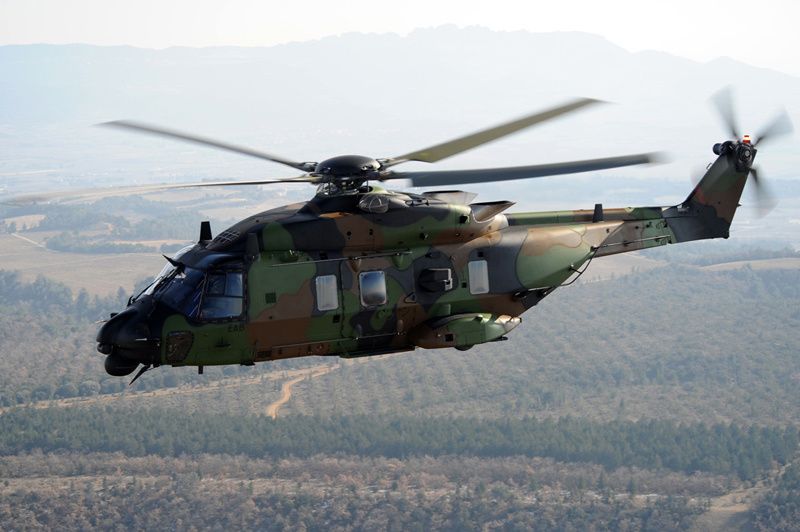
Caïman (NH90 TTH) – photo GAMSTAT P.Gillis


WARSAW, September 28 (RIA Novosti)


Poland plans to spend $3 billion on multirole military helicopters for its armed forces in the near future, local paper Rzeczpospolita reported on Friday, with a new competition replacing an earlier tender.


The main candidates for the deal are America's Sikorsky offering its S-70 Blackhawk, Franco-German Eurocopter, NH-90 and AgustaWestland with its AW149.


"The armed forces want to buy 70 helicopters, and not 26 as planned previously. A tender wil be completed by the end of the year and a deal should be signed by May 2013," Deputy Defense Minister Valdemar Skrzypczak said.


An earlier tender announced on 29 March, set out a requirement for 16 tactical transports for the land forces, four anti-submarine warfare (ASW) and three maritime search and rescue (SAR) helicopters for the navy and three search and rescue examples for the air force, all using one type of helicopter.


A decision on the purchase will be signed by Defense Minister Tomasz Siemoniak at the end of October, after which technical consultations will take place with potential suppliers. Local production of the machines is likely to be one of the conditions of the tender, the paper says.


The deal could be Poland's largest ever military equpment buy after its 2003 purchase of American Lockheed F-16 fighters for 12 billion zloty ($3.08 billion).

Partager cet article
Repost0
27 septembre 2012 4 27 /09 /septembre /2012 16:41

http://lignesdedefense.blogs.ouest-france.fr/media/00/00/3728534322.jpg


27.09.2012 par P. CHAPLEAU Lignes de Défense


Le 25 septembre, des forces américaines de la Combined Joint Task Force Horn of Africa (CJTF-HOA) et des personnels française basés à Djibouti ont pris part à un exercice bilatérale. Cet exercice d'évacuation massive de blessés qui était le premier de ce type à Djibouti.

Cliquer ici pour voir une galerie de photos prises durant cet exercice.

medex2.jpg

Partager cet article
Repost0
27 septembre 2012 4 27 /09 /septembre /2012 08:05

E 3F photo Armee de l Air


Sep. 24, 2012 - By PIERRE TRAN  Defense News


PARIS — France is being asked to pay an extra $5 million on a $466 million contract after the Pentagon ordered Boeing to stop work to upgrade the French Air Force’s four airborne early warning aircraft, sources familiar with the situation said.


Although relatively small, about 1 percent of the program budget, the added cost and negotiations are grating on the nerves of French defense officials.


“There might be reduced capability because of the technical solution proposed,” a French official said. There may also be another technical change that would drive the cost higher, the official said.


“Program protection issues” over technology deemed too sensitive for export led U.S. Defense Department officials to issue an order in the domain of stop-work on the upgrade of the four French E-3F airborne warning and control system (AWACS) aircraft, a source briefed on the subject said.


DoD’s export procedure seems to have been slow on the program protection issues, but defense officials insist the client must pay.


If the changes are accepted, the upgrade is expected to start in the first half of 2013, a year late, the French official said. France is the first export client for midlife upgrade to the Block 40/45 standard, also being installed in the U.S. Air Force’s 32-strong AWACS fleet.


U.S. officials early this summer called for a due diligence study to see whether there was a technical risk on the export deal and asked Boeing to put a hold on the French upgrade, agreed to under a $466 million contract signed in 2010 under Foreign Military Sales (FMS) rules.


The total contract comprises $440 million and a $26 million reserve amount under the FMS regime. Boeing gets $324 million of the total amount, as prime contractor for the upgrade.


“The credibility of FMS is in play,” a second French official said. Cost increases are part of negotiations being held “in the framework of the contract,” the official said.


The Direction Générale de l’Armement procurement office, Boeing and a spokesman for the Defense Security Cooperation Agency either declined to comment or could not be reached as of press time.


A modernization of the French AWACS fleet is important for trans-Atlantic cooperation, French Air Force Gen. Jean-Paul Palomeros said Sept. 10.


The upgrade is vital for “interoperability,” he said. “We need to have the best-performing equipment possible.”


The Pentagon order to stop work led to Boeing incurring costs the company wants to recover from the client. Boeing had sent staff over to Paris to work on the equipment modernization and had to idle the personnel.


Most of the cost increase stems from the stop-work order.


On the due-diligence assessment, the U.S. side concluded “mostly no risk,” and small modifications were needed, limiting the engineering cost.


An administrative waiver or re-engineering were options to deal with the program-protection issues, with the former available if the re-engineering costs were too high.


The U.S. government is negotiating on behalf of France, as the midlife upgrade contract was signed under FMS rules, which put the deal on a government-to-government basis.


The French authorities spent $10 million in 2009 on a risk-reduction study that looked at the engineering and technological issues behind the upgrade. The program protection issues did not arise at the time.


With future upgrades, the AWACS planes could be linked up to Tiger attack helicopters to support a 360-degree strike force in joint operations, he said.


Robbin Laird, with consultancy ICSA, based here and in Washington, questioned whether it was fair for France to pay for the delay since it appeared the upgrade had been held up by a U.S. policy review.


The modernization of the planes and the ground system had been due to start in June at Le Bourget airport. Boeing is the prime contractor for the midlife upgrade, with Air France Industries acting as prime contractor at the depot level.


In a Feb. 3, 2010, statement, Boeing said it had been awarded a $324 million FMS contract, which would be the largest-ever upgrade for the French AWACS fleet.


The Block 40/45 standard updates the mission computing system and is intended to boost network-enabled operations, increase reliability and reduce life-cycle costs, Boeing said in the 2010 statement.


Under the contract, the French upgrade is due to be completed by the second quarter of 2015.

Partager cet article
Repost0
27 septembre 2012 4 27 /09 /septembre /2012 08:00

AAS-72X--photo-EADS.jpg


Sept. 26, 2012 by Dave Majumdar – FG


EADS North America has started a voluntary flight demonstration of its AAS-72X+ helicopter for the US Army's Armed Aerial Scout programme. The company plans to fly two aircraft-an AAS-72X and an EC145 T2-over the next two weeks at a "high altitude location" for the demonstration flights.


"We welcome this opportunity to prove the superior capabilities of our offering for the Army's Armed Aerial Scout, and we're ready to move forward into a competition," says Sean O'Keefe, EADS's North America chairman.


Should the AAS-72X+ win a renewed army competition, the aircraft would replace the Bell OH-58 helicopter. It would be manufactured in Columbus, Mississippi, by EADS's American Eurocopter unit, but its mission systems would be provided by Lockheed Martin.


But a new competition is not a foregone conclusion.


If EADS wins any renewed competition, it says the AAS-72X+ could be fielded as early as 2016.

Partager cet article
Repost0
27 septembre 2012 4 27 /09 /septembre /2012 07:55

MQ-9_Reaper.jpg


BURLINGTON, Mass., Sept. 26 (UPI)


BAE Systems has been selected joined in the effort to develop the U.S. Air Force's Dismount Detection Radar system, which is to be fielded in 2014.


The Dismount Detection Radar system is a project led by Raytheon, which chose BAE for development of the system's radar command, control, processing, exploitation, dissemination and mission planning modules.


"Our Ground Moving Target Indicator's exploitation capability and integrated radar control technology enables the DDR to robustly find and track potential threats to warfighters, vehicles, and individuals in near real-time, day and night," said David Logan, vice president and general manager of Technology Solutions at BAE Systems.


"We look forward to working closely with our teammate Raytheon and the U.S. Air Force to quickly deliver this mission-enabling capability."


The Air Force says the system's deployable, mission-ready software will act as the operator interface with radar units.


"The dismount detection radar will help soldiers, intelligence analysts and commanders in the field make critical decisions," said Lt. Col. Ed Byrne, DDR project manager for the U.S. Air Force. "This innovative radar represents a true team effort between government and industry."

Partager cet article
Repost0
27 septembre 2012 4 27 /09 /septembre /2012 07:55

bae systems


26 Sep, 2012, The Economic Times (Reuters)


LONDON: BAE Systems needs its proposed merger with Airbus parent EADS to succeed if it is to avoid being cast adrift as a company without a clear strategy in a shrinking industry or a takeover target for predatory US rivals.

If the planned $45 billion merger between the British defence group and the European aerospace giant does not go ahead, BAE could look to do a deal with a US group, sell off its standalone US business or remain alone trying to squeeze growth from the contracting global defence sector.

Europe's biggest defence deal in a decade faces many hurdles, including a row over the proposed 60/40 EADS-BAE ratio, how to ringfence top-secret projects and how to satisfy governments keen to safeguard EADS operations in France and Germany.

"BAE see their defence earnings going down, what do they do about it? They either get into bed with someone going up like EADS or they team up with someone who can help them rip a load of costs out and get economies of scale like a Rockwell Collins , a General Dynamics or a Lockheed Martin ," said an equities manager at a British investment house holding a stake in BAE.

"The conspiracy theorists say BAE are hoping to flush out a bid from one of the US prime contractors."

Such plans could, however, be scuppered because of the US government's reluctance to see more consolidation among their prime contractors and competition reduced. Some analysts believe this attitude could change given that BAE is one of the biggest foreign suppliers of weapons to the Pentagon.

"BAE's strategy has taken it deep into UK and US defence but both of those markets are in deep trouble over the medium-term but at the moment doing nothing is not really an option for BAE," said Societe Generale defence analyst Zafar Khan.

If the merger falls foul of the many political and regulatory obstacles in its way, BAE will be left stranded and Ian King, its chief executive of four years, will face tough questions about his vision for the company, both past and present.

"BAE doesn't have a 'Plan B' as such, it's the deal with EADS or back to trying to drive growth from defence and cyber, which is pretty limited," said a source close to the British contractor.

Partager cet article
Repost0
26 septembre 2012 3 26 /09 /septembre /2012 16:30

E 3F photo Armee de l Air


25 septembre 2012 – opex360.com


Voilà une affaire qui  donnera certainement du grain à moudre à ceux qui s’opposent aux achats d’armements “sur étagère”. En février 2010, la France avait signé un contrat avec Boeing dans le cadre du dispositif américain des Foreign Military Sales (FMS) afin de porter les 4 avions E3-F SDCA (Détection et commandement aéroportés, soit AWACS pour l’Otan) de l’armée de l’Air au standard Block 40/45.


“Cette modernisation, la plus importante effectuée à ce jour pour les AWACS français, va permettre à ces avions de disposer d’informations plus exploitables et d’une meilleure conscience de la situation” avait expliqué, à l’époque, un responsable de Boeing.


Il était donc prévu d’intégrer, à partir de 2012, de nouveaux équipements électroniques ainsi que des logiciels plus performants pour traiter les informations obtenues via le standard de liaison de données L16 et les radars. L’intégration de ces nouveaux matériels devait être effectuée par Boeing, dans les ateliers d’Air France Industrie situés au Bourget.


Pour rappel, les E3-F, développés à partir d’une cellule d’un Boeing 707, avaient été commandés par la France en 1987 auprès des Etats-Unis. Mis en service au début des années 1990, ils sont mis en oeuvre depuis la base aérienne 702 de Bourges-Avord par  l’Escadron de Détection et de Commandement Aéroporté (EDCA) 00.036 “Berry”.


Le coût de l’opération avait été estimé à 466 millions de dollars, dont 326 millions revenaient au constructeur américain chargé de la modernisation des E3-F, au sujet de laquelle personne n’avait rien trouvé à redire. Sauf jusqu’à récemment.


Comme, en effet, ce programme suppose la livraison de modules qu’il juge maintenant trop sensibles pour être exportés, le Pentagone s’est depuis ravisé, bloquant ainsi la modernisation des avions français, laquelle aurait dû commencer en juin dernier.


Cette décision contraint donc à modifier le projet initial, ce qui, selon Defense News, et en plus de causer des retards, pourrait limiter la portée de la modernisation des E3-F, ou encore faire augmenter les coûts.


D’ailleurs, quoi qu’il arrive, la France aura à payer un supplément de 5 millions de dollars, que le Pentagone refuse de prendre à sa charge, même s’il est directement responsable de cette situation. Une partie de cette somme correspond aux frais engagés par Boeing pour ses équipes présentes à Paris et qui sont maintenant au chômage technique.


L’estimant importante pour la “coopération transatlantique”, l’ancien chef d’état-major de l’armée de l’Air (CEMAA), le général Paloméros, désormais à la tête du Commandement Allié Transformation (SACT) de l’Otan, a déclaré, le 10 septembre, que cette modernisation des E3-F est “indispensable pour l’interopérabilité”.


NB : Contactée, la DGA n’a pour le moment pas répondu aux questions de Zone Militaire relatives à ce dossier.

Partager cet article
Repost0

Présentation

  • : RP Defense
  • : Web review defence industry - Revue du web industrie de défense - company information - news in France, Europe and elsewhere ...
  • Contact

Recherche

Articles Récents

Categories