Overblog Tous les blogs Top blogs Entreprises & Marques Tous les blogs Entreprises & Marques
Suivre ce blog Administration + Créer mon blog
MENU
18 septembre 2012 2 18 /09 /septembre /2012 16:25

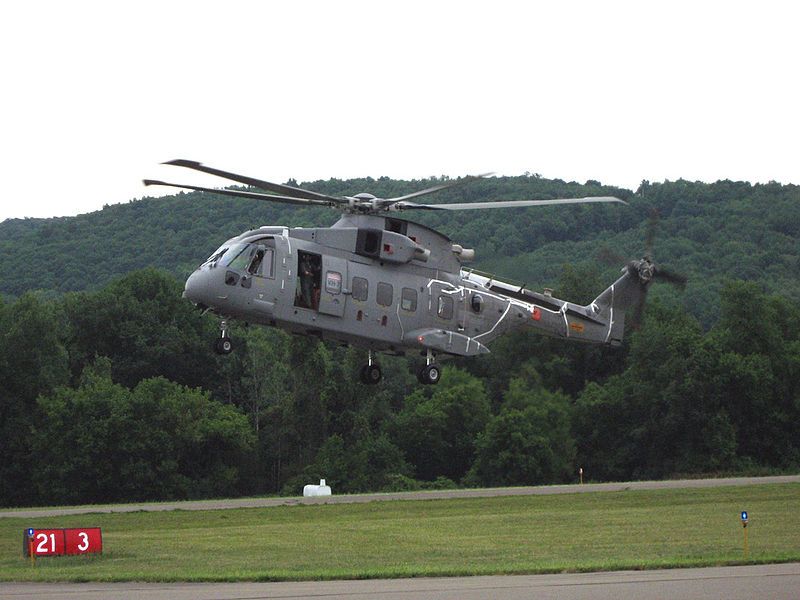
AW101-undergoing-VH-71-testing-near-the-Lockheed-Martin-fac.jpg


... and Navy 'Marine One' Presidential Helicopter Programs


FALLS CHURCH, Va. – Sept. 18, 2012 – Northrop Grumman Corporation


Northrop Grumman Corporation  and AgustaWestland (AW), a Finmeccanica company (FNC IM, SIFI.MI), announced that they have signed a comprehensive teaming agreement to respond to anticipated requests for both the new U.S. Air Force Combat Rescue Helicopter and the U.S. Navy's recently announced program to develop a new "Marine One" presidential helicopter. A U.S.-built helicopter based on the AW101 platform will be offered by Northrop Grumman to meet these requirements.


The agreement pairs Northrop Grumman's proven management and systems integration expertise with AgustaWestland's world-renowned rotorcraft manufacturing and advanced helicopter design and development. The AW101 system offers both programs an optimum mix of capability to successfully bring the best possible new combat rescue helicopter to the Air Force and the best possible new presidential Helicopter to the Navy-Marine Corps team.


Northrop Grumman has a long history of success in managing the development of complex air systems. The company delivers products across a spectrum of capabilities – from fully autonomous strategic unmanned systems such as the Fire Scout and Global Hawk to the E-2D Advanced Hawkeye, the stealthy B-2 bomber and the most advanced battle management system in the world today, the E-8 Joint STARS. That record will be coupled with the continuous investment in rotorcraft technology development AgustaWestland has made to field the world's most advanced, rugged and reliable helicopters.


Northrop Grumman and AgustaWestland are partnering to offer affordable systems that are total solutions without compromise. These will be proven, advanced rotorcraft, built in the United States and fully integrated with the most advanced mission suites, integrated onboard sensors and communications systems available today. These systems will meet the future needs of both programs. The AW101 system is a mature, reliable, highly capable and combat-proven multimission aircraft that affordably meets the needs of the nation's combat search and rescue forces and will serve the nation's presidents far into the future.


"This is a strong partnership between two companies that combines each company's strengths," said Paul Meyer, vice president and general manager of advanced programs and technology at Northrop Grumman's Aerospace Systems sector. "While Northrop Grumman has broad expertise in systems integration of large aircraft programs, AgustaWestland has world-leading expertise in global rotorcraft and vertical lift. We believe that this industry partnership will bring together the best experience, expertise and resources, ensuring that the customer receives the best solution."

"We are delighted to have Northrop Grumman as a partner, with their impressive history of supporting the U.S.

Department of Defense," said Bruno Spagnolini, chief executive officer of AgustaWestland. "We strongly believe that the AW101 is the right aircraft for both missions and that this team can succeed."


AgustaWestland is a global leader in the military and commercial rotorcraft markets and has more than 100 years of experience in the aerospace industry. AgustaWestland now supports over 4,700 aircraft in over 90 countries and has the widest and most modern range of rotorcraft of any manufacturer for military, government and commercial applications. Please visit www.agustawestland.com for more information.


Northrop Grumman is a leading global security company providing innovative systems, products and solutions in aerospace, electronics, information systems, and technical services to government and commercial customers worldwide. Please visit www.northropgrumman.com for more information.

Partager cet article
Repost0
18 septembre 2012 2 18 /09 /septembre /2012 14:50

F-22-Raptors-PMP source Defence Talk


14 septembre 2012 Par Elodie Vallerey – USINE NOUVELLE


Pour le PDG du groupe de défense Lockheed Martin, la position des autorités américaines va permettre de constater "s'il y aura ou pas une consolidation des grands" acteurs de la défense.


La projet de fusion des groupes européens BAE Systems et EADS a été officialisé il y a seulement deux jours que, déjà, les concurrents de la potentielle future entité se positionne.


C'est le cas de l'américain Lockheed Martin, mastodonte de la défense aux Etats-Unis. Son PDG Robert Stevens a tenu ce 14 septembre une conférence de presse... et a répondu aux questions concernant le projet de fusion du siècle. En évoquant notamment son interrogation sur le positionnement futur du Pentagone vis-à-vis du nouveau groupe à naître.


"La politique au Pentagone, depuis un moment déjà, est de ne pas favoriser la consolidation des grands groupes" de défense, a-t-il rappelé, comme l'indique l'AFP.  Il dit donc regarder "avec un certain intérêt" le projet de rapprochement de BAE et EADS, "car je pense qu'ils vont tous les deux être perçus comme des grands fournisseurs par le ministère de la Défense".


"Cela pourrait être un test" d'une éventuelle évolution de la politique sur la consolidation du secteur, "et le secteur va regarder ça avec attention", a-t-il assuré.


"Nous serons prêts pour la concurrence si elle arrive", a affirmé le PDG de Lockheed Martin. "S'il y a quelque chose que nous voulons acheter nous l'achetons, s'il y a quelque chose que nous voulons vendre nous le vendons, nous n'allons pas être influencés outre mesure par une réaction concurrentielle d'autres entreprises", a-t-il martelé.


"Nous continuons de gérer notre entreprise en tablant sur une augmentation de la concurrence", qui arrivera "qu'il y ait réduction des budgets (de la défense aux Etats-Unis) ou pas, que cette fusion se fasse ou pas", rapporte l'AFP.


Et d'imaginer "une grande transaction compliquée", en particulier parce qu'elle implique plusieurs pays.

Partager cet article
Repost0
17 septembre 2012 1 17 /09 /septembre /2012 17:25

BAE-APKWS-on-Unmanned-Aircraft.jpg


Sep 17, 2012 ASDNews Source : BAE Systems PLC


For the first time, the Advanced Precision Kill Weapon System (APKWS®) will be integrated onto an unmanned aerial vehicle, BAE Systems announced today.  The company, which designed and manufactures the guidance section of the laser-guided rocket, was recently awarded a U.S. Navy contract to add the APKWS onto the MQ-8B Fire Scout UAV.


“APKWS’ precision firepower will soon be available on a UAV platform,” said Roy Rumbaugh, APKWS program manager at BAE Systems. “With BAE Systems’ innovative technologies, the Fire Scout will engage targets on land or at sea with laser-guided accuracy while keeping our warfighters out of harm’s way.”


The system is being integrated onto the Fire Scout in response to an urgent operational need and is being prepared for rapid deployment. BAE Systems will support this rapid APKWS integration by performing system analyses and modeling based on its high fidelity, integrated flight simulator.


"This expansion onto unmanned aircraft is the next exciting step after demonstrating performance on both rotary and fixed-wing manned aircraft," Rumbaugh said.


Unmanned aircraft can operate in regimes that are considered too hazardous for manned aircraft and dramatically expand the types of missions that can be conducted from surface ships.


The APKWS is the U.S. government's only program of record for the semi- active laser-guided 2.75-inch rocket. U.S. Marine aviators recently completed the initial operational test and evaluation phase of the APKWS program, firing successfully against stationary and moving targets from AH-1W and UH-1Y helicopters. The APKWS system has since been deployed in Afghanistan and the company continues to ship units to theater for use against insurgent forces.


BAE Systems has been the APKWS prime contractor since 2006. The company is partnered with the Direct and Time Sensitive Strike Program Office at the U.S. Naval Air Systems Command for the development, integration, and delivery of the APKWS.

Partager cet article
Repost0
15 septembre 2012 6 15 /09 /septembre /2012 21:22

EADS BAE


13 septembre 2012, par Philippe Leymarie - Défense en ligne


Sur le papier, la fusion EADS-BAE serait l’opération du siècle : un mariage de géants entre le constructeur franco-allemand d’Airbus – une success story européenne – et la principale entreprise britannique d’armement, qui a ses entrées auprès du Pentagone américain. Et la naissance d’un titan : l’avènement de ce ménage européen à trois – en forme d’union sacrée contre Boeing – pourrait entraîner une série de restructurations dans une industrie européenne de l’armement qui s’épuise à fabriquer, en ordre dispersé et sur une base essentiellement nationale, des modèles concurrents de chasseurs, blindés, navires ou sous-marins…


Dans l’immédiat, ce rêve de naissance d’un leader mondial de l’aéronautique et de l’espace est plutôt créateur… de pagaille. Jeudi 13 septembre au matin, le titre EADS dégringolait à nouveau à la bourse de Paris (- 8 %). Dans une note, la banque d’investissement américaine Citi fait valoir « qu’étant donné la performance d’EADS depuis le début de l’année, le risque associé à la fusion potentielle avec BAE plus concentré sur les activités de défense et la remontée de l’euro contre dollar, nous estimons que le moment est opportun pour dégrader la valeur ». Et donc pour se défaire de ses actions EADS.


BAE, qui avait bénéficié d’une embellie lors de l’annonce, mercredi 12 septembre, a également perdu plus de 6 % à la mi-journée ce jeudi – le tout faisant l’effet d’une douche froide sur les deux partenaires en quête de fusion. Commentaire, toujours de Citi : « Nous pensons que les synergies pourraient être difficiles à concrétiser pour le nouvel ensemble, vu notamment la nécessité de séparer certaines activités sensibles » – une allusion aux liens privilégiés qui unissent le britannique BAE au Pentagone américain. La banque ajoute que « le défi (décrocher des contrats avec la défense américaine, premier pourvoyeur de contrats militaires au monde) sera difficile à relever pour le nouvel ensemble ».

Prudence des donneurs d’ordre Retour à la table des matières

L’annonce de ce projet d’alliance – via des indiscrétions répercutées par l’agence Bloomberg – semble d’ailleurs avoir pris de court les « donneurs d’ordre », qui restent prudents :

- le gouvernement allemand n’a pas encore donné son feu vert à la fusion, même s’il semble soutenir en sous-main l’initiative de l’actuel patron d’EADS, l’allemand Tom Enders (qui a succédé en juillet au français), qu’on dit soucieux de se dégager de la dépendance à l’égard des Etats actionnaires ;
- Daimler, le constructeur automobile allemand, détenteur de 15 % du capital d’EADS (et de 22,35 % des voix) a indiqué qu’il prévoit toujours cette année de réduire sa participation dans le groupe ;
- le groupe français Lagardère (7,5 % du capital, mais en voie également de se désengager) veut d’abord « s’assurer que toutes les conséquences du rapprochement ont été prises en considération » ;
- le ministre français de l’économie, Pierre Moscovici, s’est exprimé en termes laconiques, assurant qu’il se prononcerait « le moment venu, en vertu des conventions en vigueur » ;
- son collègue ministre du Redressement productif, Arnaud Montebourg, n’a souhaité faire aucun commentaire sur France Inter, jeudi 13 septembre, pour « préserver la confidentialité d’une négociation géostratégique très importante ».

A contre-courant Retour à la table des matières

Le mariage est plutôt inattendu, comme l’explique – entre autres – le Financial Times, pour qui BAE aura fait « une volte-face stratégique complète ». Le quotidien britannique pointe les nombreux obstacles dressés sur la route de l’union, et le temps qu’il faudra de toute façon pour les lever. Il est vrai que ce projet de rapprochement est à contre-courant, l’heure étant plutôt à l’euro-scepticisme au Royaume uni, et jusqu’à un certain point en France et en Allemagne.


Rien n’avait transpiré sur le sujet, en début de semaine à Brest, dans les couloirs de l’Université d’été de la défense où des centaines de parlementaires français et européens, ainsi que des industriels et militaires n’avaient pas manqué, comme à l’ordinaire, de s’interroger sur l’incapacité de l’Europe à mettre en œuvre une politique de défense commune et crédible, et sur son impuissance à mettre de l’ordre dans une industrie de l’armement affaiblie par la baisse générale des budgets de défense des Etats, et qui reste cependant morcelée et organisée sur un mode essentiellement national. L’annonce, dans cette enceinte, de tractations franco-germano-britanniques sur un futur groupe aéronautique commun aurait sans doute été mise sur le compte de « l’esprit de Lancaster House » – qui a permis depuis deux ans la relance de la coopération franco-britannique en matière de défense.

Loin devant Boeing Retour à la table des matières

EADS, qui a notamment enchaîné les succès civils (Airbus, Eurocopter, Astrium), peinait sur le secteur défense, avec le « boulet » Eurofighter (partagé, déjà, avec BAE), les retards de l’A400M, un échec sur les drones, des réorganisations successives, sans parler de la perte du marché des avions-ravitailleurs de l’US Air force, et du déficit dû à l’euro fort (alors que les transactions aéronautiques s’exécutent en dollars).


Le groupe ainsi constitué serait vraiment tripartite, les deux poids lourds militaires européens se retrouvant adossés à « la » puissance économique du continent, avec une structure mixte civilo-militaire permettant de jouer sur les synergies, et de manœuvrer entre les cycles industriels assez différents de ces deux secteurs. Le tout avec une clé de répartition « réaliste » du capital (60 % pour les actionnaires d’EADS, 40 % pour BAE), d’un montant conséquent de 38 milliards d’Euros, avec un chiffre d’affaires de 72 milliards d’Euros, et un effectif de 220 000 emplois, qui le placeraient loin devant Boeing.


Au nombre des obstacles qui se dressent sur la voie d’un rapprochement :

- l’action préférentielle de type « golden share » dont dispose l’Etat britannique (qui lui donne un droit de veto) au sein de la société BAE, et son accord spécial avec le Pentagone ;
- l’existence de filiales en France, Espagne et Allemagne d’EADS ;
- le contentieux déjà ancien entre Français et Allemands pour respecter une égalité stricte des deux Etats au sein du capital d’EADS.
- le fait que les deux groupes sont complémentaires, mais aussi partiellement concurrents : leur addition peut ainsi aboutir… à une soustraction, en tout cas de personnel – ce que ne manquent pas de redouter les syndicats.

Abandon du régalien Retour à la table des matières

Fabrice Bréguier, qui dirige Airbus, a fait savoir que ce rapprochement – s’il se confirme – « ne devrait pas avoir de conséquences sur les personnels, les programmes et l’organisation de sa société », membre du groupe EADS, et rappelé que BAE est un ancien actionnaire d’Airbus (à 20 %), et travaille étroitement depuis toujours avec EADS sur plusieurs projets aéronautiques majeurs (la gamme Airbus, l’Eurofighter, etc).

En revanche, si cette fusion aboutit, le français Dassault, constructeur aéronautique privé mais « national », se retrouvera bien seul, à moins qu’il ne fasse alliance avec Thalès (ex-Thomson) et Safran (ex-SNECMA) - les deux autres gros opérateurs français de défense.


Reste l’inconnue du poids de l’Etat, notamment français, dans la structure future : la question intéresse les syndicats (rapport à la sécurité de l’emploi) et tous ceux qu’inquiète un abandon du régalien au profit du privé, et de la souveraineté au profit d’une supranationalité mal encadrée. Il serait question d’un système de « golden share » (comparable à celui qui existe déjà à BAE pour le gouvernement britannique ) : il permettrait aux Etats actionnaires, de toute façon minoritaires dans ce Meccano industriel, de bloquer une décision si leurs intérêts majeurs étaient en jeu. Mais, dans ce cas, il y aurait trois possibilités de veto...

Partager cet article
Repost0
15 septembre 2012 6 15 /09 /septembre /2012 12:45

F-35 Joint Strike Fighter source defpro.com


Sept. 14, 2012 Source: Defense-Aerospace.com


THE HAGUE --- What will the outcome of the elections in the Netherlands mean for its fighter acquisition plans? It is probable that, despite the previous parliament’s opposition to the deal, it will finally go through, according to Dutch sources, as a by-product of negotiations to form a new governing coalition.


The results of the Sept. 12 election give a total of 74 seats out of 150 to parties that have previously opposed the controversial acquisition of the F-35: Labour PvdA (39 seats), Socialist Party SP (15 seats), Freedom Party PVV (Wilders, 15 seats), Green Left GL (3 seats) and Animal Party PvdD (2 seats). This bloc had 82 seats in the previous parliament.


Backers of the F-35 acquisition won 62, 4 more than in the previous parliament: Conservative Liberals VVD (41 seats), Christian Democrats CDA (13 seats), Reformed Christian Party SGP (3 seats), and Christian Union (2 seats).


A third bloc of parties that proposed continuing the F-35’s current SDD phase without committing to acquisition, or has a neutral position, took 14 seats, 4 more than in the previous parliament: Progressive Liberals D66 (Democrats, 12 seats), the newly-formed 50+ party (seniors, 2 seats).


The VVD is a very strong pro-JSF party with many ties within industry and defense, and its strong position in any future governing coalition probably means that the F-35 acquisition project for the Royal Netherlands Air Force is unavoidable after these elections.


Observers point out that, although the F-35 acquisition was not even mentioned during the election campaign and debates, 77% of Dutch voters opposed acquisition of the F-35, even including a small majority of voters supporting the pro-F-35 parties: 55% of

VVD voters, 51% of the SGP voters and 60% of CDA and CU voters.


The election results mean that a governing coalition must be formed to have a working majority, probably between the VVD-PvdA and D66/GL parties or, alternatively, between the VVD-PvdA-CDA.


In both cases, the key factor influencing the final outcome of the fighter acquisition plan will be the attitude of Labour (PvdA), and whether its newly-elected MPs are prepared to change their point of view as has often happened in the past.


In 2001, PvdA was against the JSF; but after the elections in 2002 they voted (conditionally) to participate in the System Development and Demonstration (SDD) Phase.


In 2006, PvdA was not in the government and opposed signing the MOU for the follow-on Production, Sustainment and Follow-On Development (PSFD) phase. However, after the November 2006 elections, PvdA formed a coalition government and, after long negotiations and controversies, agreed to buy the first LRIP3 and LRIP4 aircraft, and to participate in the subsequent Initial Operational. Testing and Evaluation (IOT&E) phase.


So, while Labour has a history of protesting against the F-35, it has often changed its mind when this was the price of its participating in government. This may well happen again.


In any case, the F-35 acquisition will be one of the key items to be settled during the coalition negotiations.


(JB with editing by GB)

Partager cet article
Repost0
15 septembre 2012 6 15 /09 /septembre /2012 12:20

ChemringEOD


Sep. 14, 2012 By ANDREW CHUTER  Defense News


The Carlyle Group has been given until Oct. 12 to make a decision on whether it wants to go ahead with a deal to acquire British-based defense contractor Chemring.


The U.S. private equity group secured an extension to the original Takeover Panel requirement on the possible takeover, which was due to expire today.


Chemring announced in August that Carlyle had made a preliminary expression of interest for the countermeasures, munitions and pyrotechnics maker.


The company last year had revenues of 754 million pounds ($1.22 billion) but issued a profits warning shortly after the approach from the private equity group.

Partager cet article
Repost0
15 septembre 2012 6 15 /09 /septembre /2012 07:45

EADS BAE


14 septembre 2012 Par Elodie Vallerey – USINE NOUVELLE


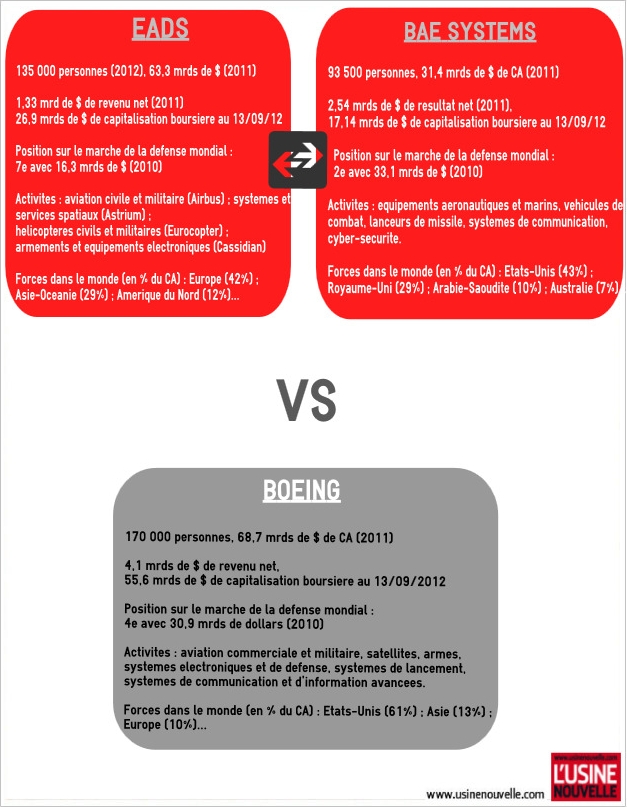
INFOGRAPHIE  Pour comprendre les enjeux d'une éventuelle fusion entre EADS et BAE Systems pour les secteurs de l'aéronautique et de la défense mondiaux, il est nécessaire de placer en parallèle les forces de la nouvelle entité européenne et celles du groupe américain Boeing, grand rival d'EADS.


https://s3.amazonaws.com/easel.ly/all_easels/24164/EADS/BAE_vs_Boeing/image.jpg

Partager cet article
Repost0
15 septembre 2012 6 15 /09 /septembre /2012 07:35

eurofighter-typhoon-airbus-a380


14.09.2012 Par Sylvain Cypel (correspondant à New York) - LE MONDE


Le projet de mariage entre EADS et BAE Systems suscite un certain nombre d'interrogations. Parmi celles-ci, la position qu'adopteront les Américains n'est pas la moindre. BAE Systems figure dans les dix premiers fournisseurs de la défense américaine. Qu'adviendra-t-il de ses contrats ? Quelles seront les relations avec le Pentagone, une fois EADS majoritaire (60 % du capital) dans le nouvel ensemble, avec les Etats français et allemand dans le tour de table, sous la forme d'une "golden share" ?


"Le risque a été identifié et les premiers contacts avec Washington sont plutôt positifs", a assuré au Monde Marwan Lahoud, le directeur général délégué d'EADS.


Outre-Atlantique, les intervenants du secteur semblent penser que cette fusion devrait certes avoir un impact considérable, en accélérant une compétition internationale déjà très tendue et où, dans tous les grands Etats occidentaux, les dépenses militaires sont revues à la baisse. Mais, selon eux, elle aurait peu de conséquences immédiates aux Etats-Unis.


"Si la fusion réussit, ce qui n'est pas acquis, et que la nouvelle société est bénéficiaire, alors, à long terme, elle disposera d'une masse critique qui lui offrira forcément de nouvelles possibilités, prévient Richard Aboulafia, vice-président du Teal Group, organisme d'expertise dans l'aéronautique et la défense. Elle aura une capacité plus forte de développement de nouveaux produits face à ses concurrents américains."


"Mais personne ne s'inquiète aux Etats-Unis, assure Loren Thompson, consultant aéronautique-défense du Lexington Institute. Cela ne modifiera rien aux fondamentaux américains et ne menacera en rien, dans l'immédiat, le marché militaire sur le territoire américain."


"GUERRE ÉLECTRONIQUE"


Sous couvert d'anonymat, un consultant de Boeing explique que l'avionneur américain ne s'inquiète pas du projet européen. Celui-ci "créerait un concurrent d'une taille plus volumineuse, mais dont la structure de direction serait encore plus compliquée à gérer que celle d'EADS, qui l'était déjà beaucoup", note-t-il.


Pour le Wall Street Journal, la structure proposée par Tom Enders, le patron d'EADS, pour diriger la nouvelle entité devrait néanmoins rendre plus difficile la critique sur son identité non américaine – ce qui a valu à EADS de perdre la "bataille" des avions ravitailleurs face à Boeing. Cela pourrait potentiellement lui ouvrir de nouveaux marchés.

Reste que l'une des craintes les plus fortes aux Etats-Unis porte sur les risques de transfert de technologies sensibles – dans la "guerre électronique" surtout. Technologies auxquelles BAE a accès, mais "inaccessibles jusqu'ici aux Allemands et aux Français", indique M. Aboulafia.


Selon M. Thompson, "tout dépendra de la structure de direction de la nouvelle entité. Si elle inquiète le Pentagone, alors les craintes de transferts indus peuvent surgir". Pour de nombreux experts, c'est ce qui expliquerait les nombreuses visites effectuées, durant l'année écoulée, par M. Enders au Pentagone, afin de rassurer ses hauts responsables.

Partager cet article
Repost0
15 septembre 2012 6 15 /09 /septembre /2012 07:30

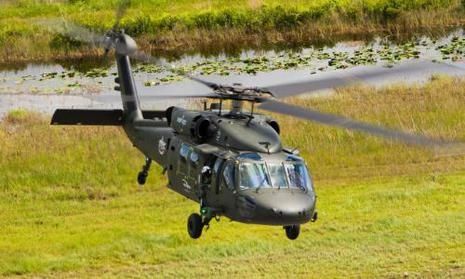
Sikorsky S-70i BLACK HAWK helicopter. Photo Sikorsky


ODOLENA VODA, Czech Republic, Sept. 14 (UPI)


Czech aircraft manufacturer Aero Vodochody has won a contract from PZL Mielec of Poland to produce helicopter cockpit assemblies.


The assemblies are for Sikorsky Aircraft's S-70i Black Hawks, the international version of the UH-60, which PZL Mielec produces as a subsidiary of the U.S. company.


A minimum of 50 cockpit assemblies are to be produced through 2017 but Aero Vodochody didn't reveal financial details of the deal, which was signed at the ILA Berlin air show.


The cockpit assemblies are a single assembly that includes the nose section, the windshield canopy and the platform upon which the aircraft's pilots sit. Electrical wiring and flight controls -- the cyclic stick and the anti-torque pedals -- are included.


"AERO Vodochody is a proven aerostructures manufacturer with an established history of delivering high quality airframe assemblies to Sikorsky," said PZL Mielec President Janusz Zakrecki.


Aero began producing cockpits for Sikorsky's UH-60M Black Hawk last year and has worked with produced cable harnesses for the S-70i for the past two years.


Read more: http://www.upi.com/Business_News/Security-Industry/2012/09/14/Czech-company-producing-S-70i-assemblies/UPI-40701347651526/#ixzz26UgFtHmv

Partager cet article
Repost0
14 septembre 2012 5 14 /09 /septembre /2012 22:06

EADS BAE


14 septembre 2012 Par Elodie Vallerey – USINE NOUVELLE


Pour le PDG du groupe de défense Lockheed Martin, la position des autorités américaines va permettre de constater "s'il y aura ou pas une consolidation des grands" acteurs de la défense.


La projet de fusion des groupes européens BAE Systems et EADS a été officialisé il y a seulement deux jours que, déjà, les concurrents de la potentielle future entité se positionne.


C'est le cas de l'américain Lockheed Martin, mastodonte de la défense aux Etats-Unis. Son PDG Robert Stevens a tenu ce 14 septembre une conférence de presse... et a répondu aux questions concernant le projet de fusion du siècle. En évoquant notamment son interrogation sur le positionnement futur du Pentagone vis-à-vis du nouveau groupe à naître.


"La politique au Pentagone, depuis un moment déjà, est de ne pas favoriser la consolidation des grands groupes" de défense, a-t-il rappelé, comme l'indique l'AFP.  Il dit donc regarder "avec un certain intérêt" le projet de rapprochement de BAE et EADS, "car je pense qu'ils vont tous les deux être perçus comme des grands fournisseurs par le ministère de la Défense".


"Cela pourrait être un test" d'une éventuelle évolution de la politique sur la consolidation du secteur, "et le secteur va regarder ça avec attention", a-t-il assuré.


"Nous serons prêts pour la concurrence si elle arrive", a affirmé le PDG de Lockheed Martin. "S'il y a quelque chose que nous voulons acheter nous l'achetons, s'il y a quelque chose que nous voulons vendre nous le vendons, nous n'allons pas être influencés outre mesure par une réaction concurrentielle d'autres entreprises", a-t-il martelé.


"Nous continuons de gérer notre entreprise en tablant sur une augmentation de la concurrence", qui arrivera "qu'il y ait réduction des budgets (de la défense aux Etats-Unis) ou pas, que cette fusion se fasse ou pas", rapporte l'AFP.


Et d'imaginer "une grande transaction compliquée", en particulier parce qu'elle implique plusieurs pays.

Partager cet article
Repost0
14 septembre 2012 5 14 /09 /septembre /2012 12:55

eurofighter-typhoon-airbus-a380


13/09/2012 par David Barroux, rédacteur en chef Industrie, high-tech et médias – lesEchos.fr


Coup de tonnerre dans le ciel de l’aéronautique. EADS, la maison-mère d’Airbus et BAE, le champion britannique de la défense, ont annoncé qu’ils envisageaient de fusionner. Si le deal aboutissait, les actionnaires d’EADS contrôleraient 60% du nouvel ensemble, ceux de BAE 40%.


Il faut avoir conscience qu’il s’agirait d’un événement colossal. C’est un peu comme si après s’être mariés Renault et Mercedes décidaient de fusionner avec Rolls Royce, Mini, Jaguar et Fiat. Comme si dans l’agroalimentaire, Nestlé rachetait Danone et Cadbury. Ou si dans le pétrole Total fusionnait avec Shell et BP. On parle là d’un séisme industriel. D’un événement qui rebat considérablement les cartes.


Si les deux premiers groupes d’aéronautique et de défense européens s’unissent, le groupe qui pourrait naître de cette fusion serait le numéro un mondial de l’aviation, de la défense et de l’espace. En chiffre d’affaires, on parle d’environ 100 milliards de dollars, contre moins de 70 pour Boeing et moins de 50 pour Lockheed Martin, le numéro deux américain. C’est la preuve que quand l’Europe se donne la main, elle peut doubler l’Amérique et repousser la concurrence chinoise.


Le mariage sera compliqué à mettre en oeuvre c’est sur mais c’est incontestablement la bonne stratégie. Nous sommes dans l’ère de la mondialisation. Et pour résister dans ce jeu là, il faut être gros pour dégager des économies d’échelles. C’est vrai dans tous les secteurs mais encore plus dans la défense et l’aéronautique ou les barrières à l’entrée technologiques sont gigantesques. Développer est hors de prix. Et quand on est seul et petit, on est sur de finir par décrocher.


Ensemble, EADS et BAE peuvent être bien plus efficaces. Surtout que ce serait l’union de deux groupes très complémentaires. Vous avez d’un côté EADS qui est très fort dans le civil (80% de son chiffre d’affaires)avec sa filiale Airbus et de l’autre BAE qui est un poids lourd dans la défense. En terme de métiers la complémentarité est très forte. Et sur le plan géographique BAE est très présent aux Etats-Unis, ce qui va permettre à EADS de s’américaniser et d’être ainsi plus actif sur le premier marché au monde.


Le mariage est tellement beau qu’on se demande pourquoi il n’a pas eu lieu plus tôt. L’élément déclencheur, c’est la crise des finances publiques. Les états sont endettés, ils vont donc revoir à la baisse les budgets de défense. Mais ils ne veulent pas moins de canons, tanks ou avions de chasses moins performant. Ils veulent juste se montrer plus économes. Et du coup, les Etats veulent passer des commandes à des groupes plus gros, plus efficaces. Les Etats-Unis ont connu à l’époque de la présidence Clinton une grande vague de consolidation dans la défense. C’était la fin de la Guerre froide. On parlait alors du “dividende de la paix”. Les dépenses militaires avaient fondu et les géants s’étaient mariés en Amérique. Aujourd’hui, il y a fort à parier que la même chose va se passer en Europe.


C’est d’ailleurs une bonne nouvelle pour les Etats. Pour l’instant les pouvoirs publics n’ont rien fait. Ils sont juste spectateurs. Ils ont laissé les entreprises agir. Mais demain ils auront des fournisseurs plus forts et en prime la France qui est actionnaire d’EADS va pouvoir vendre des actions pour quelques milliards. Cette fusion, c’est même bon pour réduire la dette de l’Etat.

Partager cet article
Repost0
14 septembre 2012 5 14 /09 /septembre /2012 12:40

Nuclear--Biological-Radiological-Reconnaissance-Vehicle.jpg


A U.S. Army soldier guides a Nuclear, Biological, Radiological Reconnaissance Vehicle in the Fort Stewart training area. (Photo: U.S. Army)


September 14, 2012 defpro.com


CHARLOTTE, N.C. | Chemring Detection Systems ("CDS") a Chemring Group ("Chemring") company, announced a $49 million contract award to supply biological detection systems to the US Army and US Navy. The award was made by the Edgewood Contracting Division of the Aberdeen Providing Grounds Contracting Command for over 100 Joint Biological Point Detection Systems (JBPDS) and Initial Fielding Packages. The systems will be installed on Navy ships such as the USS Ross (DDG 71) and in the Stryker Nuclear Biological Chemical Reconnaissance Vehicle (NBCRV).


The Joint Biological Point Detection System (JBPDS) provides automatic detection and identification of airborne biological agents at very low levels, triggers local and remote warning systems, and communicates threat information over standard communication systems. JBPDS is manufactured in CDS' Charlotte, NC facility. The systems are due for delivery between December 2012 and December 2013.


The JBPDS program is an US Army program managed by the Joint Program Executive Office for Chemical and Biological Defense (JPEO-CBD). The system is the only US Biological Detection system that has been through Whole System Live Agent Test. There are many variants of the JBPDS including Shipboard, HMMWV shelter, trailer and standalone fixed-emplacement. Multiple systems can be networked for command and control from a single operational interface to provide a broad area of surveillance. The JBPDS is available for sale to international customers with an approved US State Department export license.

Partager cet article
Repost0
14 septembre 2012 5 14 /09 /septembre /2012 11:32

bae systems


14/09 lesEchos.fr (Reuters)


Aux Etats-Unis, la société britannique BAE Systems est généralement considérée comme l'un des acteurs de la sécurité nationale, ce qui n'est pas le cas d'EADS dont les racines françaises, allemandes et espagnoles restent clairement identifiées.


Près de 40.000 employés dans 42 Etats - dont la Virginie, le Texas ou la Pennsylvanie -, des programmes de recherche dans une pléthore d'universités et des lobbyistes efficaces sont pour beaucoup dans le fait que l'origine britannique de BAE est rarement mentionnée.


Maintenant que les deux sociétés européennes envisagent une fusion, la question est de savoir si la réputation de BAE outre-Atlantique va bénéficier à EADS, ou si la britannique va à l'inverse voir sa tâche se compliquer aux Etats-Unis.


Analystes et industriels soulignent que BAE s'est fait une place dans le paysage de l'industrie de la défense américaine au cours des dix dernières années grâce à une série d'acquisitions stratégiques et à une adhésion sans faille aux procédures de sécurité.


Des milliers de ses employés bénéficient d'accréditations des agences de sécurité gouvernementales et BAE est membre de l'Association des industries aérospatiales américaines, qui a en revanche refusé l'adhésion d'EADS en raison de la présence dans son capital de gouvernements européens.


Linda Hudson, directrice générale de la branche américaine de BAE, souligne que la société qu'elle dirige est liée aux autorités américaines par un accord de sécurité qui lui permet de contribuer aux programmes les plus sensibles.


"Cela crée une dynamique intéressante et compliquée, car en théorie, notre maison mère ne peut pas nous dicter notre conduite", explique-t-elle, l'accord limitant en outre la quantité et la qualité des données qui peuvent être transférées hors des Etats-Unis.


Les modalités de l'éventuelle fusion doivent encore être discutées, mais BAE a déjà fait comprendre qu'il n'entendait pas renoncer à cet accord de sécurité, mais au contraire l'étendre à EADS.


L'ACCORD DE SÉCURITÉ SERA LA CLÉ


La société européenne a elle aussi conclu un accord particulier avec les autorités américaines, sans toutefois travailler sur des programmes aussi sensibles. Elle construit de petits hélicoptères pour l'armée américaine, mais elle a perdu l'an passé le marché des avions ravitailleurs de l'US Air Force au profit de Boeing.


Selon les experts, BAE a de son côté gagné des parts du marché américain en adoptant une stratégie délibérément peu agressive.


"Elle a fait preuve d'intelligence. Plutôt qu'essayer de gagner un énorme contrat, qui aurait pu être bloqué, elle a fait une série de petites acquisitions qui, mises bout à bout, lui donnent un beau portefeuille", note Ron Stallard, analyste chez RBC Capital Markets.


Les liens étroits entre Washington et Londres ont également favorisé la quasi-naturalisation de BAE, qui participe au plus important programme d'armement du Pentagone, le chasseur F-35 Joint Strike Fighter de Lockheed Martin, qui a déjà coûté 396 milliards de dollars (304 milliards d'euros).


BAE a réalisé un chiffre d'affaires de 14,4 milliards de dollars aux Etats-Unis l'an dernier, dix fois supérieur à celui d'EADS, ce qui classe la société britannique parmi les dix premiers fournisseurs du Pentagone.


"Les employés de BAE aux Etats-Unis, les membres de son conseil d'administration et ses partenaires commerciaux sont presque tous américains", rappelle le consultant en matière de défense Loren Thomson, selon lequel le succès d'une entité BAE/EADS dépendra de la nature de l'accord de sécurité conclu avec Washington.


Ce rapprochement ne semble en tout cas pas susciter pour le moment de réticences majeures aux Etats-Unis, d'autant que l'administration Obama se montre favorable à une collaboration accrue entre Washington et ses alliés ainsi qu'à une concurrence plus forte dans le domaine de la défense pour faire baisser les prix.

Partager cet article
Repost0
13 septembre 2012 4 13 /09 /septembre /2012 14:25

EADS BAE


13 septembre 2012 USINE NOUVELLE


Il est vraisemblable qu'une fusion entre EADS et BAE Systems serait autorisée aux Etats-Unis, selon plusieurs sources proches du dossier et pourrait inspirer d'autres rapprochements dans le secteur de la défense.


Les deux groupes de défense devraient cependant modifier divers accords de sécurité passés chacun de leur côté pour éviter tout problème sur certains programmes de défense américains jugés sensibles.


La fusion ne poserait pas de gros problèmes de concurrence aux USA, qui n'est pas pour l'heure un gros marché militaire pour EADS, selon les sources.


EADS et BAE Systems n'ont pas beaucoup d'activités redondantes outre-Atlantique, ajoutent-elles. En outre, BAE Systems jouit d'une réputation avérée sur certains des programmes militaires américains les plus sensibles.


Le Pentagone a dit mercredi que les deux groupes n'avaient pas encore soumis de projet détaillé mais selon des personnes au fait du dossier, ils ont déjà eu des conversations avec des responsables américains.


"Nous n'avons pas encore été informés officiellement d'une fusion mais nous l'examinerons si elle nous est soumise", a déclaré le lieutenant colonel Elizabeth Robbins, porte-parole du Pentagone.


EADS, la maison mère d'Airbus, et le groupe britannique BAE Systems ont annoncé mercredi discuter d'un rapprochement qui créerait un nouveau géant européen de l'aéronautique et de la défense, un projet motivé notamment par la baisse des dépenses de défense en Europe et aux Etats-Unis.


BAE emploie près de 40 000 personnes dans 42 Etats américains et EADS 3 000 dans 15 Etats. Le chiffre d'affaires de BAE aux Etats-Unis a été de 14,4 milliards de dollars en 2011 et celui d'EADS de 1,4 milliard de dollars environ.

EADS construit de petits hélicoptères pour l'armée américaine mais en dehors de cela est peu représenté, d'autant qu'il a perdu l'an passé le marché des avions ravitailleurs de l'US Air Force au profit de Boeing au terme de bien des péripéties.


Un haut fonctionnaire du Pentagone avait dit la semaine dernière à Reuters que de nouvelles coupes dans le budget de la défense pourraient amener le Pentagone a être moins regardant en matière de fusion entre grands acteurs du secteur.


Il ajoutait que toute proposition, même impliquant de gros groupes, serait examinée au cas par cas.

"Si les budgets sont suffisamment serrés, il y aura de la consolidation à tous les niveaux", avait dit à Reuters ce mois-ci Linda Hudson, qui dirige les activités américaines de BAE.


BOEING ÉTUDIE LA SITUATION


Jim McNerney, le directeur général de Boeing, a dit mercredi qu'il n'avait pas encore envisagé toutes les implications de cette nouvelle. Pour autant, il ne considère pas que la nouvelle entité qui naîtrait de la fusion représente une réelle menace.


"Je ne pense pas que cela nous menace fondamentalement", a-t-il répondu, interrogé à ce sujet.

"C'est le témoin d'une consolidation mondiale qui s'amorce", a-t-il ajouté, estimant qu'une fusion EADS-BAE produirait une société qui saurait mieux équilibrer ses activités entre le militaire et le civil, un modèle que, selon lui, Boeing suit depuis quelque temps.


Chez Lockheed Martin, personne n'a fait de commentaires.


Un porte-parole de BAE aux Etats-Unis a signalé que les deux sociétés avaient passé avec les autorités américaines des accords de sécurité particuliers leur permettant de travailler sur des contrats publics sensibles.


EADS, beaucoup moins présent aux Etats-Unis, serait sans doute englobé dans cette procédure maintenant bien établie avec BAE, selon une source au fait du dossier.


Pour ce qui est de l'aval du département de la Justice, il semble être acquis, selon un expert américain.

"Je ne vois rien qui pose problème", dit Darren Bush, un ancien du département de la Justice qui enseigne le droit à l'université de Houston. "Toutes les sociétés basées aux Etats-Unis vont en faire des gorges chaudes mais, pour ce qui du point de vue antitrust, je ne vois pas bien ce qu'elles peuvent y faire."


"On peut douter que les arguments légaux existent pour bloquer le mariage BAE-EADS, d'autant qu'aucun des deux n'est un acteur majeur et qu'ils ont peu d'activité redondantes", renchérit William O'Neill, un ancien du Pentagone devenu consultant pour l'Institute for Defense Analyses.


Avec Reuter, par Andrea Shalal-Esa

Partager cet article
Repost0
13 septembre 2012 4 13 /09 /septembre /2012 11:35

bae systems


12/09/2012 Par Florentin Collomp – LeFigaro.fr)


Le géant britannique, BAE Systems, est né en 1999 de la fusion de British Aerospace et de Marconi Electronic Systems.


Le premier avion commercial de Havilland Comet, le Concorde, l'Eurofighter Typhoon… BAE Systems et ses ancêtres sont derrière de grands symboles de l'aéronautique. Héritier de constructeurs navals et de sous-marins, de fabricants d'équipements militaires et de systèmes électroniques, c'est devenu un géant de la défense, au troisième rang mondial par son chiffre d'affaires: 19,1 milliards de livres (23,9 milliards d'euros) l'an dernier. Il emploie plus de 100.000 personnes dans le monde.


BAE Systems est né en 1999 de la fusion de British Aerospace et de Marconi Electronic Systems. Le britannique participait alors au mouvement de consolidation de la défense et de l'aéronautique européenne, initié en réaction à la fusion de Boeing et de McDonnel Douglas aux États-Unis deux ans plus tôt.


Dans un premier temps, il avait mené des discussions approfondies pour se rapprocher des allemands de DaimlerChrysler Aerospace (DASA). Mais, voyant d'un mauvais œil le rapprochement de ces derniers avec le français Aerospatiale pour donner naissance à EADS, British Aerospace avait décidé au dernier moment d'abandonner son projet de fusion quasiment bouclé pour racheter son rival anglais Marconi, mis en vente par General Electric.


Ce choix a isolé quelque peu BAE du reste de l'industrie européenne. En 2006, il s'en est éloigné encore en cédant ses 20 % dans Airbus. À la place, il a mis le cap sur les États-Unis. Aujourd'hui, il est l'un des principaux fournisseurs du Pentagone. Ses activités outre-Atlantique représentent 40 % de son chiffre d'affaires, devant le Royaume-Uni (30 %), l'Australie, l'Arabie saoudite et l'Asie.


Londres vigilant sur ses intérêts


Mais la réduction des dépenses militaires américaines, la fin de la guerre en Irak, le retrait d'Afghanistan, affectent son activité. Au premier semestre 2012, son chiffre d'affaires a reculé de 10 %, fortement impacté par la chute de 30 % des ventes de sa division «land and armaments» aux États-Unis, qui fournit à l'armée son tank Brad­ley. En Grande-Bretagne, la société, basée à Farnborough, réduit régulièrement ses effectifs industriels.


Pour compenser l'effondrement de ses sources traditionnelles de revenus, BAE mise sur la guerre électronique, les systèmes d'information liés au cyberespace. Il intervient par exemple dans les dispositifs de surveillance des transactions financières pour lutter contre le blanchiment d'argent, les interceptions de com­munications ou la sécurité in­formatique.


Défensif, ce rapprochement avec EADS marque son retour vers l'Europe et l'aéronautique civile. Les deux groupes coopèrent sur les avions de combat Eurofighter. Le gouvernement britannique a assuré mercredi veiller au respect des intérêts du pays.

Partager cet article
Repost0
13 septembre 2012 4 13 /09 /septembre /2012 07:50

ABM MDA Missile Defense Systems Slide lg


September 12, 2012  - defpro.com


Remarks by Frank A. Rose, Deputy Assistant Secretary, Bureau of Arms Control, Verification and Compliance


Berlin, Germany | I would like to thank the Missile Defense Agency, the American Institute of Aeronautics and Astronautics (AIAA), and our German hosts for putting on this outstanding conference, which over the years has become a much anticipated annual event. It’s been a distinct honor to be invited to speak at this conference for three years running and my pleasure to once again represent the State Department this afternoon at this influential gathering of missile defense experts from more than twenty nations.


Today, I am going to provide a brief update on the implementation of the European Phased Adaptive Approach or EPAA, our ongoing and growing cooperation with our NATO allies, the current status of U.S. and NATO missile defense cooperation efforts with Russia, and recent developments in our missile defense cooperation in other key regions.


IMPLEMENTATION OF THE EUROPEAN PHASED ADAPTIVE APPROACH


At the State Department, I am responsible for overseeing a wide range of defense policy issues, including ballistic missile defense. For nearly three years, I have been focused on carrying out the vision articulated by the President when he announced in September 2009 that the EPAA would “provide stronger, smarter, and swifter defenses of American forces and America's Allies,” while relying on “capabilities that are proven and cost-effective.” The EPAA will provide comprehensive protection for all of our NATO European Allies and augment the defense of the U.S. homeland.


As laid out in the 2010 Ballistic Missile Defense Review, “[t]he United States seeks to create an environment in which the development, acquisition, deployment, and use of ballistic missiles by regional adversaries can be deterred, principally by eliminating their confidence in the effectiveness of such attacks.”


Creating this new strategic environment depends on strong cooperation with our allies and partners. In order to make this vision a reality, President Obama has made international cooperation on missile defense a key priority, and we are pursuing a region-by-region approach based on the following three principles:


First, the United States will strengthen regional deterrence architectures built upon solid cooperative BMD relationships with an eye toward efficiently incorporating assets and structures that our partners already have today or are seeking.


Second, the United States is pursuing approaches to BMD within key regions that are tailored to their unique deterrence requirements and threats, including the scale, scope, and pace of their development, and the capabilities available and most suited for deployment. Specifically, we will phase in the best available technology to meet existing and evolving threats, and adapt to situations that evolve in the future.


Third, recognizing that our supply of BMD assets cannot meet the global demand we face, the United States is developing mobile capabilities that can be relocated to adapt to changing regional threats and provide surge defense capabilities where they are most needed.


In implementing this approach in Europe, we designed the EPAA to protect our deployed forces and Allies in Europe, as well as improve protection of the U.S. homeland against potential ICBMs from the Middle East.


As you know, we have made great progress in implementing the President’s vision in Europe.


EPAA Phase One gained its first operational elements in 2011 with the start of a sustained deployment of an Aegis BMD-capable multi-role ship to the Mediterranean in March 2011 and the deployment of an AN/TPY-2 radar in Turkey, which became operational in December 2011. Spain has also agreed to host four U.S. Aegis destroyers at the existing naval facility at Rota. These multi-mission ships will support the EPAA as well as other EUCOM and NATO maritime missions.


For Phase Two of the EPAA, we have an agreement with Romania to host a U.S. land-based SM-3 interceptor site beginning in the 2015 timeframe. This site will provide protection against medium-range ballistic missiles launched from the Middle East. In June of this year, the United States conducted its second consecutive successful test of the SM-3 IB interceptor and the second generation Aegis BMD 4.0.1 weapon system. This success was a critical accomplishment for Phase Two of the EPAA, which will see SM-3 IBs deployed in Romania in the 2015 timeframe.


We also have an agreement with Poland to place a similar land-based interceptor site there, including the SM-3 IIA, in the 2018 timeframe for Phase Three of the EPAA, which will extend BMD protection to all of NATO Europe.


Finally, the Department of Defense has begun concept development of a more advanced interceptor, known as the SM-3 IIB, which will be deployed in EPAA Phase Four in the 2021 timeframe. The SM-3 IIB will provide an intercept capability against intermediate-range ballistic missiles and an additional layer for a more enhanced homeland defense against potential ICBM threats to the United States from the Middle East.


COOPERATION WITH NATO ALLIES


As I made clear earlier, international cooperation is key to achieving the President’s vision of undermining potential adversaries’ confidence in the effectiveness of their ballistic missile attacks. To better achieve this end, the Obama Administration is implementing the EPAA within the NATO context.


At the 2010 Lisbon Summit, NATO Heads of State and Government approved a new Strategic Concept and took the historic decision to develop the capability to defend NATO European populations and territory against the increasing threat posed by ballistic missile proliferation. The Allies also welcomed the EPAA as the U.S. national contribution to the new NATO territorial missile defense capability, in support of our commitment to the collective self-defense of the Alliance under Article 5 of the North Atlantic Treaty.

At the Lisbon Summit, NATO Heads of State and Government also decided to expand the scope of the NATO Active Layered Theatre Ballistic Missile Defense (ALTBMD) program to serve as the command, control, and communications network to support this new capability. NATO Allies have committed to investing over $1 billion in ALTBMD to support NATO missile defense. NATO’s plan for missile defense is based on the principle that individual Allies will make voluntary national contributions of BMD sensors and interceptor systems, capabilities that will be integrated into the NATO ALTBMD command and control backbone. As with any national contribution, Allies are responsible for the costs associated with their own contributions.


On May 20-21 of this year, the NATO Heads of State and Government met in Chicago for the NATO Summit and announced that NATO had achieved an interim BMD capability. This means that the Alliance has an operationally meaningful standing peacetime BMD capability. NATO also agreed on the BMD-related command and control procedures, designated Supreme Allied Commander Europe as the commander for this mission, and demonstrated an interoperable command and control capability.

To support this interim BMD capability, the United States has offered EPAA assets to the Alliance as our voluntary national contributions to the BMD mission. The AN/TPY-2 radar deployed in Turkey is now under NATO operational control. In addition, U.S. BMD-capable Aegis ships in Europe are also now able to operate under NATO operational control when threat conditions warrant.

These decisions have created a framework for Allies to contribute and optimize their own BMD assets for our collective self-defense, and the United States welcomes and encourages such contributions from Allies. We believe that NATO BMD will be more effective should Allies provide sensors and interceptors to complement the U.S. EPAA contributions. Several NATO Allies already possess land- and sea-based sensors that could potentially be linked into the system, as well as lower tier systems that can be integrated and used to provide point defense such as PATRIOT. If Allies should decide to develop their own BMD capabilities, that would create significant opportunities for European industries, science, and technology. In short, there is absolutely no requirement or assumption that NATO missile defense will be “made in the USA.” The only requirement is that the systems contributed by Allies be interoperable with NATO ALTBMD.


Some of our NATO Allies already have begun to invest in assets that can be contributed to the NATO BMD mission, while others are continuing to study the issue. For example, the Netherlands has indicated that it will spend close to 250 million Euros to modify the SMART-L radars on its frigates to detect and track ballistic missiles at long ranges and has indicated it will contribute its Patriot BMD systems to the NATO missile defense mission. Allies also can contribute via pooling of BMD assets and joint development and procurement. In a time of austere budget environments, these and other “smart defense” initiatives provide a cost-effective way of providing for the common defense, demonstrate alliance solidarity, and ensure that the burden of tackling today’s tough security challenges is shared.


COOPERATION WITH THE RUSSIAN FEDERATION


Despite our differences of opinion, we remain convinced that missile defense cooperation between the United States and Russia (and between NATO and Russia) is in the national security interests of all countries involved. For that reason, missile defense cooperation with Russia remains a Presidential priority for this Administration, as it has been for administrations going back to President George H.W. Bush in the early 1990s.


When President Obama announced his new vision for missile defense in Europe in September 2009, he stated that “we welcome Russia’s cooperation to bring its missile defense capabilities into a broader defense of our common strategic interests.” Missile defense cooperation with Russia will not only strengthen our bilateral and NATO-Russia relationships, it could also enhance NATO’s missile defense capabilities. For example, Russian sensors would be a valuable addition to the defense of the Euro-Atlantic area.


As the Chicago Summit Declaration stated, “Through ongoing efforts in the NATO-Russia Council, we seek to determine how independent NATO and Russian missile defence systems can work together to enhance European security.” Successful missile defense cooperation would provide concrete benefits to Russia, our NATO Allies, and the United States and will strengthen – not weaken – strategic stability over the long term.


At Chicago, the NATO Allies made a very clear statement of our intent regarding strategic stability and Russia’s strategic deterrent. NATO declared in the Chicago Summit Declaration “…the NATO missile defense in Europe will not undermine strategic stability. NATO missile defense is not directed against Russia and will not undermine Russia’s strategic deterrence capabilities.” Through cooperation and working alongside the United States and NATO, Russia would see firsthand that this system is designed for ballistic missile threats from outside the Euro-Atlantic area, and that NATO missile defense systems can neither negate nor undermine Russia’s strategic deterrent capabilities. Close cooperation between Russia and the United States and NATO is therefore the best and most enduring way for Russia to gain the assurances it seeks that U.S. and NATO missile defenses cannot threaten Russia’s strategic deterrent. Cooperation would also send a powerful signal to proliferators that the United States, NATO, and Russia are working together to counter their weapons programs.


While we seek to develop ways to cooperate with Russia on missile defense, it is important to remember that under the terms of Article 5 of the North Atlantic Treaty, NATO alone bears responsibility for defending the Alliance from ballistic missile threats. This is why the United States and NATO cannot agree to Russia’s proposals for “sectoral” or “joint” missile defense architectures. Just as Russia must ensure the defense of Russian territory, NATO must ensure the defense of NATO territory. NATO cannot and will not outsource its Article 5 commitments.


Furthermore, we cannot accept Russia’s demand for legally-binding guarantees that our missile defenses will not threaten Russia’s strategic deterrent. Russia’s demand that such guarantees include a set of “military-technical criteria” would create limitations on our ability to develop and deploy future missile defense systems against the evolving ballistic missile threats presented by Iran and North Korea. As the growth of the ballistic missile threats continues unabated, we cannot place artificial limits on our ability to defend ourselves, our allies, and our partners. This includes any limitations on the operating areas of our BMD-capable multi-mission Aegis ships.


We would, however, be willing to establish a political framework for cooperation that includes a statement that our missile defenses are not oriented toward Russia. Any such statement would publicly proclaim our intent to work together and chart the direction for cooperation. Indeed, this is what we have been saying to Russia for the past several years.


During the G-20 Meeting in Los Cabos, Mexico, President Obama and President Putin announced in their June 18, 2012, Joint Statement that “despite differences in assessments, we have agreed to continue a joint search for solutions to challenges in the field of missile defense.” As I mentioned previously, we strongly support missile defense cooperation between NATO and Russia.

A near-term area for advancing our joint efforts is the NATO-Russia Council Theater Missile Defense Computer-aided Exercise, or TMD CAX. TMD CAX Phase 1, which occurred earlier this year, was successful and allowed for NATO and Russian experts to work together to determine the value of various forms of BMD cooperation, and the results of the exercise demonstrated the potential operational value of missile defense cooperation between NATO and Russia. And, if at any point Russia doesn’t believe that it is benefitting from such cooperation, then it can discontinue cooperation. We recognize that it will take time and effort to build trust, which is exactly why we seek to cooperate with Russia on this issue.


The United States and NATO have been transparent about our BMD programs. We have provided Russia with a number of ideas and approaches for transparency and we are also committed to discussing other approaches to building confidence between our two countries and between NATO and Russia. Despite our disagreements, we look forward to continuing discussions with the Russian Federation to develop a mutually-beneficial framework for missile defense cooperation.


MISSILE DEFENSE DEVELOPMENTS IN OTHER REGIONS


The United States, in consultation with our allies and partners, is continuing to bolster missile defenses in other key regions such as the Middle East and the Asia-Pacific in order to strengthen regional deterrence architectures.


As with Europe, we are tailoring our approaches to the Middle East and the Asia-Pacific so that they reflect the unique deterrence and defense requirements of each region.


In the Middle East, we are already cooperating with our key partners bilaterally and multilaterally through venues such as the recently established U.S.-Gulf Cooperation Council (GCC) Security Cooperation Forum. Several of our partners in the region have expressed an interest in buying missile defense systems, and some have already done so. For example, just last year the UAE contracted to buy two THAAD batteries that, when delivered, will enhance the UAE’s security as well as regional stability. The UAE also has contracted to purchase Patriot PAC-3 to provide a lower-layered, point defense of critical national assets. As Secretary Clinton said recently on a visit to Saudi Arabia, “we can do even more to defend the Gulf through cooperation on ballistic missile defense.” We look forward to advancing cooperation and interoperability with our GCC partners in the years ahead.


Additionally, we are continuing our long-standing and steadfast cooperation with Israel on missile defense on key systems such as Arrow 3, David’s Sling, and Iron Dome.


In the Asia-Pacific, we are continuing to cooperate through our bilateral alliances and key partnerships. For example, the United States and Japan already are working closely to develop jointly an advanced interceptor known as the SM-3 Blk IIA, and continue to work on enhancing interoperability between U.S. and Japanese forces. We are also continuing to discuss BMD bilaterally with the Republic of Korea and Australia and we recently had our annual meeting of the U.S.-Australia-Japan trilateral missile defense forum.


CONCLUSIONS


The increasing threat associated with the proliferation of ballistic missiles reinforces the importance of continuing to strengthen our collaborative missile defense efforts. We need to work together, bilaterally and multilaterally, to determine how we can leverage fully our unique capabilities to protect ourselves. After all, developing robust regional deterrence architectures is not the job of the United States alone – it requires close and continuing cooperation with all of our allies and partners in order to succeed.


We are proud of how much we have already achieved by working with our allies and partners to counter the threat from ballistic missiles, but admittedly, there is still much to do – and we are looking forward to achieving higher levels of BMD cooperation and effectiveness.

Partager cet article
Repost0
13 septembre 2012 4 13 /09 /septembre /2012 07:50
Polish Defence Official Attends Missile Defence Conference


September 12, 2012 defpro.com


Berlin | On 10 September Under-Secretary of State in the Ministry of Defence (MOD) for Defence Policy Robert Kupiecki participated in annual international conference Multinational Ballistic Missile Defence Conference on missile defence organised by the US - Missile Defence Agency and Institute of Aeronautics and Astronautics.


This year's - 25th edition of the conference took place in Berlin. Over 400 delegates from several states and representatives of armament industry participated in it.


In his address Minister Robert Kupiecki emphasised Poland's engagement in the development of missile defence systems both in national dimension - in the context of planned modernisation of the air defence system including gaining missile defence capabilities and in NATO dimension - building the allied common system as well as in the context of cooperation with the US - deploying the US installation on the territory of Poland.


Participation of representatives of Polish Ministry of Defence every year at the conference and inviting Minister Robert Kupiecki to give a speech during this year's edition underscores Poland's presence in the group of states noticing the rising significance of air and missile defence systems for international security.

Partager cet article
Repost0
12 septembre 2012 3 12 /09 /septembre /2012 20:58

EADS BAE


September 12, 2012 by Stephen Trimble – FG


Washington DC - A merger with BAE Systems could dramatically expand the EADS presence in the North American defence market, but at the same force divestitures of business units with sensitive US-made technologies.


BAE has benefited more than any foreign company from the UK government's "special relationship" with the White House.


Those ties allowed the company to acquire Sanders from Lockheed Martin in 1998, a company with electronic warfare technologies so sensitive they were made off-limits to BAE's European competitors. BAE also was cleared to acquire United Defense, a major land and naval armaments company in 2005.


Both acquisitions offered BAE the opportunity to grow quickly in the US defence market during a decade when military spending soared. Meanwhile, BAE's foreign competitors were forced to grow slowly through smaller acquisitions and by moving existing production to US soil.


A notable exception was Finmeccanica's acquisition of DRS Technologies in 2008. At the time, Italy's government, led by Silvio Berlusconi, supported US policy in Iraq and Afghanistan. EADS North America also expressed interested in DRS Technologies, but it was never clear if the deal would have been cleared by the Committee on Foreign Investment in the US (CFIUS).


A CFIUS review of the proposed EADS-BAE merger would be likely to focus on the disposal of BAE's Sanders unit, a leading maker of electronic warfare tools and weapons for the US military and its allies. It supplies, for example, the ALR-94 electronic warfare system for the Lockheed Martin F-22 and the Barracuda electronic warfare system for the F-35.


But Teal Group aerospace analyst Richard Aboulafia says a divestment of the entire US arm of BAE Systems is not out of the question.


He says: "There are many benefits and many avoided negatives to separating the US business. From the US standpoint that includes not being affiliated with a European prime."


At the same time, any US assets that would be retained under a merged BAE-EADS company could still be highly valuable. Although US defence spending is predicted to contract by $500 billion over the next decade - an amount that could be doubled if the US Budget Control Act is not amended or repealed by January - the Department of Defense still remains the world's largest weapons buyer by a significant margin.


Among the programmes that would gain involvement from EADS if the merger proceeds is the F-35. "It's either a huge opportunity or a huge challenge, depending on your viewpoint," adds Aboulafia.


The combined business would also be more of a competitive threat to Boeing on its home turf, he notes "from both its critical mass and its [US] industrial footprint".

Partager cet article
Repost0
12 septembre 2012 3 12 /09 /septembre /2012 20:31

EADS BAE


September 12, 2012 chicagotribune.com (Reuters)


WASHINGTON (Reuters) - Boeing Co Chief Executive Jim McNerney on Wednesday said his company was not threatened by merger discussions between Europe's EADS , the parent of Airbus, and Britain's BAE Systems Plc .

He said the proposed merger between the two European aerospace companies reflected the start of global consolidation in the defense industry, spurred by declining military spending in the United States and Europe, and was likely aimed at giving EADS greater access to the U.S. defense market.


"I have a pretty deep and abiding faith in our company's strength, so I don't see this as something that is going to threaten us fundamentally," McNerney told Reuters after a speech to the Council on Foreign Relations in Washington.

"It does reflect a global consolidation that is beginning to happen," he said, adding that an EADS-BAE merger would create a larger entity with more balanced commercial and military operations, a model that Boeing has followed for some time.

McNerney declined to comment further, saying he had not studied the issue.

Boeing beat out EADS last year to win a huge order to build 179 refueling planes for the U.S. Air Force, a deal EADS had hoped would help it expand its footprint in the United States.

In June, Airbus announced plans to build a large production facility in Mobile, Alabama.

(Reporting by Andrea Shalal-Esa; Editing by Dale Hudson, Gary Hill and John Wallace)

Partager cet article
Repost0
12 septembre 2012 3 12 /09 /septembre /2012 16:40

medium-extended-air-defense-system-meads-lg


September 12, 2012 defpro.com


ORLANDO/MUNICH/ROME | The first Medium Extended Air Defense System (MEADS) Multifunction Fire Control Radar (MFCR) has been integrated with a MEADS battle manager and launcher at Pratica di Mare Air Force Base near Rome, Italy.


The objectives of the integration test series were to demonstrate that the MEADS TOC could control the MEADS MFCR in coordination with the MEADS Launcher. At Pratica di Mare, the MFCR demonstrated key functionalities including 360-degree target acquisition and track using both dedicated flights and other air traffic.


MEADS International President Dave Berganini said, “The MEADS MFCR combines extraordinary capability and cost effectiveness. It can detect and track advanced threats with 360-degree coverage and no blind spots. Unlike fielded radars, it is highly mobile and C-130 transportable.”


The MFCR has been airlifted to White Sands Missile Range, N.M., in preparation for an intercept flight test later this year.


The MFCR is an X-band, solid-state, phased array radar using element-level transmit/receive modules. It provides precision tracking and wideband discrimination and classification capabilities. For extremely rapid deployments, the MEADS MFCR can provide both surveillance and fire control capabilities until a surveillance radar joins the network. The MFCR uses its main beam for uplink and downlink missile communications. An advanced Mode 5 identify friend-or-foe subsystem supports improved threat identification and typing.


Through its plug-and-fight capability, the MFCR simply acts as a node on the MEADS network. The MEADS battle manager lets a commander dynamically add or subtract sensors and shooters as the situation dictates without shutting the system down.


MEADS International Technical Director Marco Riccetti said, “Integration of the MFCR, Battle Manager and Launcher is proving that all elements are capable of tracking live targets and engaging them virtually. We are on track for a successful intercept flight test at White Sands Missile Range later this year.”

Partager cet article
Repost0
12 septembre 2012 3 12 /09 /septembre /2012 16:35

UH-60 Black Hawk source asdnews


September 12, 2012 defpro.com


KIELCE, Poland | Sikorsky Aerospace Services (SAS) and PZL Mielec – manufacturer of S-70i BLACK HAWK helicopters in Poland announced Sept. 5 they have signed a Letter of Intent with Poland’s principal maintenance, repair and overhaul (MRO) company Wojskowe Zaklady Lotnicze NR 1 S.A. (WZL 1). The agreement relates to a Polish Government decision to procure up to 26 S-70i multi-role helicopters made in Mielec for the Polish armed forces. SAS is the aftermarket division of Sikorsky Aircraft Corporation, a wholly owned subsidiary of United Technologies Corporation.


Founded in 1947, WZL 1 is Poland’s leading provider of aviation maintenance and overhaul services. Under the terms of the agreement, PZL Mielec, SAS and WZL 1 will explore ways that WZL 1 could offer its expertise in line, base and component maintenance and upgrades, as well as other general MRO services, to support a future helicopter procurement by the Polish Ministry of Defence. The Letter of Intent also addresses the proposal to establish a regional MRO center in Poland to support other BLACK HAWK operators.


“As a leading MRO provider with expertise supporting the Polish armed forces, WZL 1 is well established to provide in-country support for the BLACK HAWK helicopter,” said Frank DiPasquale, SAS Vice President of Sales and Strategic Relationships. “We are also excited that WZL 1 could also serve as a central base for regional support of our BLACK HAWK fleet.


This year, the Polish Ministry of Defence is expected to release a tender for multi-role helicopters followed by a contract award in late 2013. Sikorsky will offer the Polish-built S-70i aircraft, a customizable variant of the BLACK HAWK helicopter flown by militaries in 25 countries.


“The potential production of S-70i BLACK HAWK helicopters in Mielec for the Polish Armed Forces brings an opportunity to grow the entire Polish aviation industry,” said Janusz Zakrecki, President of PZL Mielec. “To work with WZL 1 will be a positive move as we seek to expand our network of partners, and develop local suppliers.”


"Acquisition of new helicopter platform for Polish Ministry of Defence gives us opportunity for further development and becoming a modern company. WZL-1 is open to cooperate with any potential partner, which will be a supplier of a new helicopter for PMOD. It will be an honor to cooperate with SAC" said Jan Pietowski, Chairman of the Board of WZL-1.”

Partager cet article
Repost0
12 septembre 2012 3 12 /09 /septembre /2012 12:45

eurofighter-snowy-peaks-alps-mountain-range-lg.jpg


Two Eurofighter jets maneuver amid the snowy peaks of the Alps mountain range. The Eurofighter Consortium and prime contractor Alenia Aermacchi have selected Northrop Grumman's inertial and satellite navigation systems for Tranche 3 of the Eurofighter Typhoon.


Sep 12, 2012 (SPX)


Pomezia, Italy -  Northrop Grumman has been selected by the Eurofighter Consortium and prime contractor Alenia Aermacchi to provide inertial and satellite navigation systems for Tranche 3 of the Eurofighter Typhoon multirole combat aircraft.


Northrop Grumman Italia will provide the Eurofighter Fibre-optical Gyro Inertial Navigation System and a global positioning system (GPS) receiver for the Eurofighter aircraft in all of the programme's participating nations, including the United Kingdom, Germany, Italy and Spain.


The new contract is valued at 30 million euros and builds on Northrop Grumman's extensive experience with the Eurofighter programme spanning more than 20 years as a supplier for all three tranches of the programme. Northrop Grumman Italia has delivered a total of more than 400 inertial navigation systems for Tranches 1 and 2 of the Eurofighter.


"This award reflects Northrop Grumman's continuing success and growth in the international market, as well as the robust relationship that we have built with Alenia Aermacchi over many years," said Marco Clochiatti, managing director and general manager of Northrop Grumman Italia.


"Additionally, our selection for the Eurofighter programme by all four nations reaffirms the strong reputations our products have for advanced technology, reliability and precision."


Based on high-accuracy fibre-optic gyro technology, Northrop Grumman's inertial navigation system and complementary GPS receiver incorporate state-of-the-art features, such as selective availability/anti-spoofing module architecture and an anti-jam antenna system.


Also, the GPS unit supports future enhancements such as digital maps and direct drive display, which utilizes a graphics processor capable of directly controlling the aircraft's multifunction displays for improved viewing and integration in the aircraft's avionics.

Partager cet article
Repost0
11 septembre 2012 2 11 /09 /septembre /2012 18:35

Ravitaillement-en-vol-d-un-Rafale.jpg


Ravitaillement en vol d'un Rafale de l'armée de l'air française opéré en juin 2008 par un avion de l'armée de l'air US au-dessus de Kandahar (Afghanistan). (Travers Eric/Sipa)


11-09-2012 Par Vincent Lamigeon - Challenges


Invité de l'université de la Défense à Brest, Charles Edlestenne a souligné que les futurs F-35 américains allaient coûter bien plus cher que le Rafale. Le patron de Dassault invite donc les Américains à acheter français.


C’est l’une des provocations dont Charles Edelstenne a le secret. Un des Scuds que le patron de Dassault Aviation s’emploie à envoyer avec une régularité de montre suisse. Deuxième jour de l’Université de la défense, ce mardi 11 septembre à 9h00 à Brest : un paisible débat s’engage sur la "défense de l’Europe". Industriels, militaires, ambassadeurs, responsables d’agences de défense et d’armement devisent des déboires des programmes européens et américains, notamment le gigantesque programme de chasseur F-35, ou JSF, dans lequel les Etats-Unis avaient réussi à embarquer des pays européens comme le Royaume-Uni, l’Italie, les Pays-Bas ou le Danemark.


Charles Edelstenne se lève. Demande le micro. Et se lance dans un pilonnage sans pitié du programme américain, dont le coût total a dérapé de 50% en quelques années, de 1.000 à 1.500 milliards de dollars selon le Pentagone. "Les difficultés actuelles ne sont qu’un début, car la phase de maturation des systèmes sera bien plus complexe. Le coût unitaire a déjà dépassé celui du Rafale, alors que les quantités commandées pour le F-35 sont plus de dix fois plus importantes..."


La raison du maintien de ce programme ruineux ? Charles Edelstenne se fend d’un sourire: "Les Américains l’appellent le programme TINA, pour "There is no alternative". Mais si, il y a une alternative : c’est le Rafale, un avion éprouvé techniquement et financièrement."


Une boutade qui repose sur une réalité concrète


Le message est limpide : si les pays du programme F-35, Etats-Unis compris, venaient à y renoncer, Dassault serait enchanté de placer son Rafale. Même si le constructeur a pris l’habitude de ne livrer que 11 appareils par an à son seul client français : "Si les Etats veulent quelques centaines d’avions, on s’arrangera sans problème", rigole Eric Trappier, directeur international de l’avionneur.


Bien sûr, la proposition de Charles Edelstenne relève avant tout de la boutade : on verrait mal Washington et ses alliés renoncer à un programme à 1.450 milliards de dollars (sur la durée de vie des appareils) pour acheter le chasseur français, même si le Rafale coûterait probablement bien moins cher que le F-35.


Mais la saillie de ce matin a au moins le mérite de poser clairement les données du problème : malgré des surcoûts phénoménaux, des difficultés techniques énormes sur le moteur F135 de Pratt & Whitney, et des retours industriels qui déçoivent les alliés de Washington, le programme F-35 de Lockheed Martin a bel et bien réussi son objectif stratégique : assécher les budgets de défense de plusieurs Etats européens, grêvés par cet achat, tout en les empêchant d’aller voir la concurrence malgré les retards et les surcoûts du programme.


En cette période de rédaction d’un nouveau Livre blanc de la défense, la leçon n’a rien d’anecdotique. L’OTAN, et à travers elle les Etats-Unis, ne cessent de faire pression pour que l’Europe se convertisse au "pooling and sharing" et à la "Smart defense", deux anglicismes en vogue pour définir la mutualisation et le partage entre alliés d’équipements militaires comme les ravitailleurs ou les drones de surveillance. Ce fut l’une des grandes antiennes du sommet de l’OTAN de Chicago.


Une stratégie qui pourrait être celle de l’Europe face à l’ogre américain


A première vue, l’idée a de quoi séduire des Etats européens en pleine phase de contraction de leurs budgets de défense. Mais le piège est patent : la plupart de ces partages se font, et risquent de toujours se faire, sur des matériels américains. "La Smart Defense est une machine de guerre pour l’industrie américaine, assure ainsi Jean-Louis Carrère, président de la commission Défense du Sénat. L’exemple du F-35 et peut-être bientôt de la défense anti-missiles balistiques [projet de bouclier européen basé sur des radars, des destroyers et des missiles intercepteurs américains, NDLR] montre que c’est leur méthode pour assécher les budgets nationaux et tuer l’industrie européenne de défense." Le tout sans les retours industriels espérés par les clients européens : "Sur le F-35, le retour industriel pour les partenaires, notamment le Royaume-Uni, se mesure au pied à coulisse", pointe le délégué gééral pour l’armement Laurent Collet-Billon.


En proposant un mutualisation sur la base du Rafale, Charles Edelstenne esquisse peut-être la stratégie qui pourrait être celle de l’Europe face à l’ogre américain : la mutualisation des équipements, oui, mais en intégrant une dimension de préférence européenne. Reste à savoir si les alliés historiques de Washington en Europe, Londres en tête, l’entendent de cette oreille.

Partager cet article
Repost0
11 septembre 2012 2 11 /09 /septembre /2012 18:29

cyber warfare


11 septembre 2012  - par Valery Marchive - lemagit.fr


Les chercheurs en sécurité qui surveillent les cybercriminels impliqués dans l’opération Aurora de 2009 ont constaté une hausse des compétence du groupe ainsi d'un degré élevé de sophistication dans leur modus operandi : progression des exploits de vulnérabilités zero-day en 2011 et au moins quatre failles tout aussi inédites au cours des derniers mois.

Les principales cibles d'Aurora semblent être les fournisseurs de l’armée américaine et ses partenaires, tels que des fabricants de composants électroniques et mécaniques, a indiqué une étude de Symantec dévoilée en fin de semaine dernière. Celle-ci souligne l’utilisation de failles inédites - dites zero-day - et le recours au phishing - ou hameçonnage - ciblé. Le groupe responsable de l’opération Aurora en 2009 utiliserait ainsi cette technique pour infecter les postes de travail d’employés des entreprises visées. Il aurait en outre introduit un style d’attaque dit «watering hole», visant les vulnérabilités de sites Web fréquemment visités par les employés de ces entreprises : les cybercriminels attendent que la victime visite le site compromis puis analysent son poste de travail à la recherche de vulnérabilités.


«Le groupe dispose apparemment d’une source illimitée de vulnérabilités inédites », estime ainsi Symantec qui baptise l’opération du nom de projet Elderwood, en s’appuyant sur le code source de l’exploit utilisé pour les attaques. «Les vulnérabilités sont utilisés selon les besoins, souvent très rapidement l’une après l’autre si la vulnérabilité exploitée est susceptible d’être très prochainement rendue publique.» 


Symantec estime que le groupe a utilisé environ 8 failles zero-day en 2011. Il aurait poursuivi ses attaques ciblées en 2012 et, depuis avril dernier, il se serait appuyé pour cela sur deux failles inédites dans le lecteur Flash, ainsi qu’une autre dans Internet Explorer et enfin une dernière, dans les Microsoft XML Core Services. Des failles comblées depuis.

Les attaques de l’opération Aurora ont été découvertes en décembre 2009. Google et des dizaines d’autres entreprises ont été victimes de cette opération dont l’origine supposée serait la Chine. Les attaquants semblent viser un grand nombre de cibles, dont des groupes de défense des droits de l’homme. Les victimes ont été infectées par le cheval de Troie Hydraq, via une vulnérabilité d’Internet Explorer. Ce logiciel malveillant ouvrait une porte dérobée sur la machine de la victime, permettant in fine aux attaquants d’infiltrer le réseau de l’entreprise visée.


Les activités du groupe de pirates font l'objet d'une étroite surveillance chez les experts en sécurité. Mais la détection des attaques reste difficile, souligne Eric Chien, directeur technique senior de Symantec Security Response. Selon lui, le groupe change constamment ses exécutables et son infrastructure de commande et de contrôle, tout en s’appuyant sur de nouveaux exploits. Le groupe travaille par vagues, visant activement ses cibles sur une période de trois mois, avant de se mettre en sommeil pour plusieurs mois.


«Les entreprises américaines sont clairement des cibles prédominantes dans les statistiques mais nous trouvons des traces de ce groupe partout dans le monde», explique Chien. «Ces gars sont tenaces; ils ont de la constance; et toutes les organisations concernées sont potentiellement vulnérables.» 


Eric Chien a indiqué que les chercheurs de Symantec ont détecté des éléments de code d’Hydraq dans les exécutables collectés dans le cadre d’attaques conduites en 2011 et en 2012. La couche de dissimulation du code malicieux est réutilisée, permettant aux antivirus et autres systèmes de protection d’être efficaces dans la détection du cheval de Troie, assure-t-il. 


Mais, selon Chien, le recours à des failles zero-day indique un haut niveau de qualification et de financement. «Ils disposent clairement d’une infrastructure avec des développeurs d’outils capables d'aider les opérateurs à conduire leurs attaques, estime-t-il. Nous ne disposons pas d’éléments indiquant qu’il s’agisse d’un gang de cybercriminels classiques. Ils cherchent des données relevant de la propriété intellectuelle, comme des plans, des codes sources, mais aussi des données d’espionnage industriel.» 


De son côté, Symantec a alerté les fournisseurs du secteur de la Défense qu'une nouvelle série d’attaques devrait survenir, selon lui, en 2013. Le groupe de pirates pourrait alors également viser les partenaires ou les filiales des entreprises ciblées.


Le groupe continue certes de recourir largement au phishing ciblé. Mais il emploie également, et de plus en plus souvent, la technique du Watering Hole, avance Symantec. Celle-ci a été initialement identifiée par RSA en juillet. Les vulnérabilités sont fréquentes dans les sites Web et elles permettent aux pirates d’injecter du code malicieux dans les iframes. Ils n’ont alors plus qu’à attendre que leur victime visite le site infecté. 


«Les attaquants sont susceptibles de compromettre un site Web des mois avant qu’ils ne l’utilisent pour une attaque, estiment les chercheurs de Symantec. Mais une fois le site compromis, les attaquants s’y connectent régulièrement pour vérifier qu’ils y ont encore accès.»

Partager cet article
Repost0
11 septembre 2012 2 11 /09 /septembre /2012 16:50

Rafale-assembly-line-in-Merignac.jpg

The Rafale assembly line in Merignac, France.

(Photo: Dassault Aviation)


September 11, 2012 International Institute For Strategic Studies - IISS Strategic Comments - Volume 18, Comment 27


Europe's combat aircraft industry faces an uncertain future. While it still has several types of fighter aircraft in production, there is no new European-developed manned combat aircraft currently in prospect and the outlook for the development and production of unmanned air systems is also unclear.


There remain six final assembly lines for three types of combat aircraft: the Eurofighter Typhoon built in the United Kingdom, Germany, Italy and Spain, Dassault's Rafale, built in France, and Saab's Gripen, built in Sweden. The manufacture of Rafale and Typhoon – at least within Europe – is likely to have ended by around the turn of the decade, though there will be substantial work in upgrading aircraft already built. The production of the Gripen, meanwhile, now appears likely to continue into the 2020s with Sweden and Switzerland to buy the Gripen NG, a mid-life update of the basic design.


So far, however, there is nothing now being considered within Europe that – at least in terms of production capacity – could directly take the place of all three types.


Several European countries are already buying a next-generation combat aircraft, the American-made F-35 strike fighter: Britain, Italy, the Netherlands, Norway, Italy and Turkey are all participants in the F-35 Lightning II programme. All have contributed funding to the aircraft's development phase, with Britain providing an estimated 8% of the total cost, some $2 billion. But the role of European companies in the F-35 is limited to that of sub-contractors.


New European developments are now focused on unmanned military aircraft. A potentially important move was made in July by France and the UK to begin to establish a future programme, with the announcement that the two countries would launch an initial study of an unmanned combat air system (UCAS). While such a project will help sustain high-end design and development skills, any future production runs would almost certainly be far smaller than the present generation of combat aircraft. This has important implications for the defence aerospace manufacturing base.


AMERICAN DOMINANCE


As things stand, the F-35, for which Lockheed Martin is prime contractor, is likely to be the West's dominant combat aircraft for decades to come. It is not yet, however, in service and has suffered substantial delay and cost escalation. Washington, facing funding constraints, has slowed the planned production rate over the next few years. Despite these issues, the likelihood remains that the aircraft will become the mainstay of the US military's strike-fighter fleet, and will also be prevalent in European combat aircraft fleets. France and Germany are not participating in the programme.


For Europe's defence aerospace manufacturers the F-35 represents both a threat and an opportunity. The aircraft's penetration of the European market undermines the continent's requirement for indigenous combat aircraft development. But many European companies are suppliers to the F-35 programme, so it provides them with the potential security of large-scale production runs, particularly BAE Systems of the UK, which is manufacturing the rear section of the aircraft.


European governments and industry leaders face a difficult choice when trying to balance their shrinking defence budgets: commit to joint development programmes of next-generation air combat platforms – bearing in mind that fighter aircraft are among the most expensive items of equipment to develop and purchase – or accept that the technological design and development capabilities of Europe's defence aerospace industry will gradually be lost.


Whether consciously or not, this would in effect mean accepting Europe's dependence on the United States to meet any future manned combat aircraft needs.


UNMANNED SYSTEMS


The past decade has witnessed the growing use of unmanned aerial vehicles (UAVs) as both sensor and weapons platforms. Israel and the US were early adopters of the technologies, and have secured strong positions in the export market for certain classes of UAVs in the tactical arena. However, because of the use of classified stealth technologies for advanced unmanned combat air vehicle designs, any European collaborative projects are likely to be restricted to a limited number of NATO allies.


The Franco-British decision on UCAS collaboration thus offers one route to sustaining some European capability and production capacity – though the initial investment in a preparation phase is modest at €13m. This phase is intended to draw up a joint approach to the development and testing of the key technologies required for an operational unmanned stealthy strike system.


Following the completion of the first phase, expected to last around 18 months, the two partners will have to decide whether to commit to a significantly more costly second phase. This would see the construction of a demonstrator air vehicle, with flight testing set for the first few years of the next decade. The aircraft would enter into service between 2030 and 2035. BAE Systems and Dassault are the two industry leads, drawing on their respective experience of unmanned systems. Engine manufacturers Rolls-Royce and Snecma are also jointly exploring propulsion options for such an air vehicle.


The two nations may also jointly develop an unmanned medium altitude long-endurance surveillance aircraft. A decision is expected once the recently elected French government has finished re-evaluating its unmanned aircraft needs and acquisition approach.


The UK and France already have unmanned combat air vehicle work in train. Over the coming year they will fly their respective technology demonstrators of unmanned combat aircraft, the Neuron and Taranis. The former is a French-led six-nation European project, while Taranis is an entirely British development. The British programme, led by BAE Systems, has been supported by a considerable amount of highly classified work which has focused on making the aircraft as stealthy as possible. Considerable effort has gone into minimising its radar signature, as well as the amount of infra-red radiation emitted by the engine. By contrast, given the multinational nature of the Neuron project, it is unlikely to have explored low-observable technologies to quite the same extent. The experience gained from both the Taranis and Neuron will help inform the Anglo-French UCAS work. Neither Taranis nor Neuron was intended to lead directly to a system suitable for production.


MANNED FIGHTER PROJECTS


Following the heavy use of unmanned systems in Iraq and Afghanistan, and with expectations that they will continue to have a growing role at least in uncontested airspace, there is a question mark over the likely extent of future global requirements for crewed combat aircraft. This does not mean, however, that manned combat aircraft programmes have come to a halt quite yet.


Several countries are continuing to pursue manned combat aircraft projects, including the US, China, Russia, India, Japan, South Korea and Brazil. The US is already looking at the generation of fighters beyond the F-35, as well as a future bomber. Meanwhile Moscow now has three Sukhoi T-50 prototypes of its fifth-generation fighter in flight test, and Beijing has two J-20 prototypes flying. Both aircraft have low-observable design characteristics, and while neither is likely to be as stealthy as the US F-22 Raptor, they represent considerable developments for their respective industrial bases. Assuming the T-50 and J-20 come to fruition, they will also provide a significant increase in capability for their respective air forces.


India, Japan, South Korea and Brazil have aspirations to use the development of new combat aircraft to boost their respective national industrial sectors. Though some – or possibly none – of these projects may come to fruition, they should not be dismissed. India has used its very long-running light combat aircraft programme as a vehicle for industrial development – in spite of the troubled history of the programme – and it is now in the early stages of an advanced medium combat aircraft project. This is intended to be a reduced-radar-signature multi-role combat aircraft, with an in-service date of towards the end of the next decade. India is also a junior partner in the Russian T-50 project, and intends to purchase 214 of the type for its own air force. Japan, though an F-35 buyer, has also funded the ATD-X low-observable fighter technology demonstrator project, while South Korea has the KF-X indigenous fighter programme intended to develop an F-16-class fighter with stealthy characteristics. Beyond Brazil's FX-2 fighter procurement, a decision upon which may emerge by the end of the year, the country also harbours ambitions to develop a next-generation fighter in partnership with a third party.


European industry has in the recent past tried to use some of these potential programmes as a basis for future development, but without success. EADS, the parent company of Airbus and Eurocopter, and Saab had also floated longer-term co-development possibilities when competing in South Korea and Brazil respectively. Meanwhile all three European fighters, Gripen, Rafale and Typhoon, have secured other export orders, but these, however welcome, sustain only the current designs, or developments thereof.


This leaves Europe's two main military powers, France and the UK, continuing to grapple with the problem of sustaining their respective combat aircraft sectors in the medium to long term.


EUROPEAN COOPERATION


Any future aircraft programmes and collaborations will reflect the continued scaling down of capabilities and ambitions by European countries. In the UK, for example, aims in the 1990s to develop or buy different types of manned combat aircraft to replace the Harrier and the Tornado GR4 have had to be abandoned. As long ago as 2005, then-defence minister John Reid noted that: 'Our current plans do not envisage the UK needing to design and build a future generation of manned fast jet aircraft beyond the present [Typhoon and F-35] projects.' Further cuts to the air force were implemented in a 2010 defence review, and a similar outcome seems likely in France's review, which is now under way.


It is against this background that London and Paris have been trying to align defence research and development more closely to maximise the benefit of their national spending, with one aim being common acquisition projects. The two countries signed a ground-breaking treaty on defence and security cooperation in 2010.


Defence ministers Jean-Yves Le Drian and Philip Hammond, meeting in July for the first time since the election of French President François Hollande, signed the UCAS agreement and also a memorandum to enable cooperation on the Watchkeeper tactical unmanned air system. They discussed the potential for military cooperation between specialised units of the two armies using the same systems. Watchkeeper is being developed for the British Army by Thales of France to provide intelligence, surveillance and reconnaissance. It is expected to enter service this year.


Their communiqué said: 'The UK and France are determined to set the pace in Europe for cooperation to deliver their future capability requirements and the ministers agreed that cooperation on specific programmes may include other close allies with similar capability and contribution, when practicable and feasible.'


Meanwhile, France also signed a declaration of intent with Germany to identify possible collaborative development and procurement projects – the two countries had previously been working on the joint acquisition of a medium-altitude long-endurance unmanned aircraft, and the previous French administration decision to pursue such a programme with London instead had caused consternation in Berlin.


Germany, Italy and Sweden are closely watching the development of the Anglo-French relationship in the military air sector to determine their own options, which could perhaps include taking part in some form of expanded collaboration.


LIMITED PROSPECTS


Future decisions on cooperation to develop new aircraft – unmanned or even manned – will be crucial for the future of Europe's defence industry. But such projects are likely to be of modest scale in terms of production numbers. Between them, London and Paris may purchase as few as 100 unmanned combat aircraft.


This – even when combined with supply contracts for American-built aircraft – is unlikely to sustain a European production base on the scale that currently exists. As they mull future collaboration, governments and industry will face the problem of managing a considerable reduction in manufacturing capacity.


Full text

Partager cet article
Repost0

Présentation

  • : RP Defense
  • : Web review defence industry - Revue du web industrie de défense - company information - news in France, Europe and elsewhere ...
  • Contact

Recherche

Articles Récents

Categories