Overblog Tous les blogs Top blogs Entreprises & Marques Tous les blogs Entreprises & Marques
Suivre ce blog Administration + Créer mon blog
MENU
17 janvier 2013 4 17 /01 /janvier /2013 08:20

chuck-hagel


17 janvier 2013 Guysen International News


Chuck Hagel, choisi par Barack Obama comme nouveau secrétaire à la Défense, sera auditionné le 31 janvier par le Sénat qui doit donner son aval à cette nomination, a annoncé mercredi la commission des Forces armées du Sénat.

Partager cet article
Repost0
16 janvier 2013 3 16 /01 /janvier /2013 19:20

rtn11 ids jlens img1 photo Raytheon


16 janvier 2013 par Nicolas Laffont - 45enord.ca


Une récente démonstration a prouvé que les opérateurs peuvent observer des cibles en mouvement de surface en temps réel - y compris un faux terroriste plaçant un engin explosif improvisé – en utilisant un système de ciblage MTS-B Multi-Spectral de Raytheon Company monté sur les dirigeables JLENS (Joint Land Attack Cruise Missile Defense Elevated Netted Sensor System).


Lors de la démonstration financée par Raytheon, et malgré l’épaisse fumée des récents incendies de forêt, d’origine naturelle, un capteur électro-optique/infrarouge MTS-B (EO/IR) monté sur un système de surveillance JLENS a suivi de nombreuses cibles avec le capteur infrarouge. La vidéo du MTS-B est passée par l’attache de l’aérostat, permettant aux opérateurs de regarder les flux en direct de camions, de trains et de voitures à plusieurs dizaines de kilomètres de là. Bien que le MTS-B suit visuellement des cibles, le JLENS suit simultanément des cibles de surface avec son système de radar intégré, ce qui démontre le potentiel pour intégrer le radar JLENS et la charge EO/IR.


Dans le cadre de la démonstration, les opérateurs ont également utilisé le capteur électro-optique MTS-B pour regarder des employés de Raytheon simuler la plantation d’un engin explosif improvisé en bordure de route.


« Le radar de conduite de tir intégré au JLENS et le radar de surveillance à 360 degrés donnent la capacité à détecter et attaquer les menaces de surface et aériennes comme des bateaux essaimage et les missiles de croisière anti-navires», a déclaré Dave Gulla, vice-président de Global Integrated Sensors pour Raytheon Integrated Defense Systems. « L’intégration du MTS-B, éprouvé, sur le JLENS fait du JLENS un système multi-mission et permet de mieux défendre la zone de bataille et de protéger les infrastructures essentielles et les voies navigables. »

Partager cet article
Repost0
16 janvier 2013 3 16 /01 /janvier /2013 17:20

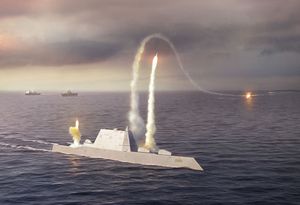
USS Zumwalt (DDG-1000) source naval-technology.com


TEWKSBURY, Mass., Jan. 16, 2013 /PRNewswire


Raytheon Company has delivered more than six million lines of software to the U.S. Navy for the DDG 1000 Zumwalt-class destroyer program. Part of the Total Ship Computing Environment (TSCE) -- the integrated mission system for the DDG 1000 class -- the software delivery supports ship activation and combat system testing, set to commence this year.


The magnitude of this software development program is recognized as one of the most complex in the history of the U.S. Navy. TSCE continues to achieve all critical readiness milestones on schedule, currently at Technology Readiness Level 6 after demonstrating the system's ability to perform in relevant end-to-end operational environments. Recently, the Engine Control System and core Integrated Power System capabilities were tested at the Navy's land-based test site, where automated control of the Navy's first all-electric ship was successfully demonstrated.


"We attribute TSCE success to the rigorous process employed by the incredibly talented industry team, building in incremental testing throughout development to verify quality, mitigate risk and detect any defects early enough to avoid any impact to the Navy's schedule or cost," said Kevin Peppe, vice president of Seapower Capability Systems for Raytheon's Integrated Defense Systems business. "The upcoming tests and ship activation will demonstrate the robust capability and functionality of TSCE, the integrating element delivering mission wholeness for this revolutionary new warship."


TSCE is the product of true industry-government collaboration, leveraging the expertise of diverse partners, including Navy laboratories, Lockheed Martin, Northrop Grumman and a host of small, innovative companies.


Highly Scalable, Automated and Open


Raytheon's TSCE encompasses all shipboard computing applications, including the combat management system; command, control, communications, computers, and intelligence elements; ship machinery control systems; damage control; embedded training; and support systems. The system leverages a modern, open-architecture approach that provides a scalable platform for cost-efficient delivery of new mission capability.


TSCE delivers a high degree of modularity and automation, helping to advance the Navy's open architecture goals, and is a key source of reuse for other platforms. The sailor-centric human-computer interface, combined with the high level of automation achieved with TSCE, is a primary driver for the significant reduction in manning for Zumwalt-class destroyers when compared with today's Arleigh Burke-class destroyers.


Raytheon serves as the prime mission systems equipment integrator for all electronic and combat systems for the DDG 1000 program. Working with the Navy and a team of industry partners, Raytheon is leading the effort to transform the Navy's ship requirements to reality. Work on the DDG 1000 program is performed by more than 800 Raytheon employees, as well as by approximately 1,800 subcontractors and supplier partners in 43 states across the country.


About Raytheon

Raytheon Company, with 2011 sales of $25 billion and 71,000 employees worldwide, is a technology and innovation leader specializing in defense, homeland security and other government markets throughout the world. With a history of innovation spanning 90 years, Raytheon provides state-of-the-art electronics, mission systems integration and other capabilities in the areas of sensing; effects; and command, control, communications and intelligence systems, as well as a broad range of mission support services. Raytheon is headquartered in Waltham, Mass. For more about Raytheon, visit us at www.raytheon.com and follow us on Twitter @raytheon.

Partager cet article
Repost0
16 janvier 2013 3 16 /01 /janvier /2013 17:20

AGM-88_HARM_on_FA-18C.jpg


TUCSON, Ariz., Jan. 16, 2013 /PRNewswire


The U.S. Air Force awarded Raytheon Company a $12.3 million contract to begin full rate production of High-Speed Anti-Radiation Missile (HARM) Control Section Modification (HCSM) upgrade units. Raytheon received the award as the result of a down-select competition.


The modification adds a GPS receiver and an improved inertial measurement unit (IMU) for precision navigation to the existing HARM. HCSM also features a digital flight computer that merges targeting solutions from navigation and seeker systems. These enhancements improve the probability of hit, while controlling where the missile can and cannot fly.


"Leveraging several years of experience with HARM, Raytheon's HCSM will provide the Air Force with enhanced capability and accuracy, while simultaneously reducing collateral damage or risk of fratricide," said Chuck Pinney, HARM program director for Raytheon Missile Systems. "HCSM will fill a critical capability need for the warfighter."


Raytheon is scheduled to begin modification of existing HARMs early this year with delivery of HCSM units beginning in the fourth quarter of 2013. Raytheon has teamed with Honeywell, Rockwell Collins and others for the HCSM program.


The contract was awarded in Raytheon's fourth quarter of 2012.


About HARM and HCSM

The AGM-88 High-Speed Anti-Radiation Missile is a key battlefield element to suppress or destroy surface-to-air missile radars, early warning radars and radar-directed air defense artillery systems. HARMs have made hostile airspaces worldwide safer for U.S. and allied warfighters. The missile resides in the inventories of eight countries.


    More than 4,000 HARMs have been employed in combat.

    HCSM adds GPS/IMU navigation accuracy, giving HARM the ability to engage time-critical targets.

    HCSM has new features that degrade counter-HARM tactics, while reducing the risk of fratricide or collateral damage.


About Raytheon

Raytheon Company, with 2011 sales of $25 billion and 71,000 employees worldwide, is a technology and innovation leader specializing in defense, homeland security and other government markets throughout the world. With a history of innovation spanning 90 years, Raytheon provides state-of-the-art electronics, mission systems integration and other capabilities in the areas of sensing; effects; and command, control, communications and intelligence systems, as well as a broad range of mission support services. Raytheon is headquartered in Waltham, Mass. For more about Raytheon, visit us at www.raytheon.com and follow us on Twitter @raytheon.


Note to Editors

The contract was announced by the Department of Defense in November 2012.

Partager cet article
Repost0
16 janvier 2013 3 16 /01 /janvier /2013 08:20

LCS Freedom-class frigate undergoing flight deck certificat


January 15, 2013 by Galrahn -- informationdissemination.net


Chris Cavas apparently spent some time on USS Freedom (LCS 1) last week and has a few new items of interest regarding the upcoming deployment. The first item of news is the crew size has been increased and we for the first time we have an actual number.

Some modifications already have been made to Freedom to prepare for the deployment. One of the most significant was a decision to increase the ship's core crew and provide additional berths for the detachments and other teams. Several berthing areas that previously featured two-high “racks” now are fitted with three-highs, and some two-person officer staterooms have had a third berth installed. 

Overall, 20 new berths were installed, bringing the total berthing capacity to 98. More can be accommodated in “berthing modules” installed in the mission bays.

When fully manned, the former 40-person core crew will have 50 sailors, plus racks for three junior officers learning the ship. Three “prospective” officers set to join the crew in a few months already were on board to prepare for LCS duty handling main propulsion and combat systems.

 I am unsure how the numbers break down in all areas, but an increase from 40-person core crew to a 50-person core crew is a 25% increase, plus three officer berths which can and will be used for many things - including I suspect contractor support. That also means there are 10 additional berths for mission module crews.

I don't believe anyone is surprised to see the final number of sailors for LCS is around 100 people. In the end success of the LCS manning initiatives will have to be proven, and the bet here isn't necessarily the number of sailors on the Littoral Combat Ships, rather the quality of contractor maintenance support will be decisive regarding the manning scheme for the platform.


The second item involves the much troubled launch ramp.

During the upcoming yard period, a new steel launch ramp will replace the original aluminum ramp in the waterborne mission zone. The lightweight ramp was not intended to store an RHIB, but crews operating Freedom greatly preferred leaving the boats in a ready position on the ramp, and a heavier installation was needed.


The upcoming yard period is the last 3-4 week availability in the yard before deployment. To me this seems like a fairly significant - albeit necessary - change to the platform that probably should have been done before the last minute. 

The third bit of news is that FREEDOM is getting a new paint job.

The Navy already had decided on another basic change to Freedom for the Singapore deployment — painting the entire ship. Originally, only the steel hull was painted, and the aluminum superstructure was left untouched, primarily to eliminate the need to maintain the coatings.

Freedom's counterpart in the LCS program, the all-aluminum Independence, is not painted at all above the waterline.

But when Freedom emerges from drydock in late February, it should be sporting a new, four-color camouflage scheme conceived and designed by the Blue Crew — something not seen on a larger U.S. combatant ship in many years.

  Later in the article we get to the reason why they are apparently going with the camouflage paint pattern.

Thien pointed out several features of the camo pattern and noted how the white patterns conveyed a false bow wave on the port side, while hinting at a false bow on the starboard pattern. The black areas are strategically laid over diesel engine exhausts in the ship's side, where they might hide smudge spots.

Check out the picture of USS Freedom (LCS 1) above and judge for yourself whether the ship needs a paint job. Pretty clear to me the ship needs it, and giving the ship a coat of paint before deployment isn't really a surprise. At some point it was going to happen. I would be more impressed with this if the Navy was applying one of the more modern, experimental paint blends that add low observable qualities to a ship in regards to radar.

USS Freedom (LCS 1) is a ship funded with R&D money and the Navy is doing lots of things to make clear it is a test ship for the class. In my opinion, attempting to make the ship look like a 40-knot go fast instead of a 40-knot frigate on radar with low observable paint would have made a lot of sense for FREEDOM in conjunction with a camouflage paint scheme, but instead the paint job is to cover up the exhaust smudge from the diesel and other less sightly issues with the hull.

The ship will enter the yard by the end of the week, and 3-4 weeks later the ship will be out and prepped for deployment to Singapore.

Partager cet article
Repost0
16 janvier 2013 3 16 /01 /janvier /2013 08:20

http://upload.wikimedia.org/wikipedia/commons/thumb/a/a1/XM806MachineGun.jpg/800px-XM806MachineGun.jpg

XM806 Lightweight .50 Caliber Machine Gun (LW50MG)


January 15, 2013: Strategy Page


In the United States, Congress is putting a lot of pressure on the military to develop new weapons for the infantry. Machine-guns are a particular problem and have been for over half a century. For example, the flawed M-60 light machine-gun replaced the BAR (an automatic rifle with a heavy barrel and 20 round magazine and used as a light machine-gun) and M1919 light machine-gun (which was too heavy to be portable) in the 1960s. The BAR and M1919 had been around since the 1920s. The M-60 has since been replaced by several more capable models and more are on the way. But the army has had a very hard time replacing the M-2 heavy (12.7mm/.50 caliber) machine-gun. This one also first appeared in the 1920s, but all efforts to replace it have failed. That has not halted efforts to come up with a better M-2.


Meanwhile, existing M-2s continue to undergo improvements. Last year the army convinced Congress to provide the cash to upgrade all 45,000 M2HB 12.7mm (.50 caliber) machine-guns to the M2A1 standard. This upgrade makes the M2 easier and safer to operate. Congress was convinced that this upgrade was a big deal because the M2 is one of the most effective weapons the army has, and any additional injuries caused by delays in getting all M2s modified would fall on those who refused to provide the cash (about $6,000 per machine-gun).


The M2A1 upgrade includes design changes that eliminate the need to make head space adjustments. This has long been the one big flaw of the M2 as it was easy to do this adjustment incorrectly, which caused the machine-gun to fail when used, often injuring the gunner in the process. While the quick change barrel option was greatly appreciated the elimination of the head space hassles was even more welcome.


Three years ago the U.S. Department of Defense began modifying the first 6,000 M2s. This included supplying additional barrels for the quick barrel change feature. Each barrel weighs 10.9 kg (24 pounds). There is also a mounting rail for scopes and a flash suppressor and fixed headspace (which makes the weapons easier to use). Three years ago, the Department of Defense also bought 8,000 more M2 machine-gun barrels (for $850 each). This M2A1 version is the latest upgrade for the M2 so far. Another 5,080 new M2A1 weapons were manufactured, to replace combat losses and elderly M2s that are just all wore out.


With a maximum effective range of 2,000 meters and a rate of fire of about 500-600 rounds a minute the M2 can tear up vehicles as well as enemy infantry. The M2 weighs 38 kg (83.8 pounds), plus another 20 kg (44 pounds) if a tripod is used. Most M-2s are mounted on vehicles. Since 1921 about three million have been built.


The M2, nicknamed "Ma Deuce" by the troops, has been around so long because it is very good at what it does. Accurate, reliable, rugged, and easy to use many of the M-2s currently in use are decades old and finally wearing out. The army doesn't want to build new ones and wasn't sure it could do without the venerable, and very useful, M2. Efforts to develop a superior replacement have, so far, failed.


There have been a growing number of efforts to build a better M2. Five years ago that the U.S. Department of Defense gave General Dynamics $9 million to try and develop a lightweight .50 caliber (12.7mm) machine-gun (initially called LW50, then the XM806) that works. The XM806 was supposed to be ready for troop use by 2012 but that was delayed a year and then the XM806 was cancelled last year. Designing and building a lighter and more effective 12.7mm machine-gun has been an elusive goal, and it eventually became apparent that the XM806 would not pass muster with the troops. While lighter (18 kg/40 pounds) the XM806 had half the rate of fire of the M2 and was supposed to be safer to use and easier to take apart in the field for cleaning. Not all the improvements worked and the XM806 turned out to be not good enough to replace the M2.


Actually, there have been many attempts to design a "new and improved" M2, and all have failed, to one degree or another, in one department or another. The basic problem is that the M2 is sturdy, reliable, and gets the job done to the satisfaction of the users. The XM806 tried to use a better recoil system and modern electronic sights so that gunners can get more out of fewer bullets. Most combat veterans prefer the current rate of fire (7-8 bullets per second) to the slower (4 per second) one of the XM806.

Partager cet article
Repost0
16 janvier 2013 3 16 /01 /janvier /2013 08:20

http://postmediaottawacitizen.files.wordpress.com/2013/01/id47092_600.jpg?w=600&h=477


January 15, 2013. David Pugliese - Defence Watch


Raytheon has issued this news release:


A recent demonstration proved that operators can observe surface moving targets — including a terrorist role-player planting an improvised explosive device — in real time using a Raytheon Company (NYSE: RTN) MTS-B Multi-Spectral Targeting System mounted on the JLENS.


During the Raytheon-funded demonstration, and despite heavy smoke from recent, naturally-occurring forest fires, an MTS-B electro-optical/infrared (EO/IR) sensor mounted on a JLENS surveillance aerostat tracked numerous targets with the IR sensor. Video from the MTS-B was passed through the aerostat’s tether, enabling operators to watch live feed of trucks, trains and cars from dozens of miles away. While the MTS-B visually tracked targets, the JLENS simultaneously tracked surface targets with its integrated radar system, demonstrating the potential to integrate the JLENS radar and EO/IR payloads.


As part of the demonstration, operators also used the MTS-B’s EO sensor to watch Raytheon employees simulate planting a roadside improvised explosive device.


“The JLENS integrated fire-control radar and 360-degree surveillance radar already gives the warfighter the capability to detect and engage surface and airborne threats like swarming boats and anti-ship cruise missiles,” said Dave Gulla, vice president of Global Integrated Sensors for Raytheon’s Integrated Defense Systems business. “Integrating the proven MTS-B on JLENS makes JLENS multi-mission capable and enables the warfighter to better defend the battlespace and protect critical infrastructure and waterways.”

Partager cet article
Repost0
16 janvier 2013 3 16 /01 /janvier /2013 08:20

LAV 3 - 12e Régiment Blindé du Canada – photo Jimderkai


15 janvier 2013 forces.gc.ca-  NR 13.008


MILTON (Ontario) - L’honorable Lisa Raitt, ministre du travail et députée de Halton, a annoncé aujourd’hui, au nom de l’honorable Bernard Valcourt, ministre associé de la Défense nationale et ministre d’État (Agence de promotion économique du Canada atlantique) (La Francophonie), l’attribution d’un important contrat de sous-traitance portant sur le renouvellement et l’amélioration du parc de véhicules blindés légers III de l’Armée canadienne.


Parker Hannifin Canada de Milton (Ontario) a obtenu le contrat de sous-traitance de 3,04 M$ attribué par la société General Dynamics Land Systems - Canada dans le cadre du projet de modernisation des véhicules blindés légers III.


« L’annonce d’aujourd’hui démontre que nous continuons de soutenir les courageux hommes et femmes en uniforme et les travailleurs canadiens qualifiés notamment ici, à Milton, a déclaré la ministre Raitt. Grâce aux fonds que nous investissons maintenant, les soldats disposeront de l’équipement ultramoderne dont ils ont besoin afin de remplir leurs missions de façon efficace et sécuritaire pendant plusieurs décennies. »


« Grâce aux investissements que nous avons réalisés pour renouveler les capacités terrestres, maritimes et aériennes des Forces armées canadiennes, nous pouvons compter sur un appareil militaire moderne, de premier ordre et prêt à faire face aux défis propres au XXIe siècle. Du coup, nous soutenons également les travailleurs canadiens à l’échelle du pays », a expliqué le ministre Valcourt.


Dans le cadre du projet de modernisation des véhicules blindés légers III, qui s’inscrit dans la série de quatre projets de la famille de véhicules de combat terrestre annoncée par le gouvernement du Canada, on exploitera les technologies actuelles et nouvelles en vue d’accroître la protection, la mobilité et la létalité du parc de véhicules blindés légers III. Le projet vise à moderniser une partie du parc actuel afin que ces véhicules demeurent fortement protégés, et qu’ils conservent leur mobilité opérationnelle et leur agilité tactique. Ainsi, le véhicule blindé léger III demeurera le principal véhicule de combat des forces opérationnelles au pays et à l’étranger. En outre, la durée de vie utile des véhicules sera prolongée jusqu’en 2035.


Ce contrat de sous-traitance découle du contrat de 1,064 G$ que le gouvernement du Canada a attribué à General Dynamics Land Systems - Canada en octobre 2011 pour la modernisation de 550 véhicules blindés légers. Il s’agit d’un excellent exemple de la grande qualité du travail exécuté par l’industrie canadienne grâce à la Politique des retombées industrielles et régionales du gouvernement du Canada. En concluant cette entente avec le gouvernement du Canada, la société General Dynamics Land Systems - Canada s’engage à réinvestir la totalité de la valeur du contrat dans des activités commerciales menées au Canada, ce qui augmentera encore davantage les retombées économiques découlant de ce contrat dans toutes les régions du pays.


« Notre gouvernement tire parti des investissements à grande échelle et place l’industrie canadienne en position favorable pour tirer avantage des chaînes de valeurs actuelles et nouvelles, a déclaré l’honorable Christian Paradis, ministre de l’Industrie. La Politique des retombées industrielles et régionales permet aux entreprises canadiennes d’avoir accès à des débouchés commerciaux lucratifs et garantit que la valeur totale des contrats sera réinvestie dans des activités commerciales directes et indirectes menées au Canada. »


Parker Hannifin Canada fournira à General Dynamics Land Systems - Canada des pompes et des moteurs hydrauliques qui seront intégrés aux blocs d’alimentation et aux systèmes de conditionnement d’air du véhicule blindé léger III. L’entreprise collabore avec General Dynamics Land Systems - Canada depuis plus de 15 ans. Parker Hannifin Canada a notamment fourni des pièces hydrauliques pour la fabrication de 650 véhicules blindés de transport de troupes, la première version de véhicule blindé léger.


« Les soldats canadiens ont besoin des meilleurs outils pour accomplir leurs tâches et méritent que nous leur fournissions le meilleur véhicule possible, a indiqué M. Danny Deep, vice-président de General Dynamics Land Systems-Canada. Le projet de modernisation des véhicules blindés légers III permettra d’améliorer la survivabilité, la capacité opérationnelle et la performance à long terme du parc de véhicules. Étant donné que la conception et la fabrication de ces véhicules se font au Canada et que plus de 500 fournisseurs de toutes les provinces canadiennes participent au projet, nous sommes fiers de pouvoir affirmer que les meilleurs véhicules blindés au monde sont construits au Canada. »

Partager cet article
Repost0
16 janvier 2013 3 16 /01 /janvier /2013 08:20

http://upload.wikimedia.org/wikipedia/commons/thumb/1/1e/Department_of_state.svg/600px-Department_of_state.svg.png


15 janvier 2013 Romandie.com (AFP)


WASHINGTON - La diplomatie américaine a félicité la France mardi pour son intervention militaire contre des groupes terroristes au Mali, précisant que les Etats-Unis fournissaient déjà à leurs alliés français une aide en matière de renseignement.


Il est absolument crucial de stopper l'offensive de groupes terroristes vers le Sud du Mali, d'empêcher l'effondrement du gouvernement et d'accélérer l'application des résolutions du Conseil de sécurité, a déclaré la porte-parole du département d'Etat Victoria Nuland, ajoutant que les Etats-Unis accueillaient très favorablement l'action militaire française.


Mme Nuland a répété que les Français avaient fait un certain nombre de requêtes pour appuyer leur opération au Mali lancée le 11 janvier. Ils ont demandé du partage de renseignements, du transport aérien (de troupes) et du ravitaillement en vol.


Nous leur apportons déjà du renseignement et nous examinons de très près aujourd'hui la question du transport aérien, tandis que le Pentagone aura plus à dire sur le dossier du ravitaillement, a détaillé la diplomate américaine.


L'intervention militaire française au Mali contre les islamistes armés fait les affaires de Washington, réticent à s'engager directement dans un nouveau conflit, préférant se cantonner à une aide logistique et à la formation de l'armée malienne.


Le Pentagone, une fois réglées les questions légales entourant le soutien à une opération militaire, a promis lundi par la voix de son patron Leon Panetta de fournir avions de transport, ravitaillement en vol, partage de renseignements, voire des drones de surveillance en soutien de l'initiative française.


Mais les responsables américains ont fait clairement comprendre qu'il n'était pas question pour l'administration Obama de s'engager plus avant dans un nouveau conflit alors que les Etats-Unis commencent à voir le bout du tunnel en Afghanistan.

Partager cet article
Repost0
16 janvier 2013 3 16 /01 /janvier /2013 08:20

http://upload.wikimedia.org/wikipedia/commons/thumb/1/1c/021002-M-2706G-003.jpg/800px-021002-M-2706G-003.jpg


January 15, 2013 generaldynamics.com


LONDON, Ontario, Canada – General Dynamics Land Systems-Canada has been awarded a USD$24 million contract to produce 13 Light Armored Vehicles (LAV-A2) for the U.S. Marine Corps. General Dynamics Land Systems, the Canadian company’s parent corporation, is a business unit of General Dynamics (NYSE: GD).


The LAV-A2 is a mobile, survivable and lethal system for conducting a variety of functions, including security, reconnaissance, offensive and defensive operations as part of the Marine Air-Ground Task Force. The eight-wheeled vehicle operates on land and water. It is equipped with enhanced armor protection and an automatic fire-suppression system for crew protection, as well as a robust suspension for mobility.


Vehicle production will be performed at the General Dynamics Land Systems-Canada operations in London, Ontario, with the existing workforce. The first delivery is scheduled for June 2014 and the last delivery will be made in October 2014.


The Marine Corps has ordered 253 LAV-A2 vehicles since 2007. Over 800 units of an earlier version of the Light Armored Vehicle entered service with the Marine Corps in the 1980s and continue operational deployment today.


“General Dynamics Land Systems is proud of its heritage with the Marine Corps and is committed to serving the Corps with cost-effective mission-critical products and services,” said Michael Bolon, senior vice president, Marine and Navy sector at General Dynamics Land Systems.


The contract was awarded through the Canadian Commercial Corporation, a Crown Agency of the Canadian Government.


For information about General Dynamics Land Systems, please visit www.gdls.com.

Partager cet article
Repost0
16 janvier 2013 3 16 /01 /janvier /2013 08:20

chemical arms


ALEXANDRIA, Va., Jan. 15 (UPI)


The U.S. military's Joint Program Executive Office for Chemical and Biological Defense has contracted the Tauri Group LLC for support services.


Under the three-year award, the analytical consulting firm will compete against five other awardees for task orders in the JPEO-CBD Medical Domain, which have a cumulative value of as much as $495 million.


Work would include provision of technical expertise in microbiology, molecular biology, chemistry, bio-surveillance and engineering. It would also include program management in support in Department of Defense acquisition and FDA regulations for medical counter-measure development.


"The Tauri team is prepared to hit the ground running to assist JPEO-CBD in developing and fielding medical counter-measures," said Ben Hagar, Tauri Group's program manager. "Our involvement with the Department of Defense's Transformational Medical Technologies program is longstanding, and we are excited about the opportunity to extend our support across the broader medical domain."


JPEO-CBD is responsible for research, development, acquisition, fielding, and life cycle support of chemical and biological defense equipment and medical counter-measures.

Partager cet article
Repost0
15 janvier 2013 2 15 /01 /janvier /2013 18:20

VerticalLaunchSystem - informationdissemination.net


CRYSTAL CITY, Va., Jan. 15, 2013 /PRNewswire


Raytheon Company is observing a significant program milestone, its 40th year as the U.S. Navy's provider of AN/SPY-1 radar transmitters and MK99 Fire Control Systems for the Navy's AEGIS weapon system.


Both critical components of the weapon system, the AN/SPY-1 radar and MK99 perform the search, track and missile guidance functions for AEGIS, the shield of the U.S. Navy Fleet. The company's first engineering development contract for AN/SPY-1 was awarded in 1973.


"For four decades, Raytheon has partnered with the Navy on the AEGIS program, providing the reliable performance and world-class manufacturing expertise that help protect the U.S. and its allies," said Kevin Peppe, vice president of Seapower Capability Systems for Raytheon's Integrated Defense Systems business. "As the world's leader in maritime integrated air and missile defense radars, Raytheon looks forward to continuing to support this program, advancing the legacy of AEGIS and providing our customer with the highest capability, best value solution."


Raytheon's AN/SPY-1 radar transmitter and MK99 Fire Control System have been in continuous production for 32 years as part of the Navy's AEGIS shipbuilding program, sustaining this critical system. Raytheon also provides performance-based logistics support, including spares and repairs, for AEGIS weapons systems, and the company manages system repairs in support of foreign military sales. Most recently, Raytheon has begun development efforts to introduce the latest in solid-state technologies to further improve component performance, reliability and extended service life of these systems.


Facts About Raytheon's AN/SPY-1 and MK99


    First engineering development contract awarded in 1973.

    First production contract awarded in 1981.

    108 ships equipped (17 international).

    140 AN/SPY-1 systems delivered.

    348 MK99 systems delivered.


The AN/SPY-1 and the MK99 are currently aboard the U.S. Navy's fleet of cruisers and destroyers, as well as Japanese Kongo-class destroyers, Spanish F-100-class frigates and South Korean KDX-111 King Sejong the Great-class destroyers. The AN/SPY-1 radar will also be deployed onboard the Royal Australian Navy's future Air Warfare Destroyer; Raytheon Australia serves as the combat systems integrator for AWD.


Raytheon's Radar Expertise


Raytheon's skill and experience working with large-scale, active phased-array radars spans the frequency spectrum, and dates back to the original Cobra Judy and Early Warning Radar programs -- and continues today with the advanced Dual Band Radar, AN/TPY-2 and Cobra Judy Replacement programs.


The company has a long heritage of developing and producing some of the world's most capable air and missile defense radars, dating back to the 1940s. To date, Raytheon has produced more than 1.8 million AESA (active electronically scanned array) T/R modules, the fundamental building block of modern solid-state AESA radars. The company has decades of experience working with adaptive beamforming technologies and is the industry leader in high-performance Gallium Nitride (GaN) technology.


About Raytheon


Raytheon Company, with 2011 sales of $25 billion and 71,000 employees worldwide, is a technology and innovation leader specializing in defense, homeland security and other government markets throughout the world. With a history of innovation spanning 90 years, Raytheon provides state-of-the-art electronics, mission systems integration and other capabilities in the areas of sensing; effects; and command, control, communications and intelligence systems, as well as a broad range of mission support services. Raytheon is headquartered in Waltham, Mass. For more about Raytheon, visit us at www.raytheon.com and follow us on Twitter @raytheon.

Partager cet article
Repost0
15 janvier 2013 2 15 /01 /janvier /2013 17:20

DARPA Logo


15/01/2013 by Paul Fiddian - Armed Forces International's Lead Reporter


The US Defense Advanced Research Projects Agency is working on non-lethal military systems that could be launched from sea beds years after first being deployed.


The focus of DARPA's Upward Falling Payloads programme is remotely-controlled systems - silent, low-observable capsules lying in wait on the ocean floor.


The aim is to give naval forces a new type of operational support: pre-positioned systems, ready to be used at a moment's notice. That's something beyond the scope of most present-day operations, which tend to follow weeks - if not months - of planning.


Deep Sea Systems Deployment


DARPA hasn't yet identified which types of technologies are involved in the Upward Falling Payloads programme but, in a recent press release, it does highlight the advantages of deep sea systems deployment tactics. Their primary advantage is what the agency terms ‘cheap stealth'.


Given that close to 50 per cent of the world's oceans are at least four kilometres deep, systems positioned at their very depths would be naturally tricky to detect and even more difficult to retrieve. That optimises the deep sea concealment of sensors and other electronic intelligence packages but, on the flipside, there are also many challenges involved in this kind of work.


These include producing systems resilient enough to survive years of non-use and, twinned to that, developing communications technologies able to reach them at the right time.


To that end, DARPA representatives are now looking at how oil exploration and telecommunications firms have tapped into deep sea resources and hoping that their knowledge and expertise can be of use.


DARPA Deep Seas Programme


"The goal is to support the Navy with distributed technologies anywhere, anytime over large maritime areas", program manager Andy Coon explained in a press release on the DARPA deep seas programme. "If we can do this rapidly, we can get close to the areas we need to affect, or become widely distributed without delay.


"To make this work, we need to address technical challenges like extended survival of nodes under extreme ocean pressure, communications to wake-up the nodes after years of sleep, and efficient launch of payloads to the surface."

Partager cet article
Repost0
15 janvier 2013 2 15 /01 /janvier /2013 13:20

Canadian Army Flag.svg


January 15, 2013. David Pugliese - Defence Watch


The Conservative government’s program to buy new trucks for the army, originally announced in 2006, is being rebooted. One problem however. No one involved in the process can say when such vehicles may be delivered.


Industry officials with meet with government representatives in one on one meetings scheduled to take place Jan. 17 to 20 (this Thursday to Sunday….are they actually going to meet Saturday and Sunday?) to discuss the proposed purchase of the Standard Military Pattern vehicles.


The trucks were originally supposed to be delivered in 2008. The project was considered a priority because the vehicles they are to replace have become a safety hazard, with faulty brakes and excessive rust.


The program has been stalled for years. Some in industry figure it won’t be until 2018 before the trucks are delivered to the army. After all a request for proposals has yet to be issued.


As I reported in the Citizen, one industry rep who has watched this program for almost a decade now (it was around in 2003-2004) said the standard military pattern (SMP) truck project should be renamed “FUBAR” a popular military acronym to identify something that is screwed up beyond recognition.


Here is the official Public Works response on the SMP sent to Defence Watch:


“The Government of Canada remains committed to consulting with industry when developing documentation for Requests for Proposals. This helps to create an efficient procurement approach to properly meet the needs of our client department in order to procure the much needed equipment for the Canadian Army. The main objective of the industry consultation process is to validate with industry certain aspects of the Standard Military Pattern vehicles acquisition and provide industry an opportunity to meet with Government representatives to discuss their views. Their comments will be taken into consideration.


Industry one-on-one meetings will be held in January 2013.  The Government of Canada will analyse the information obtained from the consultation process in the finalization of the SMP RFP. The intent is to issue the RFP following the analysis of the consultation process.”


So when will the analysis of the consultation process finish? Who knows?

Partager cet article
Repost0
15 janvier 2013 2 15 /01 /janvier /2013 12:20

http://twimg0-a.akamaihd.net/profile_images/2857265876/3575b7262d8634c823830c70972952ef.png


APOPKA, Fla., Jan. 14, 2013 (GLOBE NEWSWIRE)


New, Smaller Targeting Device Provides High Precision and Light Weight


The U.S. Army has awarded a contract to Northrop Grumman (NYSE:NOC) to supply Hand Held Precision Targeting Devices (HHPTDs).


The HHPTD is an advanced targeting system weighing less than 5.5 pounds and providing a greater degree of precision than previous systems. To supply the accurate information needed on the modern battlefield, the device incorporates a celestial navigation module. Devices such as the HHPTD allow forces on the ground to relay accurate targeting data to aircraft and command centers. Under the terms of the $9.2 million contract, Northrop Grumman will supply the systems over a three-year period.


"With the Hand Held Precision Targeting Device, we have used the experience we gained from the production of the Lightweight Laser Designator Rangefinder IIH to create a smaller, more lightweight targeting system," said Gordon Stewart, vice president and general manager of the laser systems business unit. "The HHPTD puts the targeting accuracy needed for today's precision GPS munitions in the hands of the warfighter."


Northrop Grumman has delivered more than 25,000 electro-optic laser systems. Currently deployed and in-production systems include man-portable products such as the Lightweight Laser Designator Rangefinder IIH and the Mark VII and Mark VIIE laser target locators; ground vehicle products such as the M1 Abrams Eyesafe Laser Rangefinder and the Sight Integrated Rangefinder for Stryker vehicles; and airborne products such as the Target Acquisition Designation Sight for the AH-64 Apache and lasers for unmanned aerial vehicles and helicopters; and Viper countermeasure lasers for the AN/AAQ-24(V) Directional Infrared Countermeasures system used to protect soldiers from the threat of infrared-guided missiles.


Northrop Grumman is a leading global security company providing innovative systems, products and solutions in unmanned systems, cybersecurity, C4ISR, and logistics and modernization to government and commercial customers worldwide. Please visit www.northropgrumman.com for more information.

Partager cet article
Repost0
15 janvier 2013 2 15 /01 /janvier /2013 12:20

http://upload.wikimedia.org/wikipedia/commons/3/39/SPAWAR_logo.gif


ARLINGTON, Va., Jan. 14 (UPI)


The U.S. Navy has added CACI International Inc. to its list of prime contractors to provide support for battlespace awareness services.


The contract, from the Space and Naval Warfare Systems Center Atlantic, is an indefinite-delivery/indefinite-quantity vehicle with a term of five years. Its value for the seven prime contractors is a total of $899 million.


"The U.S. Navy continues to be a valued customer and we are pleased that SSC Atlantic has chosen CACI to provide these important services," said John Mengucci, CACI's chief operating officer and president of U.S. Operations. "We will leverage our proven expertise in tactical intelligence systems and services as well as quick reaction capability solutions to help the Navy meet its critical requirements."


Under the award, CACI will be eligible to provide SSC Atlantic with support services such as development, integration, and testing of intelligence, battlespace awareness, and information operations applications and hardware in relation to signals intelligence.


CACI said the contract positions the company for continued growth in the C4ISR market.

Partager cet article
Repost0
15 janvier 2013 2 15 /01 /janvier /2013 08:20

http://www.45enord.ca/wp-content/uploads/2013/01/130105-athabaskan-halifax-hestia-642x243.jpg


Le Navire canadien de Sa Majesté (NCSM) Halifax et le NCSM Athabaskan en janvier 2010 voguent vers Haïti dans le cadre de l’opération HESTIA (Photo : Enseigne de vaisseau de 1re classe Mike Organ, NCSM Halifax)


14 janvier 2013 par Jacques N. Godbout - 45enord.ca


Le NCSM) Athabaskan, qui avait subi des dommages lorsqu’il était parti à la dérives quand le câble le reliant au remorqueur qui le conduisait de Port Weller, en Ontario, à Halifax, en Nouvelle-Écosse, s’était rompues, a quitté North Sydney, en Nouvelle-Écosse, autour de 8h30, heure des Maritimes, le 13 janvier pour être remorqué jusqu’à sa destination, a annoncé la Marine canadienne.


L’Athabaskan était remorqué vers son port d’attache, après qu’eut été complétée la majeure partie du carénage de ce navire de guerre de classe Iroquois, mais, le vendredi 27 décembre 2012, le câble le reliant à son remorqueur s’était rompu alors que les conditions météorologiques étaient particulièrement difficiles, les vents violents et la mer agitée.


Une fois relié de nouveau au remorqueur, après avoir dérivé plusieurs heures, le NCSM Athabaskan avait alors été conduit à North Sydney, à l’abri de la tempête, évitant ainsi une pression excessive sur le câble de remorquage.


Après l’incident, une équipe de spécialistes des Forces maritimes de l’Atlantique a procédé à une évaluation technique de l’état du navire pour s’assurer qu’il était dans un état permettant de le remorquer jusqu’à Halifax.


Le NCSM Athabaskan se dirige donc maintenant de nouveau vers son port d’attache.


La sécurité de l’équipage des remorqueurs et de navires est d’une importance primordiale dans le transit et les considérations de sécurité l’emportent sur toutes les autres, précise un communiqué de la Marine.


Le remorquage devrait de l’Athabaskan devrait maintenant prendre entre deux et trois jours avant qu’il arrive à Halifax.


À lire aussi:


Le NCSM Athabaskan a subi des dommages à la coque qui retardent sa réfection

Partager cet article
Repost0
15 janvier 2013 2 15 /01 /janvier /2013 08:20

USAF logo


January 14th, 2013 defencetalk.com


The Air Force released a new Vision document today outlining the force’s vision and way forward.


“Focused on ‘Airmen, Mission, and Innovation,’ I believe this short document captures what today’s Air Force is all about and where I think we ought to focus on for tomorrow,” said Air Force Chief of Staff Gen. Mark A. Welsh III in an email to all Airmen.


“We are the greatest air force in the world because of our Airmen–Active, Reserve, Guard, and Civilian–to remain the greatest, we must make our team even stronger,” the Vision states.


The Vision discusses the Air Force’s enduring contributions of air and space superiority; intelligence, surveillance, and reconnaissance; rapid global mobility; global strike; and command and control and the need to strengthen them.


“We already combine our air, space, and cyber forces to maximize these enduring contributions, but the way we execute these five calling cards must continually evolve as we strive to increase our asymmetric advantage,” the Vision says.

“Our Airmen’s ability to rethink the battle while incorporating new technologies will improve the varied ways our Air Force accomplishes its missions.


“Every Airman should constantly look for smarter ways to do business. The person closest to the problem is often the one with the best solution. Leaders should empower Airmen to think creatively, find new solutions, and make decisions,” according to the Vision.


The Vision concludes with a call to action for all Airmen to tell their story, being proud of who they are, what they do, and how well they accomplish the mission.


Download Link: A vision for United States Air Force (USAF)
Partager cet article
Repost0
15 janvier 2013 2 15 /01 /janvier /2013 08:20

http://upload.wikimedia.org/wikipedia/commons/thumb/0/04/Colin_Powell_2005.jpg/440px-Colin_Powell_2005.jpg


13 janvier 2013 lapresse.ca (AFP)


Washington - L'ancien secrétaire d'État Colin Powell a affirmé dimanche qu'il soutenait Chuck Hagel dont la confirmation à la tête du Pentagone promet d'être perturbée par des sénateurs républicains qui lui sont hostiles.


«Il peut faire valoir une éminente carrière publique», a affirmé le républicain Colin Powell lors d'un entretien sur NBC. «Il y a eu beaucoup de commentaires sur ce qu'il a pu dire ces dernières années sur lesquels il pourra s'expliquer lors de son audition par le Sénat».


Le républicain Chuck Hagel, dont l'audition aura lieu fin janvier, est vivement critiqué notamment par une partie de ses pairs qui l'accusent de ne pas être toujours aux côtés de l'allié israélien ou de naïveté pour son opposition passée aux sanctions contre Téhéran.


Le président américain n'a pas relevé ces critiques quand il a annoncé il y a une semaine sa nomination comme secrétaire à la Défense. Ce choix doit encore être confirmé par le Sénat, où les alliés démocrates de M. Obama ne disposent pas de la majorité qualifiée nécessaire. Des voix de sénateurs républicains seront donc nécessaires pour que M. Hagel puisse prendre ses fonctions.


«Je pense qu'il sera confirmé», a affirmé Colin Powell. «J'ai lu quelques-unes des réponses qu'il a préparées (pour son audition, NDLR) et je pense qu'il saura parfaitement se défendre et qu'il sera confirmé».


«Comme moi, le sénateur Hagel est un fervent soutien d'Israël, mais cela ne signifie pas être d'accord avec toutes les positions du gouvernement israélien», a-t-il ajouté.


«Dire qu'Hagel est un antisémite parce qu'il a parlé du "lobby juif" est honteux», a encore dit l'ancien chef de la diplomatie sous le président Bush.


Colin Powell a estimé qu'une attaque contre les installations nucléaires iraniennes était «faisable», précisant être «heureux d'avoir des personnes comme le président et Chuck Hagel qui sauront être très prudents».

Partager cet article
Repost0
14 janvier 2013 1 14 /01 /janvier /2013 17:20

pod1.jpg


14 January 2013 airforce-technology.com


Sandia National Laboratories has developed and demonstrated a new unmanned aerial vehicle (UAV), Harvester, designed to rapidly collect airborne radioactive particles for analysing the origins of nuclear bombs for the US Air Force.


Integrated with radiation sensors and specialised debris-samplers, the Harvester UAV uses two particulate sampling pods to detect radioactive particles and a third pod to provide directional guidance for a real event by following the gamma radiation trail.


As part of a formal Department of Defense (DoD) Joint Capability Technology Demonstration, the airborne particulate-collection system has already undergone testing at the Grand Forks Air Force Base in Grand Forks, North Dakota, US.


During the demonstration, the UAV successfully collected and identified naturally occurring radioisotopes of lead and bismuth produced from the radioactive decay of atmospheric radon using its pods, while providing a uniform measure for debris distribution.


The air force is expected to include the aircraft, which is equipped with three pods, additional hardware, software and ground-control equipment, in the next few years.


Sandia project lead Joe Sanders said that the Harvester platform is scheduled to enter service with the air force in 2014 to augment its current manned aircraft collection capability.


"For maximum responsiveness, we continually engaged with the air force to address its technological and operational needs throughout the project," Sanders added.


The directional gamma radiation sensor enables the Harvester to fly towards the radioactive plume "hot spot" using four large sodium iodide radiation detectors and a complex processing algorithm.


Developed with support from the Albuquerque office of National Technical Systems, the Harvester system's early research and development phase was funded by the National Nuclear Security Administration's Office of Nonproliferation Research and Development.

Partager cet article
Repost0
14 janvier 2013 1 14 /01 /janvier /2013 17:20

http://upload.wikimedia.org/wikipedia/commons/b/b2/M4-Transparent.png


January 14, 2013: Strategy Page


The U.S. Army has agreed to hold another competition to replace the aging (nearly 30 years old) M4 carbine. There has been a lot of pressure from the troops and Congress (where many of the complaints end up, after all, the M4 users are also voters.) The basic infantry weapon, the M16, is half a century old and the M4 is a shortened version of that. The rifle the M16 replaced (the M14) lasted less than a decade and the one before that (the M-1) lasted two decades. The one before that (M1903) lasted three decades and so on back to the Civil War (1861-65). The M-4 is a variant of the M-16 that was adopted in the 1980s, but there are still plenty of M-16s in service.


Meanwhile the army began upgrading its M4 assault rifles two years ago. Ultimately upgrade kits for will be purchased for 70 percent of the army’s half million M4 carbines and that turns them into M4A1s. The kits replace the barrel, receiver and auto-loading system with one that is easier to keep clean. There is also a heavier barrel and the ability to fire full automatic. There are also stronger rails on top of the barrel, for mounting scopes and such. It will take until the end of the decade to complete this upgrade, which is currently being delayed by lawsuits from the manufacturer who lost out in the bidding competition to produce the kits. Such lawsuits by losing bidders are increasingly common in American defense procurement.


Most elements (except for the piston loading system) were already incorporated by SOCOM (Special Operations Command) for their own M4s, which were the first M4A1 models to enter service. The marines are not upgrading their M4s (which are mainly used by support troops.)


This conversion kit addressed years of complaints about the M4 and M16 assault rifles. The main change was replacing the main portion of the rifle with a new component that contains a short stroke piston gas system (to reduce buildup of carbon inside the rifle) and a heavier (by 142 gr/five ounces) barrel (which reduces barrel failure from too much heat, which happens when several hundred rounds are fired within a few minutes.)


Much of this goes back to the decades old argument about replacing the recoil system in the M16 assault rifles, to make them more reliable and easier to clean. This came to a head (again) six years ago, when the army ran more tests on its M4 rifle, involving dust and reliability. Four weapons were tested; the M4, the XM8, SCAR (Special Operations Forces Combat Assault Rifle) and the H&K 416 (similar to the new M4 with the upgrade kit).


The testing consisted of exposing the weapons to 25 hours of heavy dust conditions over two months. During that testing period, 6,000 rounds were fired from each of ten weapons of each type. The weapons with the fewest failures (usually jams) were rated highest. Thus the XM8 finished first, SCAR second, 416 third and M4 last. In response, the army said it was satisfied with the M4's performance, but was considering equipping it with a heavier barrel (to lessen overheating) and more effective magazines (27 percent of the M4s 882 jams were magazine related.) The army noted that the M4 fired over 98 percent of its rounds without problems. That missed the point that the other rifles had far fewer jams. In combat, each jam is a life threatening situation for the soldier in question. The army had been forced by Congress to conduct the tests. Congress was responding to complaints by the troops.


The XM8 had 127 jams, the SCAR 226 and the 416 had 233. Thus the M-4 had nearly eight times as many jams as the XM8, the rifle designed to replace it. The M4 had nearly four times the jams of the SCAR and 416, which were basically M4 type rifles with a different gas handling system. Any stoppage is potentially fatal for the soldier holding the rifle, thus the disagreement between the army brass, and the troops who use the weapons in combat.


In dusty places like Iraq and Afghanistan, you have to clean your M16 and M4 rifles constantly otherwise the combination of carbon (from the recoil system) and dust in the chamber will cause jams. The army and marines both decided to stick with their current weapons, rather than adopt an easier to maintain weapon, like the XM8 or H&K 416, because of the billion or so dollars it would cost to switch rifles.


If the issue were put to a vote, the troops would vote for a rifle using a short-stroke system (like the XM8, SCAR or H&K 416). But the military is not a democracy, so the troops spend a lot of time cleaning their weapons, and hoping for the best. The debate involves two intertwined attitudes among senior army commanders. First, they don't want the hassle, and possible embarrassment, of switching to a new rifle that might have even more difficult problems. Second, they are anticipating a breakthrough in weapons technology that will make possible a much improved infantry weapon. This is likely to happen later, rather than sooner, but the generals kept obsessing over it. They are encouraged by recent success in development of caseless and short case ammo for a new machine-gun design.


Earlier efforts to just get the troops a more reliable rifle have failed. Back in 2005, the U.S. Army's design for a new assault rifle, the XM8, was cancelled. But now the manufacturer has incorporated one of the key components of the XM8, into M4 rifles, and calls the hybrid the H&K 416. Heckler & Koch (H&K) designed the XM8, which was based on an earlier H&K rifle, the G36. SOCOM is using the 416, but no one else is (except for a few police departments).


The XM8 (like the G36 and 416) uses a short-stroke piston system. The M16 uses the gas-tube system, which leads to carbon build up and jams (rounds getting stuck in the chamber, and the weapon unable to fire.). The short-stroke system also does not expose parts of the rifle to extremely hot gases (which wears out components more quickly). As a result, rifles using the short-stroke system, rather than the gas-tube, are more reliable, easier to maintain and last longer.


H&K developed the 416, for SOCOM, at the same time the XM8 was being evaluated by the army. SOCOM got the first 416s in 2004, a year before the army cancelled the XM8. The 416 looks like the M4, for the only thing that has changed is the gas system that automatically extracts the cartridge after the bullet has been fired, and loads the next round. SOCOM can buy pretty much whatever they want, the U.S. Army cannot. SOCOM listens to what its troops want, the army often doesn't.


The army made some other changes, as part of the M-4 component replacement. These included improved trigger pull characteristics, ambidextrous controls (to make life easier for lefties) and a round counter (in the pistol grip) to track the number of bullets fired over the lifetime of the rifle (makes for better data on how rifles perform over time, and for scheduling the replacement of components.)

Partager cet article
Repost0
14 janvier 2013 1 14 /01 /janvier /2013 17:20

CH-53K Helicopter photo Sikorsky


14 January 2013 naval-technology.com


Sikorsky Aircraft has awarded a contract to Cobham Aerospace Communications for the production of area microphone preamplifiers in support of the US Marine Corps' (USMC) next-generation heavy-lift rotorcraft, the CH-53K Super Stallion.


Known as Model 265-005 and used in a wide range of aircraft applications, the area microphone preamplifier will help in detecting and amplifying signals that are sent out of the cockpit and routes them to voice recorders.


Compatible with various other voice and data recorders, the equipment is available is different industry mounting standards such as DZUS panel mount, glare shield surface mount, and integrated or remotely-connected microphone options.


The CH-53K Super Stallion is a large, heavy-lift cargo helicopter and features three 7,500shp (5,590kW) engines, new composite rotor blades, and a wider cabin than previous CH-53 variants.


The helicopter is equipped with a new elastomeric hub system, a low-maintenance elastomeric rotor head, upgraded engines and a locking cargo rail system.


Capable of carrying more than 27,000lb of external load in extreme weather conditions, the CH-53K helicopters are being developed to replace the existing CH-53E Super Stallions in 2019.


Two additional ground test helicopters are currently undergoing airframe structural testing at the company's US facility in Stratford, Connecticut, while all the four follow-on helicopters will undergo flight testing between 2014 and 2015.


Expected to continue through and beyond 2020, Sikorsky team for the CH-53K, 200-ship programme contract involves Aurora Flight Sciences, ITT Excelis, GKN Aerospace and Spirit Aerosystems.

Partager cet article
Repost0
14 janvier 2013 1 14 /01 /janvier /2013 17:20

FA-18F Super Hornet source Strategy Page – photo US NAVY


14 January 2013 naval-technology.com


Raytheon has been awarded the performance based logistics (PBL) contract by the US Naval Supply Systems Command (NAVSUP) Weapon Systems Support to provide AN/ALR-67(V)3 radar warning receiver products and services.


Under the $89m four-year, firm fixed-price contract, Raytheon will provide supply support and repair nine weapons replaceable assemblies for the AN/ALR-67(V)3 radar warning receiver equipped on the F/A-18 A/B/C/D Hornet aircraft, as well as on the F/A-18E/F Super Hornet aircraft.


CCooperative logistics supply support arrangement (CLSSA) / repairable item replaceable option (RIRO) support for the Royal Australian Air Force (RAAF) and Canadian Forces' F/A-18 aircraft will also be provided by the company.


Developed to enhance carrier-based F/A-18 A-F tactical aircraft survivability, the ALR-67(V)3 advanced radar warning receiver delivers situational awareness in complex and high-density environments.


NAVSUP Weapon Systems Support Contracts director captain Chris Mosher said that the recent contract would improve material availability and aircraft readiness, while delivering cost savings.


The AN/ALR-67(V)3 features precision digital parameter measurements for improved performance and serves as a key enabler for advanced functionality during combat operations over the next several decades.


"The renewed ALR-67(V)3 PBL contract will continue to support fleet readiness by maximising logistics support while achieving a lower overall cost to the government and the best possible value to the taxpayer," Mosher added.


Used primarily as a fighter escort and for fleet air defence, the F/A-18 Hornet all-weather aircraft also provides force projection, interdiction and close and deep air support.


The combat-proven strike fighter has been designed to provide enhanced interoperability, total force support for the combatant commander and for the troops on the ground.

Partager cet article
Repost0
14 janvier 2013 1 14 /01 /janvier /2013 12:20

http://www.45enord.ca/wp-content/uploads/2013/01/130113-noble-guerrier-642x427.jpg

Des tireurs se préparent pour le départ, tout juste à côté

du Conex, lieu où siégeait le Centre des opérations lors

de l’exercice NG13.

(Photo: Caporal I. Provost, 35e Groupe-brigade du Canada)


13 janvier 2013 par Mélanie Thibault - 45enord.ca


L’ère actuelle traite maintenant l’information en temps réel ou du moins tente de la faire, la réalité technologique servant de tremplin à de nouvelles avancées. Les réservistes de l’armée canadienne sont à même de tester ces nouveaux outils informatiques afin d’améliorer à la fois la quête d’informations chez l’opposant, mais aussi, de réduire les pertes, autrefois laissées au hasard des dommages collatéraux, faute de précision.


Le Major François Caron, Officier des opérations lors de Noble Guerrier 13, de la 35e Groupe-Brigade du Canada est responsable, avec son équipe, de coordonner l’exercice afin que tout se passe bien. Chaque étape sur le terrain est observée du centre des opérations et structurée afin que les troupes, dans le cadre de l’exercice, puissent se confronter en toute sécurité.


Les avantages


Dans la dernière phase opérationnelle des militaires, les réservistes on déjoué les plans probables qu’aurait pu prévoir l’ennemi en l’encerclant. Entre ce qui est prévu et ce qu’il advient, les plans ont dû changer, les charges explosives montées dans la nuit par les ingénieurs, du nombre de 6, se sont fait attendre, l’une seule d’entre elles ayant accompli sa tâche en forçant l’ennemi à conserver sa position.


Une question de température, disent certains. Une chose est sûre, bien que la technologie soit avancée, rien ne prouve encore sa totale indépendance sur le terrain. Néanmoins, des progrès semblent s’être au fil su temps, et ce, grâce à la technologie.


Pour se faire, l’armée a tout mis en œuvre en commençant d’abord par l’antenne de transmission et de réception. Cette merveille a vu le jour lors de l’ouragan Katrina. Elle peut être utilisée dans des températures allant de -45 à +45 et se déplace aisément tout en ayant le poids raisonnable de 100lbs. De plus, la stabilité du patient est accrue grâce à sa forme sphérique qui fait en sorte que le vent dévie.


La compagnie UAVpro Inc, dont le siège social est d’ailleurs à Fort Pickett, où séjournait les soldats, à quant à elle fourni gratuitement de l’équipement de repérage comme le drone, en mesure de capter même de nuit. Par ailleurs cet équipement n’aura pas fonctionné comme il se devait. Malgré tout, les performances filmées par l’armée on pu voir le jour et donner de l’espoir au Centre des opérations pour qui le temps d’antenne était fourni gratuitement.


Les défis


Reste encore quelques pistes à approfondir pour que le Centre puisque avoir un contact étroit avec ses soldats. Nonobstant cela plusieurs moyens de communication sont établis et assurent la continuité des opérations, dont le logiciel Transverse qui veille aux transferts d’informations en temps réel à partir des Postes de commandement de sous-unités aux PC supérieurs, le SharePoint qui contrôle les documents transférés, tout en structurant leur contenu, ainsi que l’indispensable système Falcon View, un logiciel de cartes topographiques.


Les militaires ne seront plus jamais seuls, mais du moins, protégés par leurs pairs grâce aux outils technologiques, ce qui évoque l’esprit sain dans un corps sain…


À lire aussi:

Noble Guerrier 13 – Le réserviste: deux fois citoyen >>

Noble Guerrier 13: utiliser la fiction pour servir le réel >>

Les réservistes du Québec en route pour Noble Guerrier 13 >>

Partager cet article
Repost0

Présentation

  • : RP Defense
  • : Web review defence industry - Revue du web industrie de défense - company information - news in France, Europe and elsewhere ...
  • Contact

Recherche

Articles Récents

Categories