Overblog Tous les blogs Top blogs Entreprises & Marques Tous les blogs Entreprises & Marques
Suivre ce blog Administration + Créer mon blog
MENU
15 janvier 2012 7 15 /01 /janvier /2012 09:15

RQ-7-Shadow-USMC-source-Lignes-de-Defense.jpg


14.01.2012 par P. CHAPLEAU Lignes de Défense

Le Pentagone a modifié en fin d'année dernière deux contrats précédemment attribués  à la firme AAI Corporation. Ces contrats concernent les drones RQ-7 Shadow que l'USMC souhaite armer.

La première modification, annoncée le 23 décembre,  porte sur un montant de 10 millions de dollars. Elle concerne des modifications du Shadow pour lui permettre d'emporter une (ou plusieurs) bombe(s) guidée(s) d'une douzaine de kilos. Selon l'USMC, ces munitions ont été développées en secret. AAI dispose de douze mois pour mettre au point 8 RQ-7 en vue de leur déploiement en Afghanistan.

AAI Corp., Hunt Valley, Md., was awarded a $10,099,792 cost-plus-fixed-fee contract. The award will provide for the modification of an existing contract to option for weapons integration for the Shadow 200 unmanned aircraft system. Work will be performed in Hunt Valley, Md., with an estimated completion date of Dec.12, 2012. One bid was solicited, with one bid received. The U.S. Army Contracting Command, Redstone Arsenal, Ala., is the contracting activity (W58RGZ-11-C-0103).

La seconde modification a été  annoncée le 30 décembre dernier et concerne un autre contrat attribué à AAI Corp. Elle ajoute 54 millions de dollars au budget alloué pour  intégrer un désignateur laser léger qui permettra au RQ-7 de marquer des cibles au profit  des hélicoptères armés de missiles Hellfire, de roquettes de 70 mm guidées par laser ou de bombes Paveway. Ce travail est déjà en cours et AAI doit livrer les premiers désignateurs laser en début d'année.

AAI Corp., Hunt Valley, Md., was awarded a $54,795,517 firm-fixed-price contract. The award will provide for the modification of an existing contract to procure laser designator retrofit kits for the Shadow unmanned aircraft system. Work will be performed in Hunt Valley, Md., with an estimated completion date of March 31, 2014. One bid was solicited, with one bid received. The U.S. Army Contracting Command, Redstone Arsenal, Ala., is the contracting activity (W58RGZ-08-C-0023).

Partager cet article
Repost0
15 janvier 2012 7 15 /01 /janvier /2012 09:05

F22 raptor photo USAF

photo U.S. Air Force

13 Jan 2012 By DAVE MAJUMDAR Defensenews

A Jan. 13 report from the Pentagon's top tester said the U.S. Air Force grounded its F-22 Raptors last year "due to suspected contamination problems associated with the aircraft environmental control system and associated onboard oxygen generation system form later April through late September 2011."

Complied by the Pentagon's chief operational tester J. Michael Gilmore, the review confirms Defense News' July 25, 2011, report that toxins entering the cockpit of the Raptor had caused more than a dozen incidents that resembled hypoxia.

Since the grounding was lifted in September, the Raptor has flown more than 6,000 times. More incidents have occurred, despite Air Force precautions that include installing charcoal-based filters and having pilots wear pulse-oximeters to alert them of problems.

"There have been approximately 90 events of interest and 15 are being investigated for potential physiological incidents -- 8 involving pilots and 7 involving aircraft maintenance personnel," said Air Force spokeswoman Jennifer Ferrau. "This translates to a 1.8 percent event rate since the return to flight in September."

The Air Force categorizes these occurrences into "events of interest" and "physiological incidents." An event of interest is an aircraft indication, system malfunction or a data point that has not caused symptoms of hypoxia, but is noteworthy for data collection and further analysis, Ferrau said.

"Any event involving hypoxia-like symptoms may be categorized by Air Force Instructions as a physiological incident following an investigation," she said.

A Scientific Advisory Board quick-look study ordered last year by Air Force secretary Michael Donley should be finalizing its report either in late January or early February.

Sources say the service investigators have not found any single explanation for the Raptor's woes. The problem can't be duplicated on the ground, nor do the hypoxia-like incidents occur during any consistent altitude or phase of flight-if in fact the cause happens in the air.

Partager cet article
Repost0
15 janvier 2012 7 15 /01 /janvier /2012 09:00

LCS4-photo-Austal.JPG


The U.S. Navy's top acquisition official said Jan. 12 that shipbuilding remains a “priority.” The new littoral combat ship Coronado (LCS 4) is shown Jan. 9 just before being launched. (U.S. Navy photo via Austal USA)

13 Jan 2012 By CHRISTOPHER P. CAVAS Defensenews

The general state of the U.S. Navy's shipbuilding programs is good, two senior service officials claimed, and construction programs apparently will not be slashed to meet an expected Pentagon-wide $263 billion reduction in spending.

"We've placed a priority on shipbuilding," Sean Stackley, the Navy's top acquisition official, told reporters Jan. 12. "You can see a lot of alignment between the defense strategy and what the Navy does."

The Obama administration's fiscal 2013 budget request, scheduled to be sent Feb. 6 to Congress, will show "various impacts," Stackley said, "but we've been careful to hold to the core capabilities we need in our shipbuilding program. It's not just platforms, it's the capability we need in terms of weapon systems to be able to meet the defense strategy."

Speaking at the Surface Navy Association's symposium in Washington, Stackley commented on the progress of the Air Missile Defense Radar (AMDR), a program to develop a primary sensor to go with the Aegis weapon system. Raytheon, Lockheed Martin and Northrop Grumman are competing under-development contracts for the radar, which will be installed on Arleigh Burke-class destroyers beginning with those bought in 2016.

A downselect on the AMDR is expected to take place later this year.

"The AMDR program is going great. And I'm not blowing smoke," Stackley adamantly declared.

"I spent a very concerted couple-week period this past fall, because I've got to see for myself. So I went up to Raytheon, I went to Lockheed Martin, I went to Northrop Grumman.

"I spent a day at each going through not just the data, but looking at the hardware, sitting down and talking with the engineers individually. Getting as much information as I could to corroborate what I'm seeing inside the Navy.

"That program is going very well."

He noted that the AMDR effort is building on existing technology.

"The maturity of the technology is far beyond where folks in the building believed it could be. And the costs that we are seeing are much better than we had estimated just a couple of years ago," he said.

"And the performance - we're at the upper end of the estimated performance range. I'm bullish on AMDR."

With the AMDR installed, the new destroyers will become Flight III of the Arleigh Burke class, supplanting current Flight IIA ships.

Stackley reminded a lunch audience that the Navy would seek a multiyear procurement (MYP) in the new budget for destroyers from 2013 through 2017. Congressional MYP authorization, however, is normally based on design maturity and consistency.

Navy Undersecretary Bob Work, speaking with reporters at the symposium, explained that, for a brief time, the service plans to order both Flight IIAs and IIIs.

"There's an overlap date between the IIAs and the Flight IIIs," he said, with another block buy planned separately for the AMDR ships.

Details will arrive on Jan. 26, when DoD officials preview the 2013 budget request.
7 Cruisers To Be Cut?

Earlier, Work, speaking to a symposium audience, laid out the capabilities of the fleet being built through 2022 - and might have inadvertently let slip one of the secret numbers about future ship cuts.

"We're going to wind up with 72 Burkes, and 15 - uh excuse me, I'm not going to tell you any numbers. Rewind the tape," he said, to sympathetic laughter from the professional audience.

The Burke number would reflect the total number of Flight I, II and IIA ships, but the Navy currently operates 22 Ticonderoga-class Aegis cruisers. Speculation has been rampant that some of the cruisers, which range in age from 25 years old to 17, might be decommissioned in line with budget reductions. No officials have commented for the record, but most guesses range between six and nine ships.

Work may have let slip that seven Ticos will be put down early.

But he also exuberantly extolled the virtues of the forces the Navy will have in the future.

"Everyone focuses in on: it's going to be 313 ships, 310," he said. "What the hell do we care? I have BAMS," the Broad-Area Maritime Surveillance aircraft based on the Global Hawk unmanned aircraft.

"Those numbers don't care," Work said. "How many ships would it take to provide the same maritime domain awareness as those BAMS? It's a lot bigger than a [Reagan-era] 600-ship Navy, I guarantee you that."

With the new fleet, "we span the globe. We can concentrate because we can get there in a hurry on 35 knots on the JHSV [Joint High Speed Vessel], 40-plus knots on the LCS [Littoral Combat Ship]. Yeah, it burns a lot of fuel," he said, referring to the LCS. "Yeah, we have refuelers. We get there quickly. We can configure for what we need. We have enormous payload capacity in our big boys.

"This is a different fleet. This is a more powerful fleet. I will take this fleet over a 600-ship Navy … in a heartbeat," Work said, his voice booming.

"One thing I would regret, quite frankly, is I would rather have 100 SSNs [nuclear-propelled attack submarines]. But in almost every other case, I'll take this," he said."

"And if you aren't excited" about the new fleet, he concluded, "you don't have a pulse."

Partager cet article
Repost0
14 janvier 2012 6 14 /01 /janvier /2012 17:55

Prototype-S-97-RAIDER-Helicopter-source-ottawacitizen.jpg

January 13, 2012. 11 David Pugliese -  Defence Watch

Press release from Sikorksy:

Sikorsky Aircraft Corp., a subsidiary of United Technologies Corp. (NYSE: UTX), has selected 35 companies to join its team assembling two prototype S-97 RAIDER™ helicopters for evaluation by the U.S. military. Self-funded by Sikorsky and its team members, the RAIDER program will demonstrate the military applications of Sikorsky’s break-through X2™ rotorcraft design, which proved its capability in 2010 to double the cruise speed of conventional helicopters.

Sikorsky announced its supplier team during the Association of the United States Army’s ILW Aviation Symposium and Exposition, National Harbor, Md.

“As designer and integrator of a next-generation light tactical helicopter capable of outperforming conventional helicopters in almost every performance parameter, it was imperative we chose our suppliers for the maturity of their advanced aerospace products and technologies,” said Doug Shidler, Sikorsky’s RAIDER program manager. “Product maturity will enable Sikorsky to demonstrate the RAIDER helicopter’s flight and aerodynamic performance in a simulated military environment starting in 2014, and ultimately bring X2-designed helicopters to future customers quickly and at a very affordable price.”

The majority of the RAIDER team members are U.S.-based companies from 20 states.

Structures: Aurora (Va., Miss.); Cytec (Calif., N.Y.); East/West Industries (N.Y.); Fischer (Germany); Hexcel (Conn., Utah); PPG (Calif.); Triumph Group (Wash.).

Avionics: Avionics Instruments (N.J.); BAE Systems (N.Y.); Eaton (Miss.); Esterline Control Systems (Calif., Ill., Wash.); Garmin (Kan.); Goodrich (Fla., Minn.); Hamilton Sundstrand (Conn.); Honeywell (Ariz.); Lockheed Martin (N.Y.); Northrop Grumman (Calif.).

Propulsion: Ametek (N.Y.); Ducommun (N.Y.); Eaton (Mich.); General Electric (Mass.); Honeywell (Ariz.); Liquid Measurement Systems (Vt.); Meggitt-USA (Ga., Calif.); Spectrum (Conn.); TIGHITCO (Conn.).

Rotors and transmission: Emerson-McGill (Ind.); Fatigue Technology (Wash.); FAG Canada; Goodrich (N.Y.); Hamilton Sundstrand (Conn., Ill.); Kamatics (Conn.); LORD Corp. (Pa.); Pankl Aerospace (Calif.); Parker Aerospace (Calif., Ga.); Schultz (Calif.); SIFCO (Ohio); Triumph Group (Utah, Mich.).

Blades: Cytec (Calif., N.Y.); Eagle Aviation Technologies (Va.); Hexcel (Conn., Utah); Rotating Composites (Conn.).

The RAIDER aircraft program follows Sikorsky’s successful X2 TECHNOLOGY™ demonstrator helicopter, which in September 2010 achieved more than 250 knots (287 mph) flight speed, or twice the average cruise speed of a conventional helicopter. The National Aeronautic Association awarded Sikorsky the 2010 Robert J. Collier Trophy for the achievement, and for its potential as a future rotorcraft technology.

Sikorsky will invest about 75 percent of the RAIDER program’s expected cost, with suppliers investing about 25 percent.

Like the X2 demonstrator aircraft, the single engine S-97 RAIDER helicopter will feature coaxial counter-rotating main rotors and a pusher propeller to provide cruise speeds up to 220 knots (253 mph) with dash speeds up to 240 knots (276 mph) or higher.

“We anticipate these S-97 RAIDER prototypes will provide dramatic improvements over conventional helicopters in maneuverability, range, endurance, altitude and hover efficiency — in addition to speed,” said Chris Van Buiten, Vice President of Sikorsky Innovations, the advanced engineering and development division of Sikorsky Aircraft that has pioneered the X2 design. “These attributes of the RAIDER aircraft could very well change the way the U.S. military fights with helicopters.”

While the RAIDER aircraft will showcase the X2 design’s considerable airframe and flight characteristics, its configuration as a light tactical helicopter will enable Sikorsky to offer the aircraft as a candidate for the U.S. Army’s Armed Aerial Scout helicopter competition. The U.S. Army is seeking a new aircraft to replace the OH-58D Kiowa Warrior helicopter.

With a maximum gross weight of approximately 11,000 lbs, the RAIDER helicopter will offer full operational performance at speeds and altitudes more than twice the capability of today’s light tactical helicopters.

The Raider cockpit will feature side-by-side seating for two pilots. For armed reconnaissance and light attack missions, the aircraft can host a variety of sensors and externally-mounted weapons, with the flexibility to carry additional fuel and ammunition for extended missions. In a light utility or special operations configuration, the helicopter cabin will carry up to six troops.

Sikorsky Aircraft Corp., based in Stratford, Conn., is a world leader in aircraft design, manufacture and service. United Technologies Corp., based in Hartford, Conn., provides a broad range of high-technology products and support services to the aerospace and building systems industries.

Partager cet article
Repost0
14 janvier 2012 6 14 /01 /janvier /2012 17:35

http://www.wired.com/images_blogs/dangerroom/2012/01/120102-N-DR144-221-660x508.jpg

photo US Navy

January 13, 2012 By David Axe DANGEROOM


Flattening budgets could scuttle the Navy’s plan to boost its combat fleet from today’s 285 warships to 313. But don’t panic. Far from resulting in a “hollowing” of the Navy, as GOP presidential frontrunner Mitt Romney has claimed, the funding cuts will most likely produce a future Navy that’s about the same size as today’s.


In other words, the U.S. Navy will still be the biggest and most powerful maritime force in the world.


Multi-year ship buys already in place should bring around 10 new ships annually into the fleet for years to come. Even after some cuts, that’s enough to maintain the size of the force for decades.


There is a downside to the steady-state fleet, however. After a very busy decade that has taken its toll on the Navy’s frigates, destroyers, cruisers and other vessels, it’s possible the Navy could scale back its operations in the less volatile parts of the world such as Europe and Latin America. Deployments to the Indian Ocean and the Pacific will probably remain at their current level.


To be fair, the Navy has only telegraphed changes to the future fleet plan; nothing’s official yet. The service will “will have to re-look” the 313-ship plan that was originally released in 2006, Adm. Mark Ferguson, the Vice Chief of Naval Operations, said at a recent conference. “I think all of us recognize that under those [2006] assumptions and that financial picture that was a great force structure to do what was needed,” he said, according to Carlo Munoz of AOL Defense. “We are going to go back and take a look and see what direction that is [now].”


Funding cuts aside, a shifting strategy alone  could justify a fleet smaller than 313 vessels. The 2006 plan, written at the height of the Pentagon’s obsession with counter-insurgency, emphasized maritime security operations against smugglers, pirates, seaborne insurgents and other low-tech enemies. Maritime security operations tend to favor large numbers of inexpensive ships spread over a large area, constantly alert for bad guys. As opposed to, say, full-scale war with China. That kind of major combat is the purview of less numerous, high-tech warships sailing in tightly-packed battle groups.


The Obama administration’s new Defense Strategic Guidance, announced last week, calls for a “global presence emphasizing the Asia-Pacific and the Middle East.” The flipside is that U.S. military will likely invest fewer resources in Latin America and Europe. “The world has changed,” explained Adm. James Winnefeld, the Vice Chairman of the Joint Chiefs of Staff.


The “Pacific pivot” means greater focus on high-end warfare. That in turn could see the Navy spending more of its dwindling budget on large, sophisticated vessels such as Virginia-class submarines, Arleigh Burke-class destroyers and Ford-class aircraft carriers. There have even been rumors the Navy could expand the truncated DDG-1000 stealth battleship program.


The pivot’s big losers could be the smaller, cheaper ships optimized for low-intensity operations: the Littoral Combat Ship and the Joint High-Speed Vessel catamaran, for instance. Cutting the troubled LCS program in half, from 55 ships down to the 24 already on order, alone could reduce the future fleet from 313 to today’s level. “We say we’re going to build 55 LCSs,” shipbuilding expert Norman Polmar said. “Well, I’ll bet anyone here a whole dollar bill we’re not going to build 55.”


The steady-state fleet will still be overwhelmingly huge and powerful. At a combined 3 million tons displacement, today’s U.S. Navy outweighs the next dozen biggest navies, combined. The U.S. enjoys similar advantages in missile capacity and naval aviation. While China struggles to operate just one aircraft carrier, the U.S. Navy possesses 11 big flattops and nine small ones. After a brief period during which China built more submarines than America, U.S. sub production now equals Beijing’s — and American subs are bigger, better and last longer.


Slicing 30 ships from future plans will not significantly affect this calculus. And if the new Navy plan favors high-end warships over less-capable, smaller vessels, when it comes to major warfare the American advantage could actually increase. Even if the overall number of warships doesn’t.

Partager cet article
Repost0
14 janvier 2012 6 14 /01 /janvier /2012 17:30

High Frequency Surface Wave Radar (HFSWR) photo Raytheon

13 janvier 2012 - DRDC NR 2012 - 01 - forces.gc.ca

OTTAWA - L’honorable Peter MacKay, ministre de la Défense nationale, a annoncé aujourd’hui l’octroi d’un contrat de sept millions de dollars à Raytheon Canada. Ce contrat concerne l’aménagement d’un site d’essai pour la nouvelle génération de radars haute fréquence à ondes de surface (RHFOS) afin de déterminer l’aptitude de cette technologie à être utilisée en contexte opérationnel.

« Notre gouvernement est résolu à protéger la souveraineté canadienne », a indiqué le ministre MacKay. « Il est essentiel d’investir dans la recherche dans le domaine des technologies de surveillance afin d’aider les forces militaires à contrôler adéquatement les approches maritimes. »

Les radars traditionnels détectent des cibles dans les limites de la ligne de mire, mais ne peuvent détecter celles qui se trouvent au-dessus l’horizon. Par conséquent, pour détecter les navires de surface à grande distance, il faut effectuer des patrouilles par avion, ce qui est dispendieux et n’offre pas une couverture constante. Il est possible que le RHFOS basé au sol vienne combler cette lacune. En effet, en émettant et recevant des ondes électromagnétiques qui voyagent en suivant la surface courbée de l’océan, le radar pourrait détecter les navires au-delà de l’horizon. Puisque l’industrie canadienne participe à la conception de cette technologie depuis le début, elle sera en bonne posture pour en tirer profit et concevoir des produits commerciaux.

Ce contrat est octroyé dans le cadre du projet intitulé Surveillance active et persistante de la zone économique exclusive (PASE) de Recherche et développement pour la défense Canada (RDDC). Ce projet, qui a vu le jour en 2007, vise à analyser les systèmes de détection offerts sur le marché et en cours de conception afin d’appuyer la capacité des Forces canadiennes (FC) à surveiller les approches maritimes.

L’étape finale du projet consiste en des essais approfondis qui seront menés conjointement par RDDC et Raytheon Canada à Hartlen Point, en NouvelleÉcosse. Les résultats de ce projet seront présentés aux FC au début de l’année 2014.

« Ce projet de démonstration technologique est un excellent exemple de collaboration entre les secteurs privé et public dans le but de combler les besoins militaires grâce aux progrès scientifiques et technologiques et en tirant parti de la créativité des Canadiens », a souligné M. Marc Fortin, Ph. D., chef de la direction de RDDC. « Dans cet environnement technologique dynamique, les programmes de RDDC doivent faire en sorte que les FC disposent des informations scientifiques nécessaires pour être en mesure de déterminer quelles technologies répondront le mieux à leurs besoins. »

RDDC est le chef de file dans le domaine des sciences et des technologies au Canada dans un contexte de défense et de sécurité en constante évolution. En sa qualité d’agence du ministère de la Défense nationale, RDDC offre à ce dernier, ainsi qu’à l’ensemble du gouvernement canadien, le savoir et les technologies nécessaires pour assurer la sécurité et la défense du pays.

Partager cet article
Repost0
14 janvier 2012 6 14 /01 /janvier /2012 12:35

JHMCS-Joint-Helmet-Mounted-Cueing-System-photo-USAF.jpg

January 14, 2012: STRATEGY PAGE

A recent Canadian study found that military pilots are suffering from sore necks, and sometimes permanent damage, because of the increased weight of their helmets. Helicopter pilots appear to suffer most of all, because their helmets are heaviest of all (up to 3.6 kg/7.9 pounds) when using night vision goggles. In addition, helicopter pilots are moving their heads around more, both to the sides and down (to look at flight instruments.) The vibrations and constant maneuvers of low level helicopter flight don't help either.

Looking back, one could have seen this coming. It all began after World War II, when solid, and heavier, helmets replaced the old (but much lighter) leather ones. This did not go unnoticed. Five years ago, the U.S. Air Force introduced a new neck muscle exercise machine in air force gyms frequented by fighter pilots. This was because the new fighter pilot helmets (the JHMCS, or Joint Helmet Mounted Cueing System) weighed nearly two kilograms (4.3 pounds), which was about fifty percent more than a plain old helmet. That extra weight may not seem like much, but when making a tight turn, the gravitational pull (or "Gs") makes the helmet feel like it weighs 17.3 kg (38 pounds). You need strong neck muscles to deal with that. For decades now, fighter pilots have had to spend a lot of time building upper body strength in the gym, in order to be able to handle the G forces. Otherwise, pilots can get groggy, or even pass out in flight, as well as land with strained muscles. All this gym time is one reason fighter pilots are such chick magnets. It's unknown if the thick necks, required to handle the JHMCS, will change this.

The JHMCS allows a pilot to see displayed on his visor, critical flight and navigation information. Sort of like a see-through computer monitor or Head Up Display. Most importantly, the pilot can turn their head towards a target, get an enemy aircraft into the crosshairs displayed on the visor, and fire a missile that will promptly go after target the pilot was looking at. There is an additional advantage in letting the pilot look around more often without having to look down at cockpit displays, or straight ahead at a HUD (Head Up Display.) This kind of freedom gives an experienced pilot an extra edge in finding enemy aircraft or targets, and maneuvering to get into a better position for attacks. JHMCS is also useful for air to ground attacks.

Older pilots, especially long retired ones, remember incidents of some pilots doing exercises to strengthen neck muscles, and feeling less pain and discomfort because of it. But the Canadian study implies that the heavy helicopter pilot helmets may have exceeded even the benefits of bulked up neck muscles. Flight surgeons (doctors who specialize in the health problems of flight crew) are monitoring the situation, and have noted the higher incidence of older, often retired, pilots having permanent neck damage. This is the sort of thing that develops with older athletes, who suffer damage during short professional careers that shows up decades later as permanent damage. Thus some flight surgeons are suggesting that investing in lighter helmets (and helmet accessories) might be the best long-term solution.

Partager cet article
Repost0
14 janvier 2012 6 14 /01 /janvier /2012 12:30

High-Frequency-Surface-Wave-Radar--HFSWR--photo-Raytheon.jpg

Jan 13, 2012 ASDNews Source : Raytheon Corporation

High Frequency Surface Wave Radar System will be demonstrated at Hartlen Point, Nova Scotia

Raytheon Canada Limited has been awarded a Technology Demonstration Program for its Next Generation High Frequency Surface Wave Radar (HFSWR) by the Canadian Department of National Defence, Defence Research and Development Canada (DRDC). A system will now be installed at Hartlen Point, Nova Scotia, with a demonstration to commence in 2012.

"We believe this technology is the key to providing persistent, active surveillance of Canada's 200 nautical mile Exclusive Economic Zone (EEZ)," said Brian Smith, general manager of Raytheon Canada, Waterloo. "HFSWR is one of the most important new technologies available to protect our fisheries and marine environment and to provide ice flow monitoring in the Arctic and East Coast. We are also very proud to be working together with our partners at Northern Radar in St. John's, NL, to make this program a success."

Raytheon Canada's HFSWR is an over-the-horizon sensor that detects and tracks ship traffic within a nation's 200 nautical mile EEZ. The technology has been in development for more than 20 years with the strong support of DRDC. Internationally, Raytheon Canada has systems operational in the Black Sea and the Indian Ocean. Raytheon's HFSWR has proven itself in all operating environments and a wide range of sea state conditions; it is a fully exportable technology.

Partager cet article
Repost0
14 janvier 2012 6 14 /01 /janvier /2012 08:50

http://www.shephardmedia.com/static/images/article/x2.jpg


13 January 2012 -  by the Shephard News Team


Sikorsky has finalised its supplier team selection for assembly of two prototype S-97 Raider helicopters for evaluation by the US military. Thirty five companies were named in the team during the Association of the United States Army's ILW Aviation Symposium and Exposition, National Harbor, Md.


Structures will be provided by Aurora (Va., Miss.); Cytec (Calif., N.Y.); East/West Industries (N.Y.); Fischer (Germany); Hexcel (Conn., Utah); PPG (Calif.); Triumph Group (Wash.).


Avionics will be provided by Avionics Instruments (N.J.); BAE Systems (N.Y.); Eaton (Miss.); Esterline Control Systems (Calif., Ill., Wash.); Garmin (Kan.); Goodrich (Fla., Minn.); Hamilton Sundstrand (Conn.); Honeywell (Ariz.); Lockheed Martin (N.Y.); Northrop Grumman (Calif.).


Propulsion will be provided by Ametek (N.Y.); Ducommun (N.Y.); Eaton (Mich.); General Electric (Mass.); Honeywell (Ariz.); Liquid Measurement Systems (Vt.); Meggitt-USA (Ga., Calif.); Spectrum (Conn.); TIGHITCO (Conn.).


Rotors and transmission will be provided by Emerson-McGill (Ind.); Fatigue Technology (Wash.); FAG Canada; Goodrich (N.Y.); Hamilton Sundstrand (Conn., Ill.); Kamatics (Conn.); LORD Corp. (Pa.); Pankl Aerospace (Calif.); Parker Aerospace (Calif., Ga.); Schultz (Calif.); SIFCO (Ohio); Triumph Group (Utah, Mich.).


Blades will be provided by Cytec (Calif., N.Y.);Eagle Aviation Technologies (Va.); Hexcel (Conn., Utah); Rotating Composites (Conn.).


The Raider aircraft program follows Sikorsky's successful X2 Technology demonstrator helicopter, which in September 2010 achieved more than 250 knots (287 mph) flight speed, or twice the average cruise speed of a conventional helicopter. Like the X2 demonstrator aircraft, the single engine S-97 Raider helicopter will feature coaxial counter-rotating main rotors and a pusher propeller to provide cruise speeds up to 220 knots (253 mph) with dash speeds up to 240 knots (276 mph) or higher.

Partager cet article
Repost0
14 janvier 2012 6 14 /01 /janvier /2012 08:45

http://defensetech.org/wp-content/uploads/2012/01/AH-64above.jpg


13 January 2012 - DEFENSETECH


The future of helicopter tech will come in waves, according to one Army aviation official. As the Army fights to ensure funding for its effort to field a brand new class of choppers, known as joint multirole rotorcraft, some Army officials are hoping to advance the state of the art in chopper tech through gradual but significant upgrades to existing helicopters. This technology, once proven on existing birds, could reduce the cost and time required to build a brand new helo.

One such example is how Col. Shane Openshaw, the Army’s AH-64 Apache program manager is eyeing F-35-style distributed aperture sensor (DAS) tech for use on the Apache. “We’re thinking about how to do integration” with DAS-style technology on the third development phase of the Block III Apache sometime later this decade, Openshaw told me this week. “It’s very much in the realm of the possible.”


The F-35’s DAS system consists of six infrared cameras mounted in the airplane’s skin providing a 360-degree sphere of coverage around the jet. Video filmed by the cameras is fed directly onto a screen on the pilots helmet visor allowing him to literally look down through the bottom of his aircraft. Now, the system is still having its teething issues, especially the helmet part, but an F-35 flying over Maryland and Virginia recently tracked a missile launch in Florida by using its DAS system.


Now, the Apaches may not necessarily use the same system as the F-35, but its the concept that Openshaw likes. The miniaturization of sensor tech could someday allow him to install a network of tiny but powerful sensors around the Apache’s airframe and feed their data back to the cockpit. He pointed out that this could allow him to remove the 400-pound sensor turret on the helo’s nose. The reduced weight would improve the aircraft’s speed and fuel and weapons load.


Combine this with advancements in engine and blade tech that are already in the works — and possibly even pusher propellers mounted on the aft of the chopper — and modified versions of the basic Apache design could inch Army aviation ever closer to achieving the speed, altitude and maneuverability breakthroughs that the service wants from its next generation helo fleet, said Openshaw.


He also pointed out that the choppers must have a truly open software system that allows the helos to accept a variety of small sensors ranging from infrared cameras to threat warning receivers and a variety of weapons and countermeasure systems that can all be installed on a ‘plug and play basis’ similar to a USB stick on a computer.  This would not only allow the choppers load to be customized for missions but would ensure that new technology could be quickly developed for and installed on the aircraft.

Partager cet article
Repost0
13 janvier 2012 5 13 /01 /janvier /2012 18:00

http://upload.wikimedia.org/wikipedia/commons/1/1d/Office_of_Naval_Research_(U.S._Navy)_-_web_banner.jpg


Jan. 12, 2012 defense-aerospace.com

(Source: US Office of Naval Research; issued Jan. 12, 2012)


ARLINGTON, Va. --- Office of Naval Research announced Jan. 10, it is seeking researchers who will develop threat- and obstacle-detection and avoidance systems, as well as autonomous landing capabilities that can operate across different types of aircraft as part of a new program.


The Autonomous Aerial Cargo Utility System (AACUS) is a five-year, $98 million effort to develop sensors and control technologies for robotic vertical take-off and landing aircraft.


ONR expects teams from industry and academia to join forces to compete for the contracts. Proposals are due Feb. 22, and officials plan to award up to two contracts in April.


"AACUS is a leap-ahead technology that allows the Navy and the Marine Corps to move beyond having a highly trained operator fly an unmanned aircraft," said Rear Adm. Matthew Klunder, chief of naval research. "The program will let us leverage advanced autonomy, but still maintain the central and critical role of the human operator as the supervisor."


Marines based at outposts or in the field will be able to request the autonomous cargo helicopters for rapid resupply of combat essentials.


"We want to turn any helicopter into a logistics machine," said Dr. Mary Cummings, program officer for AACUS, ONR's newest innovative naval prototype. "In the near term, we want to succeed in fully-autonomous landings in austere locations, so Marines can get whatever they need on demand. In the long term, this could be a real life saver and revolutionize first response."


While rapid resupply is the immediate focus for AACUS, long-term applications could include critical medical missions such as casualty evacuation.


The effort follows the Marine Corps Warfighting Laboratory's successful program to develop an unmanned system capable of hauling cargo semi-autonomously to landing zones at bases. The prototype, called K-MAX, flew its first combat mission in Afghanistan in mid-December, resupplying Marines with cargo carried in a sling-load.


AACUS, on the other hand, is aimed at internal load-carrying capacity. It will be a major leap ahead in autonomy, said Cummings. While K-MAX requires a trained operator within line-of-sight to fly, any operator will be able to call for AACUS from any location.


"It's going to be designed to work with people who have no flight experience," Cummings said. "An operator will pick up his iPad or Android and make an emergency supply request. He'll request that the helicopter come to him and land as close to him as possible."


The helicopter not only will take off by itself, but will plan its own flight path and navigate its way through the airspace, requiring little to no input from an operator other than to verify its proposed landing site. The concept will require improvement in data processing.


"How you take the data from sensors and integrate them to make these decisions; that's one of the big leaps," said Cummings. "It's like putting a frontal lobe on the helicopter."


ONR provides the science and technology necessary to maintain the Navy and Marine Corps' technological advantage. Through its affiliates, ONR is a leader in science and technology with engagement in 50 states, 70 countries, 1,035 institutions of higher learning and 914 industry partners. ONR employs approximately 1,400 people, comprising uniformed, civilian and contract personnel, with additional employees at the Naval Research Lab in Washington, D.C.


----

Partager cet article
Repost0
13 janvier 2012 5 13 /01 /janvier /2012 17:45

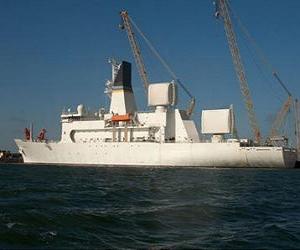
http://www.spacedaily.com/images-lg/cobra-judy-replacement-program-x-s-band-antenna-usns-howard-o-lorenzen-t-agm-25-lg.jpg

source spacedaily.com


January 13, 2012 Naval Sea Systems Command Office of Corporate Communications - defpro.com


CORPUS CHRISTI, Texas | The U.S. Navy accepted the delivery of missile range instrumentation ship USNS Howard O. Lorenzen (T-AGM 25) Jan. 10.


Constructed by VT Halter Marine in Pascagoula, Miss., T-AGM 25 will be the replacement for the existing USNS Observation Island, which was launched in 1953. The ship will provide worldwide, high-quality, dual-band radar data in support of ballistic missile treaty verification.


"This ship brings critical new technology to the fleet in an innovative design," said Frank McCarthey, the Auxiliary Ships, Small Boats, and Craft program manager for the Navy's Program Executive Office (PEO) Ships. "She is a well-built ship; we expect the USNS Howard O. Lorenzen to perform well."


Accepting delivery of this ship represents the official transfer of T-AGM 25 from the shipbuilder to the Navy and is a major milestone in the ship's transition to operational status. The ship was christened in June 2010 by the ship's sponsor, Susan Lorenzen Black, daughter of ship's namesake, the late Dr. Howard O. Lorenzen, a distinguished Naval Research Laboratory scientist.


Ship delivery follows completion of acceptance trials in November 2011. The ship is currently at Kiewit Offshore Services in Corpus Christi, Texas, for planned radar installation, integration, and testing. The government-provided communications suite is complete.


The 12,575-ton, 534-foot ship is crewed and operated by Military Sealift Command. Currently crewed by civil service mariners, Lorenzen is expected to transition to a crew of commercial mariners working for private companies under contract to MSC when the ship achieves initial operational capability in 2013.


As one of the Defense Department's largest acquisition organizations, PEO Ships is responsible for executing the development and procurement of all destroyers, amphibious ships, special mission and support ships, and special warfare craft. Delivering high-quality war fighting assets - while balancing affordability and capability - are key to supporting the Navy's Maritime Strategy.

Partager cet article
Repost0
13 janvier 2012 5 13 /01 /janvier /2012 13:05

http://www.spxdaily.com/images-lg/mk54-lightweight-torpedo-lg.jpg


Argon ST is the sole contractor for the design, development

and manufacturing of the passive, electro-acoustic decoy system,

which is used as a countermeasure against acoustic homing torpedoes.

Jan 13, 2012 Spacewar.com (SPX)

Fairfax VA - Boeing subsidiary Argon ST has received a $14.8 million follow-on award under its contract for the U.S. Navy's Surface Ship Torpedo Defense (SSTD) program. The firm, fixed-price agreement provides continuous production and delivery of new SSTD systems, as well as optional cost-plus-fixed-fee enhancements to existing SSTD systems, over a period of five years.

"The Navy has relied on Argon ST for advanced signals intelligence and countermeasure systems for almost a decade," said Joe Carlin, Argon ST vice president.

"We are committed to upgrading current systems and developing the next generation of SSTD in order to protect sailors and Marines and help them complete their missions."

Argon ST won its original contract for the AN/SLQ-25C system - commonly called "Nixie" - from the U.S. Naval Sea Systems Command in 2006.

Argon ST is the sole contractor for the design, development and manufacturing of the passive, electro-acoustic decoy system, which is used as a countermeasure against acoustic homing torpedoes.

Work on the new systems and the enhancements will be done primarily at Argon ST's facilities in Lemont Furnace and Smithfield, Pa.

Partager cet article
Repost0
13 janvier 2012 5 13 /01 /janvier /2012 12:45

B-1B_over_the_pacific_ocean-photo-USAF.jpg

January 13, 2012 Kate Blais / 95th Air Base Wing Public Affairs / AFNS – defpro.com

EDWARDS AFB, Calif. | A U.S. Air Force developmental test team here partnered with an operational test team from Texas to accelerate testing and deliver to the warfighter B-1B Lancers that can find and strike moving targets in close-air support of ground troops even quicker than before.

Merging developmental and operational testing to consolidate resources on a compressed timeline, members of the 419th Flight Test Squardon and Global Power Bomber Combined Test Force and the 337th Test and Evaluation Squadron from Dyess Air Force Base, Texas, worked to ensure the B-1 upgrade was ready for combat operations by January.

The members of the 419th FLTS and 337th TES conducted a series of tests that culminated Nov. 15, completing Laptop Controlled Targeting Pod Phase II.

"During Operation Iraqi Freedom and Operation Enduring Freedom, it became clear that the B-1 needed an additional capability to support close-air support scenarios," said Christina Ryskey, the project lead engineer and B-1 targeting pod engineer at the 419th Flight Test Squadron and Bomber Combined Test Force.

That capability came in the form of Laptop Targeting Pod Phase I.

"The first phase integrated a targeting pod, but still required the weapons system operator to manually enter any coordinates derived from the targeting pod," said Maj. David Marten, the B-1 flight commander and project pilot at the 419th FLTS. "This only allowed the pod to be useful on stationary targets."

Although Phase I allowed the B-1 to interface with the targeting pod, it proved to be a limited capability, as there was no hand-off of information from the pod back to the airplane. Although coordinates were derived from the pod, manually entering the data increased time and decreased the B-1's ability to strike a moving target.

The solution, LCTP Phase II.

"Now with the second phase, we not only have the ability to complete the loop of the targeting pod, but also include the ability to drop laser targeted bombs from the B-1," said Lt. Col. Hans Miller, the 419th FLTS commander and Bomber Combined Test Force director. "So not only can I track and identify the targets on the ground, I can strike ground targets moving at low and high speeds. That is a crucial capability that we have with this upgrade."

A completed communication loop between the plane and the targeting pod, which allows for direct importation of coordinates, shortens the kill chain, which is a significant increase to capability in the field, said Marten.

"Guys on the ground calling for air support will get their bombs faster and with more precision," he said.

"If we're told that there's a target in the vicinity, via ground troops, I can visually acquire with the pod, get exact location, directly import that information into the weapon system and attack it," said Maj. Michael Jungquist, the 419th FLTS project weapons system officer. "The targeting pod tells the weapon exactly where to go and can refine the target with lasers in the pod. I'll be able to put weapons on a target, even if it wasn't where it was when I first started looking at it."

LCTP Phase II's self-lasing capability allows the B-1 to track targets, constantly update its coordinates and employ GBU-54 Laser Joint Direct Attack Munition.

"With Phase II, the B-1 gets as much precision as any close air support player, but now combined with global reach, large payload and long loiter time provided by a strategic bomber," Marten said.

In addition to favorable test results and upgraded capabilities, the planning and execution of the testing were important pieces to the puzzle because the time between test commencement to operational delivery was only 8 months.

"Another huge success of the November test was that it was a great example of integrated operational and developmental test," Miller said. "We worked on a compressed timeline and despite some issues that were found in a test, and corrections that were presented and fixed, we were able to still meet that fielding recommendation and deployment timeline so that this can get to the fight and be useable for combat crews going out next deployment."

Checking into the fight this January is a B-1 with more capabilities to support the joint service effort.

"We had a timeline to meet in order to better support troops on the ground," Jungquist said, "and we're making that happen."

Partager cet article
Repost0
13 janvier 2012 5 13 /01 /janvier /2012 12:35

le-vbci-en-vallee-de-tagab-10-photo-MinDef-FR.jpg

photo ministère de la Défense

January 12, 2012. David Pugliese - Defence Watch

Defence Watch has been told that Nexter is hoping to bring together Canadian suppliers in the near future for its Close Combat Vehicle bid. Having as many Canadian suppliers on board a project/bid obviously helps a firm’s chances of winning the contract. The supplier’s day is set for Jan. 31 in Ottawa at this point.

In this case, the suppliers would be looking at supplying Nexter on its other projects since the wheeled VBCI vehicle that it is offering in the CCV program is an off-the-shelf system and it is likely too late to bring on new firms to contribute substantial components.


le-vbci-en-vallee-de-tagab-11-photo-MinDef-FR.jpg

photo Ministère de la Défense


The VBCI combat vehicle has been deployed in Lebanon by the French Army since September and they have noted they are happy with its performance. Thirteen VBCI armored infantry fighting vehicles were sent there. The VBCI has also been deployed since June 2010 in Afghanistan.

The Canadian Forces want to acquire 108 CCVs with an option for up to 30 more. The contract was scheduled to be awarded by the summer 2011 with initial operational capability (IOC) declared one in July 2012, according to DND. Those milestones are now redundant.

The Canadian Forces sees the CCV as bridging the gap between light armoured vehicles (five to 20 tonnes) and heavy armoured vehicles (more than 45 tonnes), coming in between 25 and 45 tonnes. The CCV will allow infantry to operate in support of the Leopard 2 tanks, providing the Army with a more balanced and integrated fleet, the Canadian Forces has stated in a background information sheet on the project.

Partager cet article
Repost0
13 janvier 2012 5 13 /01 /janvier /2012 08:50

Canadian Forces emblem

11 janvier 2012 Martin Croteau - La Presse

(Ottawa) Le vol de matériel militaire qui devait transiter par le port de Montréal ne présente aucun risque pour la population de la métropole, a assuré la Défense nationale, mercredi.

Les Forces armées ont terminé leur mission de combat en Afghanistan l'an dernier, mais le matériel qu'elles utilisaient là-bas prend des mois à rapatrier. Des dizaines de conteneurs doivent être acheminés par bateau et, pour ce faire, ils doivent transiter par le Pakistan.

Or, a révélé CBC, plusieurs conteneurs sont arrivés au port de Montréal remplis de sable et de pierres au lieu d'équipement militaire, comme pour simuler le poids du matériel qui devait s'y trouver.

Questionnée à savoir si cette situation présentait un risque pour la population de Montréal, la Défense nationale s'est montrée rassurante.

«Dans ces expéditions, il n'y a aucun équipement militaire explosif, a dit la colonel Anne-Marie Tardif, dont la division supervise l'opération de transport. Cet équipement été rapatrié par voie aérienne et maritime au Canada, mais pas à Montréal.»

La Défense, qui a lancé une enquête, n'a fourni aucun détail sur les circonstances des vols. Elle n'est pas non plus en mesure de préciser la quantité d'équipement qui a été dérobée ni la valeur de la marchandise.

La société montréalaise A.J. Maritime assure le transport par bateau du matériel militaire en Afghanistan depuis six ans. Et c'est le premier incident du genre à survenir, a indiqué à La Presse la présidente de l'entreprise, Alda Rodrigues.

Mais ces vols ne sont pas surprenants, précise-t-elle, car la région que devait traverser la cargaison avant qu'elle soit embarquée sur des bateaux est pauvre et instable.

«Entre Al-Qaeda, les Talibans et les bandits professionnels, il n'y a pas grand-chose qu'on puisse y faire, a-t-elle indiqué. Ça rappelle la mafia. Ils doivent avoir un système organisé là-bas.»

Elle précise que le matériel qu'elle devait transporter n'était pas considéré comme sensible. Le transporte lui-même a été effectué par un sous-traitant qu'elle a préféré ne pas nommer parce qu'une enquête est en cours.

A.J. Maritime n'en est pas à ses premières armes dans le transport de matériel militaire dans des zones sensibles. Elle a notamment oeuvré au Rwanda, en Croatie et à Haïti.

Partager cet article
Repost0
13 janvier 2012 5 13 /01 /janvier /2012 08:50

http://www.meretmarine.com/objets/500/40850.jpg
Lancement du LCS 4, futur USS Coronado
crédits : AUSTAL

13/01/2012 MER et MARINE


Le chantier Austal de Mobile, dans l'Alabama, a procédé le 9 janvier au lacement du LCS 4, futur USS Coronado. Il s'agit du quatrième Littoral Combat Ship de l'US Navy et du second modèle adoptant le design développé par General Dynamics et Austal. Le premier de cette série, l'USS Independence (LCS 2), a été livré à la marine américaine en décembre 2009.


Les LCS 2 et LCS 4 sont des trimarans en aluminium de 127.2 mètres de long affichant un déplacement de 3500 tonnes en charge. Pouvant atteindre la vitesse de 50 noeuds, ils disposent d'un hangar pour deux hélicoptères, un canon de 57mm et un système surface-air RAM. Pour le moment, 11 bâtiments de ce type ont été commandés.
Un autre concept de LCS, développé par Lockheed Martin et réalisé aux chantiers FMG de Marinette, dans le Wisconsin, a également été commandé à 11 exemplaires. Le premier, l'USS Freedom (LCS 1) a été livré en 2009 et le second, l'USS Fort Worth (LCS 3) est actuellement en essais.


En tout, la marine américaine compte se doter de 55 LCS, tous modèles confondus.


Le LCS 4 (© : AUSTAL)


Le LCS 2 (© : GENERAL DYNAMICS)

Partager cet article
Repost0
13 janvier 2012 5 13 /01 /janvier /2012 08:35

http://www.shephardmedia.com/static/images/article/AEWE_2.jpg

12 January 2012 - by the Shephard News Team

Raytheon’s Mobile Ad hoc Interoperability Network GATEway (MAINGATE) radio system has successfully demonstrated tactical networking capabilities during US Army exercises, providing soldiers with reliable battlefield information.

The system was used during the Expeditionary Warrior Experiment (AEWE) at Fort Benning, the system provided the backbone for wideband networking; and performed as an alternative to the cancelled Ground Mobile Radio program during the Network Integration Evaluation (NIE) at Fort Bliss, Texas, simultaneously providing multiple channels of real-time video, situational awareness, chat and other applications.

According to a Raytheon press release, during the exercises, soldiers at the squad level reliably received multiple unmanned aerial vehicle (UAV) video feeds and other high-bandwidth data services from the battalion to the tactical edge. MAINGATE provided needed capacity for reliable connectivity among cellular networks, hand-held radios and the Warfighter Information Network - Tactical (WIN-T) system. It also allowed soldiers to integrate information across battle command systems and sensors.

MAINGATE is comprised of a high-throughput radio that uses the Next Generation Mobile Ad Hoc Networking Waveform and a gateway that enables seamless battlefield connectivity. MAINGATE is a mature, off-the-shelf system in production today, with more than 100 units currently deployed in theatre. The non-proprietary waveform provided 10 times more network capacity and supported four times more nodes than competing radios at the NIE. And, it exceeds wideband networking requirements in the upcoming Mid-Tier Networking Vehicular Radio solicitation.

Partager cet article
Repost0
13 janvier 2012 5 13 /01 /janvier /2012 08:20

Sikorsky_S-97-source-Defensetech.jpg

January 12th, 2012 DEFENSETECH

Sikorsky executives today explained their strategy for moving their S-97 Raider coaxial rotor design forward in the Army’s armed aerial scout contest despite the fact that their design isn’t flying yet.

“We’re developing two prototype aircraft with the purpose of demonstrating this type of capability with the target of hitting the armed aerial scout,” said Doug Shidler, Sikorsky’s Raider program manager, when I asked him today how the company planned to effectively bid on the armed aerial scout contest with their unbuilt chopper at a press conference where Shidler was announcing the Raider’s 35 supplier companies.

“There aren’t any requirements out there yet for the armed aerial scout but what we’re trying to do is demonstrate that with new technology you can provide a great deal more capability to the Army versus extending the current fleet that has capabilities that have existed for many, many years,” said Shidler.

Keep in mind that the Army seems to largely be interested in developing an existing airframe into a new scout chopper.

Steve Engebretson, Sikorsky’s man in charge of winning the scout contest then added his two cents when I asked how the company can compete for the scout contract if it doesn’t have a prototype that can fly in this spring’s scout chopper demo.

“We have been told that everyone who was considered in the [Army’s analysis of alternatives for replacing the Kiowa Warrior chopper fleet] will have the opportunity to respond to the RfI we were one of the products included in the AoA,” said Engebretson. “The airplanes that fly [in the demo], and this is my understanding of what the Army is looking for, will be evaluated to see whether there is an existing capability good enough to meet the next AAS requirement. The other products, like ours, that were also evaluated in the AoA will get to come in and show off where our technology is, what we’re gonna cost, what our timeline looks like and how viable we are. We’ve got a ton of data, we’ve got 35 companies building hardware, we think we’re gonna be in a very good position to demonstrate the fact that we’ll provide a capability that will outdo anything that exists today at a timeline that will still meet the Army’s requirements.”

The S-97 is designed to be able to fly at 250 knots and turn in half the radius of current helos. The first flight of the Sikorsky’s demonstrator choppers is set for 2014. If the company is awarded a contract to build scout helos, it can begin production around 2021 and start fielding the choppers around 2025.

Engebretson went on to say that the coaxial technology upon which the Raider is based has already been proven, by Sikorsky’s record breaking X2 chopper and a number of existing tech that is being designed for use on the Raider.

“This is a fairly mature level of technology, it’s a new design, it’s next generation capability but it’s not a high-risk type of approach,” said Engebretson. “We’re going to demonstrate it to show that it’s an achievable in the timeline that’s there for the military requirements and that it’s going to be affordable as well.”

He also revealed that the Raider is one of the four technologies Sikorsky is considering offering up for the Pentagon’s next generation Joint Multirole Helo effort. He wouldn’t say what the other three technologies are.

Partager cet article
Repost0
13 janvier 2012 5 13 /01 /janvier /2012 08:00

F-35A-Lightning-II-flying-usaf.jpg

photo USAF

January 12th, 2012 By Lockheed Martin, DEFENCE TALK

The Lockheed Martin F-35 System Development and Demonstration 2011 flight test program resulted in the completion of more test flights and test points than in any year.

The 2011 flight test plan called for the accumulation of 872 flights and 6,622 test points by Dec. 31. For the year, the SDD program flew 972 flights and tallied 7,823 test points. The F-35A Conventional Takeoff and Landing (CTOL) variant flew 474 flights and accomplished 3,600 test points. The F-35B Short Takeoff/Vertical Landing (STOVL) variant accomplished 333 flights and 2,636 test points. The F-35C Carrier Variant (CV) flew 165 flights and tallied 1,587 test points. Along with this, the STOVL executed 268 vertical landings. The cumulative 2011 milestones were achieved through a combination of planned test flights and test points along with test flights and test points added throughout the year.

“The success of the flight test program is the result of a team of dedicated government and contractor professionals,” said Larry Lawson, Lockheed Martin’s F-35 program executive vice president and general manager. “The test team continues to gain momentum and they will build upon this success for an even better 2012. I couldn’t be prouder of the team.”

The overall F-35 SDD flight test program plan calls for the verification of 59,585 test points through developmental test flights by Dec. 31, 2016. Through 2011, the flight test team has accomplished 12,728 test points or 21.4 percent of overall testing requirements.

“These achievements speak to the rapid maturation of the F-35 program and to our team’s commitment to performing with excellence,” said J.D. McFarlan, vice president of F-35 Test and Verification. “We will now turn towards 2012, expanding the flight envelope as we continue to demonstrate the F-35’s excellent flight characteristics for all three variants.”


Major flight test achievements in 2011 include:

-    A major highlight for October was the completion of F-35B short takeoff/vertical landing (STOVL) ship suitability testing aboard the USS WASP (LHD-1) off the coast of Virginia. The test began when BF-2 executed the first shipboard vertical landing on Oct. 3. The next day, BF-2 executed the first short takeoff from the WASP. During the third week of sea trials, BF-2 and BF-4 operated simultaneously on the ship. Combined, they accomplished 72 short takeoffs and 72 vertical landings during the three-week testing period.
-    The mission systems test aircraft performed Block 1A and Block 1B software testing including demonstrating Communication Navigation and Identification (CNI) range and accuracy and integrated Electro-Optical Targeting System testing that included Tactical FLIR (Forward Looking Infra-Red) and combat laser firing. The software also displayed imagery from the Distributed Aperture System on the Helmet Mounted Display. Further testing accomplished radar search and target tracking, Synthetic Aperture Radar Mapping, Electronic Warfare testing, and multi-sensor fusion of four sensors. In addition, baseline Radar Cross Section signature testing was accomplished on three mission system aircraft.
-    On Nov. 18, CF-3, an F-35C test aircraft, conducted the first F-35 launch from the Navy’s new Electromagnetic Aircraft Launch System (EMALS). Testing the F-35C on EMALS marked the beginning of the process to integrate the carrier variant with the future carrier fleet aircraft launching system.
-    The F-35B STOVL jets conducted 268 vertical landings (VLs) in 2011 compared to 10 VLs in 2010. F-35B aircraft also completed 395 short takeoffs (STOs) this year.
-    AF-1 achieved the F-35’s maximum design limit speed of Mach 1.6 for the first time on Oct. 25.
-    Jet Blast Deflector (JBD) testing was performed by F-35C Lightning II carrier variant (CV) aircraft CF-2 at Joint Base McGuire-Dix-Lakehurst, N.J. from June 25-July 8. CF-2 successfully completed this portion of tests required to ensure the F-35C is compatible aboard an aircraft carrier.
 -   AF-6 and AF-7 completed Maturity Flight testing of the training syllabus software at Edwards Air Force Base, Calif., designed to simulate operating an F-35 without a mission control room.
 -   The F-35 program successfully performed aerial refueling testing with KC-135 and KC-10 aircraft.

Partager cet article
Repost0
12 janvier 2012 4 12 /01 /janvier /2012 18:15

Usaf.u2

DULLES, Va., Jan. 12, 2012 /PRNewswire

Raytheon to perform on-site operations, maintenance and training support for U-2 sensors, data links and Air Force DCGS

Raytheon Company  has been awarded a $179.5 million follow-on contract by the U.S. Air Force to provide Contractor Field Service (CFS) support for U-2 sensors, data links and the Air Force Distributed Common Ground System (DCGS). Raytheon has been prime on the CFS program providing support to the warfighter since the original contract was awarded in 1999.

"This contract allows us to provide more than 500 field engineers, supporting around-the-clock worldwide operations across 27 locations," said Raymond Kolibaba, vice president of Defense and Civil Mission Solutions for Raytheon's Intelligence and Information Systems business. "The program includes pre-flight system checks, mission support during flight and post-mission problem analysis."

Under the terms of the contract, Raytheon will provide support at the Air National Guard and Predator Operations Center, Air Force Flight Test Facility, Consolidated Remote Operations-Facility Airborne and DGS-X Test-bed Facility. The U-2 CFS contract also calls for Raytheon engineers and technicians to perform other services, such as training.

Raytheon is also the prime contractor for the Air Force DCGS contract. DCGS is a worldwide distributed, network centric, system-of-systems architecture that conducts collaborative intelligence operations. DCGS provides both physical and electronic distribution of intelligence, surveillance and reconnaissance data.

Partager cet article
Repost0
12 janvier 2012 4 12 /01 /janvier /2012 17:45

F35

Jan. 12, 2012 defense-aerospace.com
(Source: Fort Worth Star-Telegram; posted Jan. 11, 2012)

Top weapons acquisition officials in the Pentagon will meet next week to hold the first of two planned reviews on restructuring the F-35 Joint Strike Fighter program and setting new procurement and budget plans, according to a report by InsideDefense.com.

The on-line publication says the reviews will lead to a new cost estimate for the overall program, one which may be significantly higher than the existing $382 billion estimate for research, development and production of the 2,400-plus jets the U.S. military plans to buy.

Cost increases will be driven by continuing development delays, reductions in planned procurement due to the development delays and requirements to fix problems found in development in already produced airplanes. The Pentagon is already reported planning to cut production by 120 planes over the next five years to free up funds for continued development, the fixes and to cope with looming defense budget cuts.

Acting Pentagon weapons acquisition executive Frank Kendall will lead a meeting of the Defense Acquisition Board on Jan. 17, which InsideDefense says will be followed by a late February gathering of the same body.

"Together, these meetings are designed to reset the F-35 program after it breached “critical” cost thresholds in 2010, running afoul of a law designed to flag acquisition efforts with management and cost problems."

Partager cet article
Repost0
12 janvier 2012 4 12 /01 /janvier /2012 17:40

Littoral-Combat-Ship--Coronado---LCS-4--Austal-photo.jpg


Carried by a self-propelled transporter, the fourth Littoral Combat Ship

emerges from its final assembly building before being lowered into a

drydock for its “launch.” (Austal photo)

Jan. 12, 2012 defense-aerospace.com
 Source: Austal; issued January 12, 2012)

On January 10, 2012, Austal’s Mobile, Alabama shipyard completed the launch of the second 127-metre Independence-Variant Littoral Combat Ship, “Coronado” (LCS 4).

The roll-out marked Austal’s second use of an innovative self-propelled modular transporter system to transfer the ship from the yard’s final assembly bay onto a drydock for launch. This system was first used a few months ago, in September 2011, to successfully launch USNS “Spearhead” (JHSV 1).

Austal and the US Navy collaborated in the design of a new set of keel stands to support the ship during construction and facilitate the transition from the assembly bay. Austal’s own self-propelled modular transporters (SPMTs) supplemented those of Berard Transportation of New Iberia, LA, to provide a total of 3,800 tons lift capacity, on some 104 axle lines.

In a three-step process, SPMTs lifted the entire ship and keel stands lifted the Coronado almost three feet and moved the Littoral Combat Ship into the moored dry dock. Supporting close to 2,000 tons, the SPMT operators; aided by tug captains; the dock master and the Austal launch master manoeuvred “Coronado” aboard the dry dock in an incident-free operation.

A major improvement in safety and efficiency, the new roll-out method has shaved hours off the transfer process, and serves as a capstone in Austal’s effort to reduce cost and time required in future LCS deliveries.

The LCS and dry dock were then transported down river by tug to BAE Systems Southeast Shipyard, Mobile, where the ship was ultimately floated free of the keel stands, and was manoeuvred from the drydock. The vessel was then towed back upriver to Austal’s facility, where it will undergo final outfitting and activation before sea trials and delivery to the US Navy.

The 127-metre Austal trimaran seaframe is the platform for the LCS’s mission and weapon systems. This seaframe provides superior seakeeping and aviation as a result of its long, slender central hull and smaller side hulls (“amahs”). The trimaran hullform provides a large internal mission deck with a high payload carrying capacity. Located above the mission bay is the enormous flight deck capable of conducting dual H-60 helicopter operations. The vertical location of the flight deck on the trimaran hull form provides the highest flight deck elevation on a combatant ship other than a major amphibious vessel or aircraft carrier.

The launch of “Coronado” (LCS 4) closely follows the christening of the 103-metre USNS “Spearhead” (JHSV 1) and the celebration of the keel laying ceremony for “Choctaw County” (JHSV 2). Modular construction has also begun on JHSV 3 and “Jackson” (LCS 6) – the first of the 10-ship US Navy contract awarded to Austal, as the prime contractor, a year ago - in Austal’s 65,000 square metre Module Manufacturing Facility (MMF). Austal also has “Montgomery” (LCS 8) and JHSV 3 through JHSV 7 under contract.

For the LCS and JHSV programs, Austal is working in a partnership with General Dynamics Advanced Information Systems, a business unit of General Dynamics. As the ship systems integrator, General Dynamics is responsible for the design, integration and testing of the ship’s electronic systems including the combat system, networks, and seaframe control. General Dynamics’ proven open architecture approach provides affordable capabilities to the fleet quickly and efficiently.

Austal employs over 2,100 highly qualified shipbuilders, engineers and support staff in the United States and is steadily growing towards 4,000 employees.

Partager cet article
Repost0
12 janvier 2012 4 12 /01 /janvier /2012 13:15

Predator-B-MQ-9-Reaper-photo-General-Atomics-Aeronautical-S.jpg

12 January 2012 - by the Shephard News Team

General Atomics Aeronautical Systems (GA ASI) has unveiled a new trailing arm design for the existing main landing gear on its Predator B/MQ-9 Reaper UAV. According to a company statement, the design will be included in Block 5 aircraft, and will enhance and extend the UAV’s utility.

GA-ASI said the enhanced landing gear is available as a field retrofit to all Predator B/MQ-9 customers upon request. Reliability and performance improvements will include 30%+ increase in landing weight capacity, at the full Federal Aviation Regulation (FAR) descent rate of 10 ft per second; growth path to increase gross takeoff weight by approximately 12% (10,500 lb vs. 11,700 lb); maintenance-free shock absorber, nitrogen pressurization not required; and full rejected takeoff brake system at growth maximum weight of 11,700 lb. It also includes provisions for automatic takeoff and landing capability and Anti-lock Brake System (ABS) field upgrades

According to the company, the new landing gear successfully underwent full qualification, fatigue testing, and flight testing in January 2011. The flight test programme included fully instrumented loads validation, taxi testing, landings at a variety of weights and sink rates, and in-flight gear-swings. Only one minor revision to the original design was required following testing, which was a tribute to the success of the initial design effort.

Partager cet article
Repost0
12 janvier 2012 4 12 /01 /janvier /2012 13:00

http://cdn.defencetalk.com/wp-content/themes/dStyle165/scripts/timthumb.php?src=http://cdn.defencetalk.com/wp-content/uploads/2012/01/AH-64D-apache-sixth-guard.jpg&w=365&h=245&zc=1

January 12th, 2012 By Army News Service, DEFENCE TALK

The Missouri National Guard's 1-135th Attack Reconnaissance Battalion began the new year last week with a roll-out ceremony that officially transitioned the battalion to an AH-64D Apache Longbow unit.

The battalion, overseen by the 35th Combat Aviation Brigade, or CAB, in Sedalia, has a rich history as an Army Aviation Battalion within the Missouri National Guard. The battalion has flown the UH-1 "Huey" Iroquois, OH-58A/C Kiowa Warrior and the AH-1 Cobra.

In 1999, the battalion was designated as one of eight National Guard battalions to receive the AH-64A Apache. In 2002, the first AH-64A helicopter arrived at Whiteman Air Force Base. In August 2009, the National Guard Bureau designated the battalion as the sixth Army National Guard Longbow battalion and began fielding it with aircraft in October 2011.

"What a great day for the Attack Battalion and for the CAB as a whole," said Maj. Gen. Stephen L. Danner, adjutant general of the Missouri National Guard. He continued that he looks forward to a great long history with the Longbow aircraft in a great new building on a premiere Active Duty base.

Col. Shane Openshaw, U.S. Army Apache Program manager, said it was hard to believe that three years ago, this battalion had no plan, no money and no direction where it was going from the A Model Apaches.

"Team Apache is strong today, but it's getting stronger tomorrow," Openshaw said.

Mike Burke, director of business development for Boeing's Attack Helicopter Program, echoed Danner and Openshaw on how important the day was for both Boeing in Mesa, Ariz., and for the Missouri National Guard.

During the ceremony, the tradition of exchanging the AH-64D logbook signifies the transfer of the aircraft. David Koopersmith, vice president of Boeing's Attack Helicopter Program, presented Openshaw with the logbook. Openshaw passed it onto Danner. Danner passed it onto the 35th Combat Aviation Brigade's Commander Col. Mark McLemore with the logbook ending in the hands of Lt. Col. James Schreffler, 1-135th Attack Reconnaissance Battalion commander.

Schreffler then tossed the key to Lt. Col. Thomas Burson, Army Aviation Support Facility commander, as the manager of the flying hour program and maintenance of the aircraft.

"We have kicked off this year by breaking in our new aircraft, and beginning the progression program for our aircrews," Schreffler said.

Schreffler told Brig. Gen. Scott Vanderhamm, Whiteman Air Force Base commander, "I'm sure you have appreciated the sound of helicopter rotors over Whiteman again after somewhat of a lull in activity as we turned in our dated Alpha model aircraft."

The last A Model Apache aircraft left Whiteman Air Force Base Jan. 10. The battalion is on schedule to receive the remainder of the new D Model aircraft by this spring.

Boeing presented Danner with an Apache model and Schreffler with a framed photo of the first three Apache Longbows delivered to Boeing in Mesa, Ariz., prior to coming to Whiteman Air Force Base.

Concluding the ceremony, the spouses of current and former 1-135th Attack Reconnaissance commanders christened the first Longbow, a tradition continued by the aviation community to protect their aviators as they bravely meet the challenges faced daily in the unforgiving sky.

Partager cet article
Repost0

Présentation

  • : RP Defense
  • : Web review defence industry - Revue du web industrie de défense - company information - news in France, Europe and elsewhere ...
  • Contact

Recherche

Articles Récents

Categories