Overblog Tous les blogs Top blogs Entreprises & Marques Tous les blogs Entreprises & Marques
Suivre ce blog Administration + Créer mon blog
MENU
31 octobre 2013 4 31 /10 /octobre /2013 18:35
Adding More Tools to Counter-Improvised Explosive Device Toolbox


Oct 30, 2013 ASDNews Source : US Army


For years, route clearance patrols have helped keep the streets of Afghanistan safe from improvised explosive devices. U.S. Army combat engineers scour the country every day looking for IEDs, not just to ensure safe travel for military convoys, but also to protect the Afghan citizens who use the roads as well.


But the day of the route clearance patrol has come to an end.


In the continuing effort to increase operational effectiveness, route clearance patrol across Afghanistan are being reborn as combined-arms route clearance operations, or CARCOs.


Read more

Partager cet article
Repost0
30 octobre 2013 3 30 /10 /octobre /2013 18:20
DARPA developing single-piece aluminium hull for "IED-proof" armoured vehicle


10/22/2013 Andrew Elwell - defenceiq.com


DARPA is experimenting with new designs to create a new generation of “ IED-proof ” armoured vehicles. In conjunction with the U.S. Army’s Research Laboratory and, a leading producer of aluminium and fabricated parts, crew protection is hoped to be significantly improved by designing a. No welds, no weak points, just one single fabricated piece of formed aluminium.


In addition to the performance benefits, it’s thought an aluminium hull would be lighter and thinner than traditional steel hulls used for armoured vehicles.


"For decades, the Army has recognised the survivability benefits of a single-piece hull due to its thickness, size and shape for ground combat vehicles," said Dr. Ernest Chin of the Army Research Laboratory in a statement. "Our collaborative effort to develop continuous and seamless aluminium hull technology has the potential to be a game changer for how combat vehicles are designed and made to better protect our soldiers."


“Alcoa has helped the U.S. military stay ahead of emerging threats by innovating durable, lightweight aluminium technologies since World War I,” said Ray Kilmer, Alcoa Executive Vice President and Chief Technology Officer. “Our experts are now developing the world's largest, high-strength aluminium hull for combat vehicles to better defend against IEDs, the greatest threat our troops face in Afghanistan, while meeting the Army's affordability needs.”


The UK has already mass produced an armoured vehicle with an innovative hull design – the Foxhound. Rather than aluminium, a combination of advanced, lightweight composites are used to provide structural integrity, protection and lightweight performance. The composite pod has a V-shaped hull to help deflect the blast wave in the event of an IED explosion. The UK MoD has high hopes for the export potential of Foxhound, indicating that composite and, presumably, single-piece hull designs are both achievable and desirable.


With Alcoa also developing a single-form bulkhead for the new F-35 joint Strike Fighter, the company is well placed to work with the US military in the development of aluminium components. The real question is if aluminium is the right material to be working with. Composites are stronger, lighter and thinner than most metals, shouldn’t that be the focus of the DARPA’s efforts for future armoured vehicle design?

Partager cet article
Repost0
29 octobre 2013 2 29 /10 /octobre /2013 18:35
Afghanistan : le général Taprest accueille la relève PAMIR du contingent français

19/10/2013 Sources : EMA


Le 12 octobre 2013, le général de brigade aérienne Olivier TAPREST commandant l’aéroport de Kaboul (KAIA) et les forces françaises en Afghanistan, a réuni l’ensemble du dispositif français stationné en Afghanistan pour saluer l’arrivée du nouveau contingent français PAMIR.


Le général de brigade aérienne Olivier Taprest a rappelé que le succès de l’opération PAMIR depuis son lancement reposait sur la rigueur, la responsabilité et l’enthousiasme de tous.


Le colonel Daniel Jaunin, adjoint au général commandant la 6e Brigade légère blindée (6e BLB), a pris la fonction d’adjoint pour le contingent français, au général de brigade aérienne Olivier Taprest. A l’instar de son prédécesseur le colonel Olivier Meriau, il devra veiller au bon déroulement de la poursuite de l’engagement français au sein de l’ISAF.


500 militaires sont chargés de poursuivre l’engagement français jusqu’à la fin de la mission de l’ISAF en 2014, à travers notamment le commandement de l’aéroport de KAIA, le fonctionnement de l’hôpital médico-chirurgical militaire français de KAIA, des missions de formation au profit de l’armée nationale afghane, la participation aux fonctions d’état-major dans les structures de l’ISAF et le commandement du laboratoire européen contre-IED.

Partager cet article
Repost0
15 octobre 2013 2 15 /10 /octobre /2013 11:55
source ppe-composites.fr

source ppe-composites.fr

14.10.2013 par Frédéric Lert (FOB)


Le prix « Ingénieur général Chanson » est attribué tous les ans par l’Association de l’Armement Terrestre à des travaux ayant fait progresser le domaine de l’armement terrestre. Il a été remis cette année par la DGA à Karine Thoral-Pierre et Jérôme Raynal pour leurs travaux sur les « Panneaux composites sandwich 3D absorbeurs d’énergie de forte puissance ». Respectivement PDG de la société CEDREM et directeur commercial et marketing en charge des activités de défense au sein de la société PPE (Pôle de Plasturgie de l’Est), les deux récipiendaires reviennent avec FOB sur l’innovation qui leur a valu cette récompense.


Quels étaient vos objectifs en poursuivant ces travaux ?


Nous souhaitions mettre au point un dispositif de protection contre les ondes de pression à forte énergie et contre des éclats parfois massifs, mais peu perforants comparés aux munitions classiques. En clair, nous voulions faire face à la menace posée par les explosions d’IED. Notre objectif était d’arriver à combiner les avantages suivants, ce qui correspond un peu à la recherche d’un Graal :

- ajustement du pouvoir absorbant du dispositif en fonction de la menace à prendre en compte.

- possibilité de conformation du matériau sur tous les véhicules quelle que soit leur forme.

- facilité de manutention et remplacement rapide et aisé.

- réduction de masse.


Comment se sont réparties les tâches entre vos deux PME ?


CEDREM a réalisé tous les calculs et les conceptions pour déterminer la structure optimale capable de dissiper l’énergie issue d’une explosion. PPE a participé à la conception des matériaux sandwich 3D et avait la charge de la mise en œuvre et de la fabrication des matériaux composites préalablement calculés.


Votre « B2 Box » a été récompensée. De quoi s’agit-il précisément ?


Jusqu’à présent, les fabricants de blindage se sont attachés à réaliser des structures très dures et raides. Nous avons voulu prendre le contre-pied de cet état de fait en travaillant sur une structure souple, avec la rupture du matériau programmée pour dissiper l’énergie au moment de l’impact. Notre matériau nous offre également la possibilité de prendre des courbes et de faire de la mise en forme. La « B2 Box » (Blast Balistic Box) et « BBOX » que nous avons mise  au point est un assemblage de tissus et de mousses liés par des pontages textiles entre les peaux. Ce pontage se consomme sous l’effet du souffle et donc absorbe une partie de l’énergie de l’agression. Tous les paramètres du matériau (épaisseur, densité, raideur…) sont modulables en fonction de la performance attendue et donc donner des propriétés bien déterminées à la protection.


L’idée d’avoir un matériau « mou » qui se déforme pour absorber l’énergie paraît pourtant relativement banale. Il me semble que l’industrie de l’automobile en fait un grand usage…


L’application militaire avait été insuffisamment explorée : faire face aux agressions d’une explosion, avec souffle et fragments impose d’aller plus loin dans la réflexion. Il est vrai que jusqu’à présent, les fabricants de blindages ont eu tendance à enfermer les véhicules dans des coquilles en rigidifiant à outrance. Quand on a évoqué pour la première fois auprès de la DGA le concept d’un blindage « mou » et déformant, il semble que la rupture technologique que nous proposions était trop en avance… Mais depuis nos interlocuteurs ont changé, la DGA a évolué et notre projet a été mieux reçu…


Les matériaux de base utilisés sont tout de même classiques ?


Oui, il s’agit d’alternances de tissus de verre, de mousses, de kevlar que l’on retrouve dans les blindages modernes. Notre spécificité tient à leur assemblage très particulier.


Vos sociétés ont l’habitude de travailler les matériaux composites pour la construction navale. Comment cela a-t-il influé sur vos recherches ?


Les matériaux composites mettant en œuvre des sandwich 3D sont habituellement utilisés dans la construction de renforts de coques de bateaux ou de cloisons étanches. Nous avons simplement cherché à utiliser ces mêmes matériaux mais en utilisant cette fois leur capacité à absorber de l’énergie lors de la rupture des espaceurs. Cedrem et PPE travaillent pour un grand nombre d’applications dans l’aéronautique, le naval, le sport, l’éolien… Cela nous ouvre des horizons et nous permet de confronter des idées originales.


Quelles sont les étapes qui ont précédé l’attribution du prix Chanson ?


Nous avons commencé à travailler sur notre matériau en 2010. Des tests mettant en jeu une mine avec des fragments métalliques ont eu lieu avant l’été 2012, puis nous avons été sélectionnés pour le prix en décembre 2012.


Quelles sont les principales caractéristiques de votre matériau ?


A résistance égale, nous sommes deux fois plus légers que les céramiques que nous connaissons aujourd’hui. Et les céramiques sont elles-mêmes trois fois plus légères que l’acier. Avec la B2 Box nous sommes à 50kg/m2, contre environ 300 kg/m2 pour un blindage tout acier. La B2 Box est également modulable : on peut en mettre partout en fonction de la place disponible. Bien entendu, si l’intégration se fait dès la conception d’un véhicule, le résultat obtenu est encore meilleur.


Quels résultats avez-vous obtenu pendant vos essais ?


Les essais ont montré qu’après une explosion, la déformation de la structure est très bien contenue. Une surprotection «B2Box » permet de réduire la masse de la surprotection de l’ordre de 13% par rapport aux solutions actuelles et d’autre part son épaisseur. Nous pensons qu’une optimisation plus poussée permettrait de viser une réduction de masse de l’ordre de 20%. Ce gain en masse et le coût modéré des panneaux devraient attirer l’attention des concepteurs de véhicules actuellement pas ou peu protégés (camions, engins du génie) ou de transport de troupe.


Aujourd’hui où en êtes-vous du développement de la B2 Box ?


Les concepts sont validés et nous essayons de répondre à des demandes très spécifiques pour certains industriels. Et derrière nous préparons les outillages de production pour passer à la série.


Quels sont les industriels intéressés ?


Nous avons pour l’instant un accord d’exclusivité avec Nexter Systèmes dans un domaine d’application précis et cadré. Mais cet accord est limité dans le temps et Nexter devra donc se déterminer rapidement pour savoir s’il continue l’aventure avec nous ou pas. D’autres sociétés se pressent au portillon…

Partager cet article
Repost0
14 octobre 2013 1 14 /10 /octobre /2013 19:50
Royal Dragoon Guard receives Military Cross

British troops on patrol in Jackal vehicles (library image) [Picture: Leading Airman (Photographer) Si Ethell, Crown copyright]


14 October 2013 Ministry of Defence


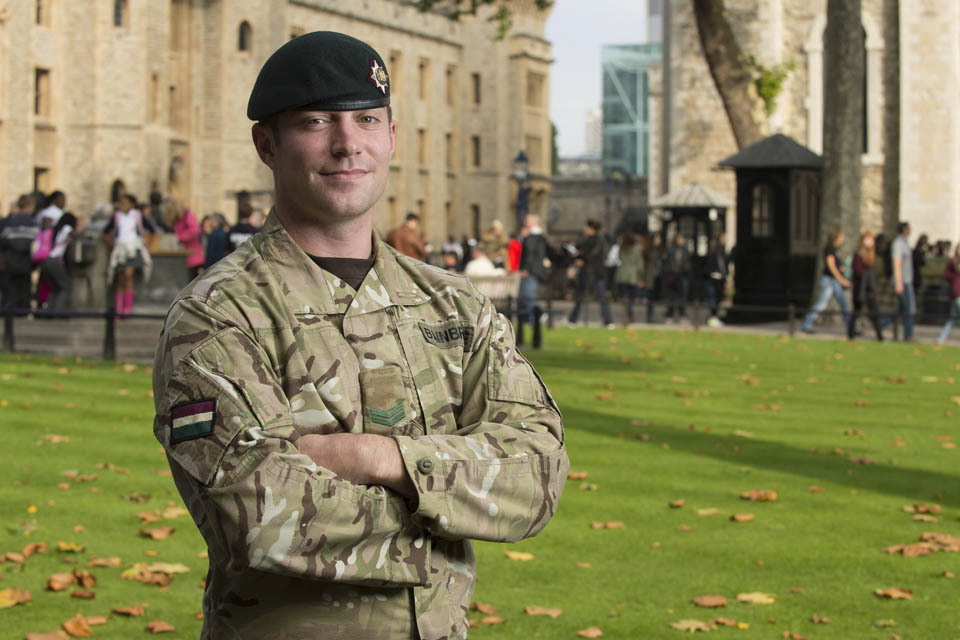
Corporal Oliver Bainbridge has been recognised for his brave actions after his patrol vehicle was hit by a roadside bomb in Afghanistan.


Corporal Bainbridge’s troop had been ordered to move into position to watch over 2 Brigade Reconnaissance Force units as they began to move towards a patrol base.

As they moved into position, the lead Jackal vehicle, of which Corporal Bainbridge was the commander, struck an improvised explosive device (IED), disabling the vehicle and engulfing it in debris and dust:

It really threw us about,” he said. “It blew the whole vehicle forward.

Corporal Bainbridge’s driver, who had a suspected broken femur, was semi-conscious and in shock. Quickly seizing control, Corporal Bainbridge conducted effective first aid before reassuring his gunner, who had been blown from the vehicle and was disorientated, and ordering him to safety.

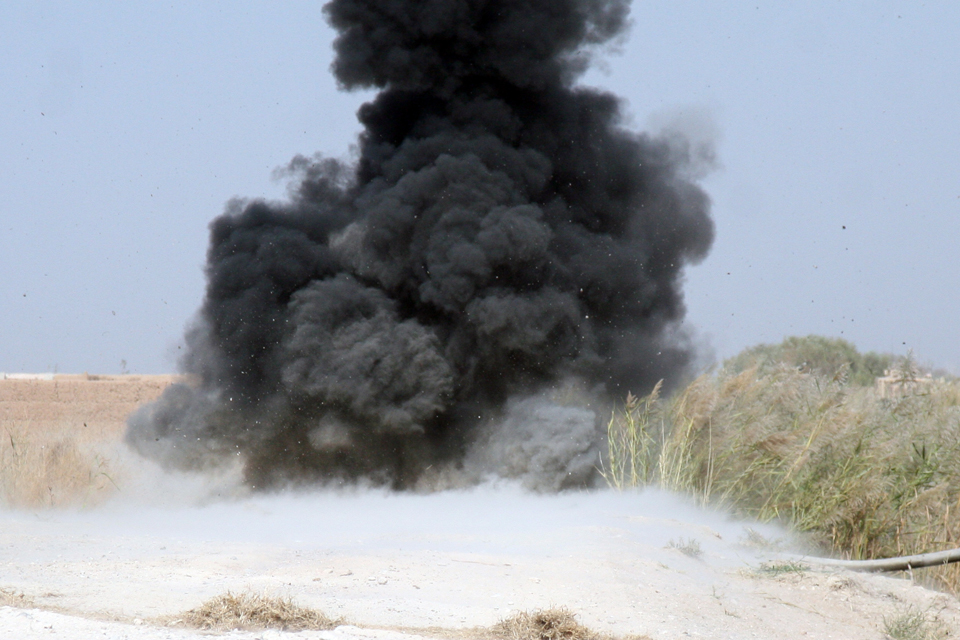
The controlled explosion of a roadside bomb
The controlled explosion of a roadside bomb in Helmand province (library image) [Picture: Crown copyright]

As a medic moved forward to assist, their position came under heavy machine gun fire. Corporal Bainbridge grabbed his injured driver, dragging him to a crater caused by the blast while simultaneously instructing the Vallon (IED detector) team and medic to seek cover.

Corporal Bainbridge lay on the driver, shielding him with his own body while exposing himself to the incoming fire for several minutes. He said:

I just wanted to protect him because he was vulnerable and couldn’t protect himself, so I had to help him.

He then took up a rifle, his own had been broken by the blast, to suppress the firing point before personally co-ordinating the extraction of his driver to the relative safety of a Warthog armoured vehicle:

At the time I just had my mind set on one thing and that was making sure there were no more casualties.

With his crew safe, and with the light fading, Corporal Bainbridge returned to his vehicle to remove all mission-essential equipment, a task that took 2 hours to complete as everything hand been bent and mangled by the blast:

I said I’d do it because the fire was so accurate and I didn’t want people standing there making a bigger target,” he said. “When I’d stripped enough equipment off to make a load I’d call guys forward to get it then they’d drag it back and wait until I’d stripped another load.

Corporal Oliver Bainbridge
Corporal Oliver Bainbridge of the Royal Dragoon Guards [Picture: Corporal Andy Reddy, Crown copyright]

Corporal Bainbridge then moved with his troop to a defensive position 100 metres north of the stricken vehicle and, at first light, he led a 3-man team back to oversee its recovery by a Warthog, under small arms fire.

Despite the risk to his own safety, Corporal Bainbridge returned for a third time to ensure nothing could be exploited by insurgents in a display of personal courage, selfless commitment and inspired leadership:

I’ve been asked why I went back, but it was my vehicle, so it was my responsibility. How can you ask somebody else to go in your place?

This action typifies Corporal Bainbridge’s character; during his military career he has been struck by IEDs on no less than 3 occasions. He said:

Seeing the damage an IED can do, it’s always in my mind. I wouldn’t say it makes you more cautious, but it means you don’t take unnecessary risks.

Corporal Bainbridge was enjoying a break at Bovington Camp when he was called in to see the Colonel:

I thought, oh no, am I in trouble?” admitted Corporal Bainbridge. “And then, when the Colonel told me I was getting an award, I was speechless for ages and then I must admit I swore, and the Colonel said ‘yeah, that would probably have been my first word too!’

Partager cet article
Repost0
20 septembre 2013 5 20 /09 /septembre /2013 22:47
Afghanistan : déclenchement du plan MASCAL

20/09/2013 Sources : EMA


Le 10 septembre 2013, en fin d’après-midi, les équipes médicales de l’hôpital militaire de l’aéroport international de Kaboul (Rôle 3 KAIA) ont déclenché le plan MASCAL (mass casualties) suite à l’explosion d’un IED (improvised explosive device) au passage d’un bus faisant plusieurs victimes civiles.


Le médecin-chef du Rôle 3 de KAIA a été prévenu de l’arrivée imminente de blessés civils suite à une demande de coopération émanant du Rôle 2 américain situé près de Ghazni, au Sud-Ouest de Kaboul, où la prise en charge a débuté.


Rapidement, l’équipe médicale a été informée du nombre de victimes, du degré de gravité des blessures ainsi que des soins qui ont déjà été administrés par le Rôle 2 américain. Après concertation avec l’anesthésiste-réanimateur de garde, le médecin-chef de l’hôpital a décidé de déclencher le plan MASCAL qui prévoit le rappel de tout le personnel de l’hôpital pour faire face à un afflux saturant de blessés.


Très rapidement, le personnel médical a regagné son poste, préparant et vérifiant son matériel. Peu de temps après, deux hélicoptères Black Hawks transportant chacun trois blessés se sont posés sur l’aéroport, à moins de 200 mètres de l’entrée des urgences où le chirurgien viscéral et le réanimateur ont effectué, ce que les médecins appellent, le triage des blessés. Les différentes équipes médicales (française, tchèque, américaine et allemande) ont ensuite rapidement évalué la gravité des blessures des différents patients et par conséquent l’ordre de passage au bloc opératoire. Une heure et demie plus tard, deux patients étaient opérés au bloc chirurgical, un autre était placé en réanimation pour être opéré dès que possible et deux autres étaient hospitalisés. Le sixième est décédé peu de temps après son arrivée au Rôle 3.


Le plan MASCAL est une procédure mise en application pour faire face à un afflux massif ou saturant de blessés. Son déclenchement relève de la responsabilité du médecin-chef du Rôle (2 ou 3). Il prend en compte non seulement le nombre de victimes annoncé mais également la gravité ou la catégorisation des blessés.


Le Rôle 3 de Kaboul est une structure multinationale sous commandement français qui se compose d’une centaine de personnes. Environ 90 militaires français arment cet hôpital, la majorité appartenant au Service de santé des armées (SSA). Cet  hôpital médico-chirurgical est capable de déployer simultanément 3 équipes chirurgicales. Ses missions sont en priorité le soutien aux forces de la FIAS (Force Internationale d’Assistance et de Sécurité), mais il peut également  accueillir du personnel des forces armées et de la police afghane. Il assure également le soutien aux différentes organisations gouvernementales et non gouvernementales, ainsi que l’aide à la population locale.


500 militaires sont chargés de poursuivre l’engagement français jusqu’à la fin de la mission de l’ISAF en 2014, à travers notamment le commandement de l’aéroport de KAIA, le fonctionnement de l’hôpital médico-chirurgical militaire français de KAIA, des missions de formation au profit de l’armée nationale afghane, la participation aux fonctions d’état-major dans les structures de l’ISAF et le commandement du laboratoire européen contre-IED.

Afghanistan : déclenchement du plan MASCAL
Partager cet article
Repost0
18 septembre 2013 3 18 /09 /septembre /2013 07:35
IED Attack Kills Senior Pakistani Officers

Sep. 17, 2013 - by USMAN ANSARI  - Defense News


ISLAMABAD — Two senior Pakistani army officers were among those killed in a weekend IED attack claimed by the Pakistani Taliban (TTP) in the restive area along the Afghan border. The attack comes as peace talks with the TTP are being pushed by the government.


Maj. Gen. Sanaullah Khan, Lt. Col. Tauseef Ahmed and Lance Naik Irfan Sattar were killed Sept. 15 when an IED targeted their convoy in the Upper Dir district near the Afghan border.


Khan was commander of 17 Division, operating in Swat, formerly a stronghold of the TTP before they were ejected by the army in 2009. The general was returning from visiting troops in the region.


Earlier IED attacks the same day on posts along Miranshah Road near Mir Ali in North Waziristan, a terrorist stronghold, killed a soldier and a member of the paramilitary Frontier Corps. An attack on members of the Khassadar — the government-allied tribal militia — in the early hours of the morning killed one and injured four.


The attack that killed Khan comes after the Sept. 9 All Parties Conference (APC) hosted by the government to establish political a consensus to tackle terrorism in the country. It unanimously adopted a resolution for unconditional talks with all terrorists, including the TTP.


Claude Rakisits, an associate professor in strategic studies at Deakin University in Australia, is one of several Pakistan analysts who are skeptical about talks with the TTP.


Killing Khan “only days after the APC resolution gives a clear indication that negotiating with the TTP is bound to be a recipe for disaster,” he said.


The deaths of two high-ranking officers “will be taken very badly by the Pakistani army,” he said.


He foresees “increasing pressure on the government to demand pre-conditions before starting formal talks, including an end to TTP violence. ... Anything less than that would mean that the military would be negotiating from a position of weakness.”


During the past 10 years there have been nine agreements with militants, but none lasted more than several months, noted Salma Malik, an assistant professor in the Department of Defence & Strategic Studies at Islamabad's Quaid-i-Azam University.


“Each time the government has faced embarrassment and lost more maneuvering space against the [non-state actors],” she said. “Ironically the accords have always been breached and unceremoniously dumped by the [non-state actors] than the government, further weakening latter’s case.”


The possibility of talks aside, the attack again raised the question of Pakistan's response to IEDs.


The deaths of two senior officers are unlikely to spark a change in thinking on better-protected vehicles, said Brian Cloughley, a former Australian defense attaché to Islamabad.


“This won't mean a change of direction to acquire these vastly expensive protected vehicles,” he said “Even if the army got them for nothing from the US ... the operating costs are horrendous and simply could not be afforded by Pakistan.”


Pakistan's own indigenous Burraq mine-resistant, ambush-protected (MRAP) vehicle has still not been officially unveiled despite claims earlier this year by officials from state-owned manufacturer Heavy Industries Taxila that it would be soon.


And despite an order for an undisclosed number of Type CS/VP3 MRAPs from China’s Poly Group Corp. in November, none have been seen in Pakistan so far.


Analyst Usman Shabbir of the Pakistan Military Consortium think tank said it is unclear why the military is seemingly dragging its feet on the acquistion of a suitable MRAP, but said the reason could be purely financial.

Partager cet article
Repost0
13 septembre 2013 5 13 /09 /septembre /2013 07:20
TenCate and US ARMY RDECOM enter multi-year CRADA agreement

Sep 12, 2013 ASDNews Source : TenCate


TenCate Advanced Armor USA and the U.S. Army Research, Development, and Engineering Command (RDECOM) have signed a multi-year cooperative research and development agreement (CRADA) to evaluate the TenCate ABDS™ active blast countermeasure system for improved soldier protection.


This collaboration enables TenCate engineers to demonstrate the ability of the TenCate ABDS™ active blast countermeasure system to protect combat and tactical ground vehicle crews from the devastating effects of insurgent mines, roadside bombs and improvised explosive devices (IED’s). RDECOM’s evaluation process ensures that the TenCate ABDS™ active blast countermeasure system solutions are robust in design and performance and ready for real world military applications.


The IED

In 2006 the US Department of Defense established the Joint Improvised Explosive Device Defeat Organization (JIEDDO) to explore and identify ways to prevent, identify and defeat IEDs. The US ARMY is also focused on this objective. For example, TARDEC’s (US ARMY Tank and Automotive Research and Development Center) ‘Occupant Centric’ soldier protection program seeks to identify, develop, and integrate technologies that will protect ground vehicle crews from underbody threats, crashes and rollovers while minimizing parasitic weight and maintaining or improving the mobility of the vehicle system.


Mitigating mine blast energy

The TenCate ABDS™ active blast countermeasure system can save lives and significantly reduce mission compromising injury by minimizing the transfer of mine blast energy witnessed by a crew. The system efficiently manages the launch acceleration of the vehicle, its flight and the ensuing fall back to earth. This CRADA is a mechanism to utilize the vast capabilities and expertise of RDECOM’s various engineering centers with an integrated approach to testing and developing the system’s features, speeding its maturation and certifying its technology readiness level (TRL) for future use on military platforms.


Lifesaving technology

“The US Army has a clear vision on the protection of mounted troops and TenCate has developed important lifesaving technologies,” says Mark Edwards, President of TenCate Advanced Armor USA. “We are committed to this world class ‘soldier survivability’ program and determined to meet or exceed every mil-spec requirement necessary to quickly, yet safely, provide this threat protection solution to our troops.”


Scalable on wide range of platforms

The TenCate ABDS™ active blast countermeasure system, developed by a dedicated team of specialists within TenCate Advanced Armor USA, has demonstrated measurable improvements in occupant survivability. Third party tests illustrate that decreased energy absorption, lower vehicle jump height, and modest ‘fall back’ can reduce injuries, shorten recovery times, and improve mission effectiveness. The TenCate ABDS™ active blast countermeasure system offers weight, space and cost efficiencies and can be retrofit onto wide range of new or fielded platforms. In addition, it is uniquely scalable to adapt to evolving threats.


TenCate ABDS™ active blast countermeasure system is the world’s first practical active underbody blast threat protection system and it is ready for platform evaluations today. TenCate Advanced Armor USA, based in Newark and Hebron, Ohio, with dedicated engineering offices in Goleta, California, specializes in engineering and manufacturing

Partager cet article
Repost0
19 juillet 2013 5 19 /07 /juillet /2013 16:50
A Vallon man 'sweeps' the ground to make sure the route is clear of IEDs [Picture: Sergeant Alison Baskerville, Crown copyright]

A Vallon man 'sweeps' the ground to make sure the route is clear of IEDs [Picture: Sergeant Alison Baskerville, Crown copyright]

19 July 2013 Ministry of Defence


A thought-provoking exhibition on improvised explosive devices (IEDs) opens today, 19 July, at the National Army Museum in London.


Some call them the perfect soldier. They never sleep. They don’t need feeding. Permanently on duty, they can wait patiently for years, until it is time for them to act.

And when they do, in an instant they can change lives, causing confusion and destruction. Over the last decade the improvised explosive device has become the insurgents’ weapon of choice and entered our lexicon of evil.

But beyond tabloid headlines, what do we really know about these devastating devices, which have in fact been around for more than a century?

The National Army Museum’s gritty and thought-provoking ‘Unseen Enemy’ exhibition scrapes away the surface to reveal the truth about the IED, its history, the people who plant them and why, those who search for them, and those who must deal with their awful consequences.

Amy Cameron, the museum’s education officer, whose idea it was to put on the exhibition, said:

The use of IEDs has created a legacy for today’s generation of soldiers, and the impact will continue for many years to come. They have changed modern conflict, and their use will continue to spread throughout the world in the future.

This exhibition highlights the experiences of the men and women who deal with these devices. The stories they tell reveal their dedication, resilience and courage in ways that are moving, humorous and inspiring.

With unprecedented help from military IED and medical experts, ‘Unseen Enemy’ bristles with fascinating, sometimes spine-chilling, things to look at and learn about.

Patrolling with equipment that can weigh as much as 50 kilograms in temperatures as high as 50 degrees Celsius tests even the fittest [Picture: Sergeant Martin Downs RAF, Crown copyright]

Patrolling with equipment that can weigh as much as 50 kilograms in temperatures as high as 50 degrees Celsius tests even the fittest [Picture: Sergeant Martin Downs RAF, Crown copyright]

Major Eamon Heakin, an ammunition and explosives disposals expert from the Royal Logistic Corps, was one of the advisers:

There are so many different stories to tell,” he said, “everything from the search dog at the front of the road party to the EOD (explosive ordnance disposal) operator who finally advances to deal with a device.

And there’s logistics too, getting all the stuff into place can be just as big a headache as actually dealing with the IED. Really it’s a story about teamwork. Without all the different people doing their jobs, you can’t achieve anything.

The exhibition is very interactive. For example, visitors will have the chance to put themselves in the boots of the troops by walking down a simulated Afghan street seeded with hidden devices.

Having first learned a bit about what the troops call ‘ground sign’, those things that warn you that something is not quite right, you set off on your short patrol. Deciding what is innocent, and what is not, means that each adrenalin-filled step could be your last.

And although you won’t be doing it in 50-degree heat while carrying 50 kilograms of kit, there is still a good chance that you will feel a trickle of sweat running down your spine. Amy explained:

We have included enough elements to indicate that every step counts, you can’t switch off, and you can’t have a bad day.

At the end you get to see all the things you should have spotted. Anything less than 100% is a fail. Which illustrates another aspect of the bomb-maker’s trade. Why is he doing this?

A Royal Marine from 42 Commando crossing a water-filled ditch while on patrol with a working dog [Picture: Leading Airman (Photographer) Dave Hillhouse, Crown copyright]

A Royal Marine from 42 Commando crossing a water-filled ditch while on patrol with a working dog [Picture: Leading Airman (Photographer) Dave Hillhouse, Crown copyright]

When an insurgent lays an IED, his intention isn’t just to blow people up. He also wants to slow things down, create doubt and disrupt the normal pattern of local life. Planting IEDs in fields, ditches and paths means that civilians can’t farm, or go to market, or tend to their daily business.

And if a soldier finds one he asks himself ‘why have they chosen this place?’ For the inexperienced, every pebble can become suspicious. Amy said:

I think that’s one of the biggest challenges that soldiers face. Because, if you approach everything in that frame of mind, it means that you don’t get your job done.

It is a grim game of cat and mouse where the insurgent and the soldier are constantly trying to stay one step ahead. Amy continued:

So we do take a good look at the complexity of the attacks, and we look at how the military develop their tactics and training to counter those developments.

This was another area where Major Heakin’s help was indispensable. He said:

We’ve spent hours listening to interviews, looking at equipment and videos and talking to capability staff officers right from the start to make sure we are being as open as we can be without compromising security.

What has been so amazing for me,” said Amy, “is just how young some of the troops are who do this job. They have to juggle all this information with such intelligence.

They have to balance all these complexities and they do it with such grace. They tell me they are nervous at first, especially if they are the Vallon man (the individual selected to go ahead with the mine detector).

But their confidence soon builds and they are quick to point out that they get so much training, the quality of which is second-to-none.

Insurgents use all manner of explosives and containers to make IEDs [Picture: Sergeant Martin Downs RAF, Crown copyright]

Insurgents use all manner of explosives and containers to make IEDs [Picture: Sergeant Martin Downs RAF, Crown copyright]

The reality of IEDs is a gritty one, and it’s one that the museum does not shrink from telling:

Our displays don’t pull any punches,” said Katy McMullen, the National Army Museum’s marketing and communications officer. “There is a medical section with some graphic things on show.

We suggest to visitors that, if they are sensitive, then this is a display that they should approach with some caution. But you can’t tell a story like this without telling all aspects of it.

It is Major James Salt from the Royal Army Medical Corps who gets the credit for doing all the running around to tell this side of the story:

Knowing what things to include from the initial point of wounding, throughout all the stages of the medical journey to recovery, was straightforward,” he said. “It was getting hold of kit for the exhibition and rounding up willing but busy people to relate their stories to Amy that was time-intensive.

Thanks to Majors Salt and Heakin, it is the product of these interviews with personnel who have an IED story to tell that sets this exhibition apart. Over the last 12 months, Amy travelled to military bases all over the UK to talk to them:

It is the strongest way of getting it across. Yes we have to interpret objects and write captions in order to get a narrative going, but it’s the soldiers’ voices that really portray the experiences which people can relate to and get some understanding of the emotions, camaraderie and the brotherhood.

Their voices are far more powerful than any words on a panel.

The displays range from technically-advanced counter-IED equipment to the ingeniously simple and fiendish examples of devices that have been constructed from everyday items:

We have some personal objects too. And some really cool scientific gadgets where we talk about advances in technology and innovation,” said Amy. “We have built a prosthetic man from artificial limbs, eyes, hearing aids, colostomy bags and even prosthetic testes to show the complexity of injuries caused by IEDs.

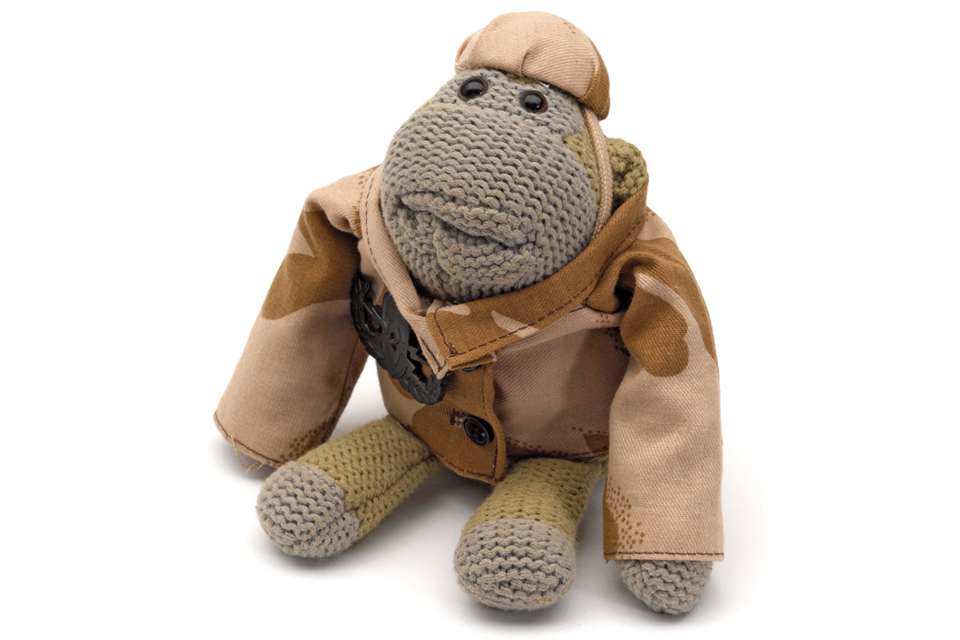
Combat monkey
Combat monkey is a team mascot who has been on many deployments earning respect, and his own badge, combat jacket and helmet, from both British and American troops [Picture: Crown copyright]

And then there is combat monkey. On loan from Corporal Leigh Charlton, who operates the explosive ordnance disposal team’s remotely-controlled vehicles, combat monkey is a team mascot who has been on many deployments, earning respect, and his own badge, combat jacket and helmet, from both British and American troops.

Like many of the individuals who have played a central role in the exhibition, Corporal Charlton won’t be able to attend the opening as he is on another tour of Afghanistan.

But this time he is in Camp Bastion, which is why combat monkey can continue his period of rest and recuperation at the museum:

These guys are amazing and inspiring,” said Amy. “To think that they come through the most challenging experiences that a human being can face, deal with it, and then go out and do it again. That’s pretty extraordinary.

Unseen Enemy runs until 31 March 2014 and entry is free.

This article is taken from the July 2013 edition of Defence Focus - the magazine for everyone in Defence.
Partager cet article
Repost0
1 juin 2013 6 01 /06 /juin /2013 11:35
Husky Mounted Detection System at Fort McCoy. Photo by Tom Michele US Army

Husky Mounted Detection System at Fort McCoy. Photo by Tom Michele US Army

May 31, 2013 Shishir Gupta, Hindustan Times 


The May 25 Maoist attack using a 25-kg explosive device in Darba has added impetus to the UPA government's plan to acquire state-of-the-art ground penetration radars from the US to detect buried improvised explosive devices (IEDs ) in low-intensity conflict zones.


The acquisition of ultra wide band microwave radars, which can detect a seven-feet underground IED, was discussed during the Indo-US homeland security dialogue last week, home ministry sources said. "Washington is more than willing to sell the high-tech radars to New Delhi for use by security forces," they added. Delegates to the meeting were led by home minister Sushilkumar Shinde and his American counterpart Janet Napolitano.


While Indian para-military forces still use hand-held metal detectors or mine sweepers to open roads for traffic in insurgency-affected zones, the US radar -- mounted on an IED-proof vehicle (like Husky or Stryker) -- scans the road ahead, jams the device's frequency and gives a 3D picture of the buried ordnance.


The US GPR, developed after a billion-dollar research, has successfully tackled IEDs in Afghanistan and Iraq. "The GPR will be extremely effective in areas afflicted by the left-wing extremists as Maoists typically bury huge IEDs under the roads and trigger them off through remote or wire detonation. The IED used in the May 25 attack was made of ammonium nitrate and hidden under the road," a senior ministry official said.


It is learnt that New Delhi will acquire these radars through the foreign direct military sales route after the radar's trials in Indian conditions. Two Virginia-based companies are market leaders in the segment and have supplied IED detection radars to the US Army.


The US is also willing to supply port scanners so that explosives and nuclear , biological or chemicals weapons do not make their way disguised as imports into India. This hi-tech equipment, which can scan a truck at one go, will be housed at major ports across the country.

Partager cet article
Repost0
27 mai 2013 1 27 /05 /mai /2013 11:50
IED: quand la formation à la lutte contre les engins explosifs est externalisée

25.05.2013 par P. CHAPLEAU Lignes de Défense


Depuis 2003 en particulier et le début des opérations en Irak, le déploiement de sociétés privés spécialisées dans le déminage et la dépollution est chose courante.

Il n'y a pas que des ONG (DDG, Apopo, Halo Trust, MAG, Handicap International...) à intervenir dans ce domaine où le travail ne manque pas, où les fonds ne manquent pas trop non plus et à haute valeur en terme d'image pour des entreprises à but lucratif (le fameux "déminage humanitaire").

La formation à la lutte contre les IED n'échappe pas à cette tendance. Ainsi au Royaume-Uni, le MoD loue les services de la société Optima depuis trois ans; Optima forme les soldats en partance pour l'Afghanistan où le nombre d'IED découverts a augmenté de 5% entre le 1er juin 2011 et le 31 mai 2012.

Optima travaille en étroite collaboration avec l'EOD & Search Training School et les producteurs d'équipements spécialisés. Les cours sont dispensés au Royaume-Uni et à Camp Bastion, dans le sud de l'Afghanistan.

Optima ne constitue pas une exception. Parmi les autres fournisseurs de formation à lutte contre les IED, citons:
- Dynamic Strategies International,
- Allen-Vanguard,
- Westminster International,
- Tactical Electronics,
- A-T Solutions,
- Stratom etc...

Certaines de sociétés travaillent en Afrique, formant par exemple les Casques verts de l'Amisom avant leur déploiement en Somalie.

Partager cet article
Repost0
23 mai 2013 4 23 /05 /mai /2013 16:45
Liberian soldiers deploying to Mali participate in IED recognition course

22 May 2013 by Africom


Armed Forces of Liberia (AFL) soldiers slated to deploy to Mali completed an improvised explosive device recognition course provided by the US military’s Operation Onward Liberty mentors at Edward Binyah Kesselly Military Barracks earlier this month.


The IED recognition course, held on May 3, built on prior IED familiarization and lane exercises, in which squads cycle through various scenarios, to provide the deploying soldiers with additional IED experience in preparation for their upcoming deployment, US Africa Command (Africom) said.


Onward Liberty (OOL) is a U.S. Marine Corps Forces Africa-led operation comprised of joint U.S. service members who mentor and advise the AFL in order to develop a national military that is responsible, operationally capable and respectful of civilian authority and the rule of law. OOL’s goal is to assist the AFL in building a professional and capable military force that can effectively contribute to the overall security environment in Liberia.


OOL personnel continue to mentor AFL leaders and training staff at all levels to ensure the deploying platoon is properly trained and equipped to succeed in partner-nation operations in Mali and to represent Liberia as a legitimate, capable and professional force for good.


U.S. Marine Corps 1st. Lt. Robert Rivera, AFL engineer mentor, oversaw the planning and execution of the IED lane course. “The purpose of this course was to identify strengths and improvement areas for the platoon and to build on their prior training ahead of their deployment,” he said. “They’ve received basic IED training and seen scenario lanes, and this training built on that. They encountered four different lanes which each entailed a dynamic, Mali-focused threat they may encounter.”


Rivera added that the platoon excelled at the entry control point lane specifically. “I was very impressed with the quality of their performance there,” he said. “I’m confident that they’ll be able to build on that and work on their improvement areas to continue to gain overall proficiency.”


AFL 1st. Lt. Nathaniel Waka, platoon commander, said that the combination of lane training and IED recognition posed a new challenge for his soldiers. “We’ve had training on each previously, but these scenarios were new,” he said. “The course was invaluable for helping the troops think on their feet and react in dynamic situations. With each new course and phase of training, our soldiers continue to improve and grow in confidence and proficiency.”

Partager cet article
Repost0
25 avril 2013 4 25 /04 /avril /2013 16:50
UK Navy receives CUTLASS bomb ordnance disposal vehicle


25 April 2013 naval-technology.com


UK Royal Navy Divers have received the new remote-controlled explosive ordnance disposal (EOD) unmanned ground vehicle (UGV) called CUTLASS, to help detect and clear hidden improvised explosive devices (IEDs).


Following its delivery, the £1m Northrop Grumman-built robot was tested by the Southern Diving Group (SDG) to validate its capabilities.


During the Naval Bomb Disposal capability exercise, conducted within HM Naval Base, Devonport, UK, CUTLASS demonstrated its ability in a simulated terrorist car bomb scenario.


Southern Dive Unit 1 officer in charge lieutenant commander Ross Balfour said that the new vehicle, controlled via a computer, features advanced optics to enable a high-level of situational awareness of its surrounding area and any device.


Using its integrated three-fingered advanced gripper-equipped manipulator arm and disruptive weapons, the bomb disposal robot can quickly respond to IED threats.


"The divers demonstrated their comprehensive underwater ability using the 7m deep training tank with divers using closed-circuit re-breathing equipment, lifting and moving a practice bomb with a remote airbag and attaching dummy explosive charges to simulate rendering it safe," Balfour added.


Designed for efficient detection and disposal of both vehicle-borne and IEDs from safer distances in all types of terrain and weather conditions, the six-wheeled next-generation UGV can accommodate a broad spectrum of payloads, sensors and tools.


"CUTLASS represents a major improvement in our explosive ordnance disposal (EOD) capability, whilst improving safety for the general public and our EOD operators," Balfour said.

Partager cet article
Repost0
18 avril 2013 4 18 /04 /avril /2013 21:22
Blast Tests Improve US Army Vehicle Design

April 16, 2013 defense-aerospace.com

(Source: US Army Research Laboratory; issued April 16, 2013)


Army Researchers Improve Vehicle Design with Blast Tests


ABERDEEN PROVING GROUND, Md. --- With the growing threat of improvised explosive devices over the past decade, Army researchers have been hard at work testing and evaluating ways to keep Soldiers safe from bomb blasts.


The U.S. Army Research, Development and Engineering Command analyzes under-body blasts, known as UBB.


Researchers at the Army Research Laboratory Survivability and Lethality Analysis Directorate have led to many improvements in vehicle design.


"Through live-fire tests, we have been able to provide a comprehensive characterization of the blast environment and occupant injuries during a UBB," said Sarah Coard, Army researcher. "Only by understanding the mechanism of injury can we apply engineering changes [to vehicles] to decrease the likelihood of those injuries. The blast environment is unique."


The Army's concern is always the same: how can a vehicle be modified to reduce the likelihood and severity of injuries to Soldiers?


"The test and evaluation community is working to a standard that 10 years ago would have been unimaginable," said Scott Welling, a member of SLAD's Engineering Analysis Branch. "The number of data channels that are used today in a test event is greater than five times the amount used prior to these conflicts."


Army experts are leveraging an ever-growing wealth of test data.


The Army's approach to live-fire testing, leverages mechanical engineering experts in the Engineering Analysis Branch and the crew-injury-physiology experts in the Warfighter Survivability Branch. Welling and Coard are partners as RDECOM's representatives on the integrated product team for live-fire testing. This ensures a comprehensive analysis of the survivability of both the crew and their vehicle.


"Another use for the data may be surprising," Coard said. "Improving the test instrumentation itself and refining and enhancing the test scenarios. One such instrument is the anthropomorphic test device, a crash-test dummy originally developed by the automotive industry. For UBB testing, it has become obvious that the ATD must be modified if it is to provide the most accurate data. So ARL is now leading an experimentation program to enhance the ATD for use in future tests."


Not only is instrumentation improving, but test designs have also become more sophisticated. In the past, a vehicle would often be tested with one crash-test dummy in it. Now, it is required that there be a crash-test dummy in every occupant location in a vehicle.


Officials said another significant change is the adoption of new and current injury criteria in order to make assessments more accurate and to achieve greater resolution in inferring what injuries would result and how. A further way that test design has evolved is by the introduction of new methodologies to analyze the motion of seats and floors.


The current war-time environment has caused testing specifications to grow and timelines to shrink. The Army has been responding to urgent materiel releases.


The Army is looking at the structural response of the vehicle and the survivability of its occupants.


For every vehicle or piece of equipment tested, researchers analyze the blast's effect on communications, mobility, firepower and mission success.


Because analysis demands so much more than merely capturing data, a holistic vantage point is vital, officials said. The testing enables researchers to provide this context to evaluators, program managers and vehicle designers.

Partager cet article
Repost0
17 avril 2013 3 17 /04 /avril /2013 18:18
Partager cet article
Repost0
17 avril 2013 3 17 /04 /avril /2013 18:14
Partager cet article
Repost0
9 mars 2012 5 09 /03 /mars /2012 08:50

Warrior-Armoured-Fighting-Vehicle.jpg

A Warrior Armoured Fighting Vehicle


08 Mar 2012 By Thomas Harding – The Telegraph


The latest upgraded Warrior armoured vehicles arrived for operations in Afghanistan last year and it has taken the Taliban less than 12 months to show they are still vulnerable.


Following severe criticism of its weak underbelly after a number of deaths the Ministry of Defence decided to increase its protection.


Since the 2003 Iraq invasion, up to a dozen Warriors had been destroyed with the loss, before yesterday, of 22 lives, including four killed outside Basra when an IED detonated underneath.


At a cost of £30 million the MoD contracted BAE Systems to vastly improve its defence, especially after the coroner at the inquest into the death of four soldiers inside a warrior said he would “urgently seek” what could be done to improve its protection.


The overhaul was substantial and expensive. At a cost of £570,000 per vehicle extra armour was added to the undercarriage and sides and more robust seating was introduced along with measures to stop internal devices flying off during a blast. In addition the gear box was improved to deal with a weight increase to 40 tons and the suspension was raised to give it further blast protection.


It was considered one of the best vehicles to safely carry troops across Helmand rough terrain while packing considerable punch with its 30mn cannon and improved battlefield sights.


Its off-road capabilities almost meant it had greater chance of avoiding Taliban bombs planted in vulnerable locations on roads.


Commanders yesterday still insisted that the Warrior remains one of the better armoured vehicles on the battlefield but questions will remain over its underbelly vulnerability.


Depite the deaths, armoured infantry officers said it should remain in service. “Nothing carries as much accurate and heavy firepower as a Warrior bar a main battle tank,” said one officer. “Despite this event we want it to remain on operations because it delivers so much.”


The vehicle has been iconic for the British Army since it was introduced in the 80s seeing active service in the Gulf War, Bosnia, Kosovo and the 2003 Iraq invasion.


With only about 20 in Afghanistan it is used sparingly and to date it is understood three have been written off by an enemy frustrated by targeting the better protected Mastiff class of vehicle. The Mastiffs are used on mainly flat terrian and do not have the off-road capabilities of the Warriors.


The Warrior should have been replaced in the coming years by a new fleet of at least 3,000 armoured vehicles in a project called FRES (Future Rapid Effects System). But with defence cuts being imposed much of FRES is likely to be axed and the MoD has already agreed a £1 billion contract with the American company Lockheed Martin to refurbish the Warrior’s gun turrets in the 400-strong fleet. That force will not have any further armour improvement than the vehicle destroyed in Helmand.


But commanders insist on having a tracked vehicle that can carry troops across rugged terrain equipped with a strong main armament.


While ministers will stick with Warriors in Helmand right up until the 2014 withdrawal Taliban bombing in the past has forced the MoD to withdraw several poorly designed or protected vehicles including the Vector, Wimik and Viking.


Airmen have also been let down by poor standards after the death of 14 servicemen when an RAF Nimrod surveillance aircraft came down over Kandahar in 2006. It was found that a faulty fuel pipe caused the accident that led to the grounding of the entire fleet.


An MoD spokesman said: “Through state of the art equipment, every effort is made to minimise risk on operations but it can never be removed entirely.”

Partager cet article
Repost0
29 février 2012 3 29 /02 /février /2012 13:55
2012-2016 JIEDDO Counter-IED Strategic Plan

2012-2016 JIEDDO Counter-IED Strategic Plan


28.02.2012 par Frédéric Lert (FOB)


La question de la lutte contre les engins explosifs improvisés (IED) est au cœur des préoccupation des états-majors, à tel point que la déclaration commune franco britannique sur la sécurité et la défense s’en est fait l’écho : « Nous reconnaissons l’intérêt que nos deux pays portent au renforcement de notre coopération bilatérale en matière de lutte contre les engins explosifs improvisés. (…) Un plan d’action conjoint, élaboré en 2012, couvrira les possibilités de coopération dans les domaines des opérations, des capacités, de la recherche et des technologies » explique la déclaration commune.


Derrière cette louable volonté se cache un enjeu technique autant qu’économique, comme en témoigne particulièrement bien l’exemple américain. Un récent rapport du GAO (Government Accountability Office, la cour des comptes locale) rappelle qu’en un peu plus de cinq ans, le Pentagone a dépensé plus de 18 milliards de dollars dans la lutte contre les IED. Cette somme correspond en fait au budget cumulé de l’organisme chargé de coordonner la lutte contre les IED, la JIEDDO (Joint Improvised Explosive Device Defeat Organization), depuis sa création en 2006. Trois milliards de dollars par an dépensés à la mode américaine (ce budget sera réduit à 2,4 Mds de dollars sur le prochain budget), c’est à dire en se lançant dans des études tous azimuts pour tenter de trouver la bonne solution contre les pièges explosifs. Le GAO reproche à la JIEDDO une organisation opaque et une gestion des programmes laissant à désirer. L’organisation ne serait pas même capable, dit le GAO, de suivre tous les efforts réalisés dans une multitude d’officines financées par le pentagone. Avec parfois à la clef de belles duplications des efforts.


Le GAO pointe notamment du doigt le financement simultané de six techniques différentes d’armes à énergie dirigées pour détruire les IED. Ces armes exploitant principalement des lasers de fortes puissances font fantasmer à l’unisson et depuis plusieurs décennies maintenant Hollywood et le Pentagone… Mais après quelques milliards de dollars dépensés en recherche, la Navy n’est toujours pas prête d’embarquer un canon laser sur ses navires. Après seize années de développement, l’Air Force vient quant à elle de jeter le gant en retirant du service son Boeing 747 anti-missile équipé d’une tourelle laser dans le nez. Reste l’US Army, qui est la seule à avoir déployé une « arme laser » sur un théâtre d’opération, et justement dans la lutte contre les IED. Le développement d’un prototype dès 1999 avait débouché quatre ans plus tard sur l’envoi en Afghanistan du système HLONS (HMMWV Laser Ordnance Neutralization System) embarqué sur un Humvee. Selon l’Army, le HLONS participa à la neutralisation de 210 « munitions non explosées » autour de la base de Bagram en six mois de présence. Pour certains, des sommes considérables avaient été dépensées pour faire un simple travail de destruction à distance, largement à portée d’une banale mitrailleuse de 12,7mm…

Partager cet article
Repost0
23 août 2011 2 23 /08 /août /2011 16:40
Mastiff protects engineer team from Helmand IED blast

A huge Mastiff armoured vehicle overshadows a young Afghan boy, on his way to fetch water from the village well, in the Shahzad region of Helmand province - [Picture: Staff Sergeant Mark Jones, Crown Copyright/MOD 2009]


23 Aug 11 UK MoD - A Military Operations news article


A group of soldiers whose task it is to clear routes in Helmand province of improvised explosive devices (IEDs) recently emerged from their Mastiff armoured vehicle unscathed when a device exploded underneath it.


31 Armoured Engineer Squadron (31 AES), 32 Engineer Regiment, normally based in Hohne in northern Germany, are currently part of the Task Force Helmand Engineer Group.


They are the leading route proving and clearance squadron and their job is to travel across the UK's area of operations in their Mastiff armoured vehicles to make sure routes are safe from IEDs and bombs.


On one of their many patrols recently, the team were clearing one of the main routes through Helmand when their vehicle struck an IED. Sapper Gareth Addy said immediately they knew what it was:


"There was a massive explosion that seriously rocked the vehicle. It was the biggest I've ever experienced. Immediately afterwards it went very quiet and then you start to realise what's happened and worry if everyone is OK."


The team quickly began their drills to assess the situation and check whether there were any injuries. Despite the size of the bomb and the force of the blast, none of the people in the Mastiff were hurt.


The vehicle sustained some damage, but, thanks to the armour and design of the Mastiff, it was only minor, and after a further assessment by the team of the route, the patrol continued with their journey.


Mastiff protects engineer team from Helmand IED blast

Sapper Gareth Addy, 31 Armoured Engineer Squadron, ready to go out on patrol in his team's Mastiff vehicle - [Picture: Crown Copyright/MOD 2011]


Sapper Addy, aged 31 from Bridlington, who is a Mastiff driver and gunner, said it was only when they returned to Camp Bastion some hours later they realised how lucky they had been:


"The vehicles we use really do work and everyone now knows that, should the worst happen, they will do a good job of protecting us. In a strange way, that incident increased everyone's morale and confidence for the remainder of the tour."


The Mastiff is a heavily armoured, 6x6 wheel-drive protected patrol vehicle which carries eight people, plus two crew. It is used in Afghanistan to transport troops and protect large convoys as well as directly engaging the Taliban with its advanced weapons systems.


Although heavily armoured, these wheeled patrol vehicles have a less intimidating profile than tracked vehicles and give commanders on the ground in Afghanistan more options to deal with the threats they are facing.


Part of the Mastiff's resilience towards mine explosions comes from the fact that its hull is V-shaped, as opposed to flat, which pushes the force of any explosion outwards.


During Operation HERRICK 14, the engineers from 31 AES have played an important part in enabling both troops and locals to move more freely from one area to another and with greater confidence in their security.


31 AES is part of the Task Force Helmand Engineer Group, made up of Royal Engineers from both 32 Engineer Regiment based in Hohne, Germany, and 24 Commando Engineer Regiment based in Barnstaple, North Devon.

Partager cet article
Repost0
2 avril 2011 6 02 /04 /avril /2011 06:00
Partager cet article
Repost0

Présentation

  • : RP Defense
  • : Web review defence industry - Revue du web industrie de défense - company information - news in France, Europe and elsewhere ...
  • Contact

Recherche

Articles Récents

Categories