Overblog Tous les blogs Top blogs Entreprises & Marques Tous les blogs Entreprises & Marques
Suivre ce blog Administration + Créer mon blog
MENU
21 novembre 2013 4 21 /11 /novembre /2013 08:35
The Indian Army's BrahMos missiles mounted on mobile autonomous launchers

The Indian Army's BrahMos missiles mounted on mobile autonomous launchers


19 November 2013 army-technology.com


The Indian Army has successfully test launched an advanced variant of the BrahMos supersonic cruise missile at the Pokhran test range in Rajasthan, India.


Launched from a mobile autonomous launcher (MAL), the BrahMos Block III variant followed the prespecified trajectory and successfully pierced the designated ''concrete structure at bull's eye'', Press Trust of India reported.


Unnamed BrahMos officials were quoted by the news agency as saying: ''The Block III variant of BrahMos with deep penetration capability is fitted with a new guidance system, and the launch by the army has successfully validated the deep penetration capability of the supersonic cruise missile system against hardened targets.''


Two regiments of the Block III variant, which has demonstrated its supersonic steep dive with precision strike capability in mountain operations, has already been inducted by the army in its inventory, whereas induction of the third regiment is currently underway.

"The launch by the army has successfully validated the deep penetration capability of the supersonic cruise missile system against hardened targets."


Developed by BrahMos Aerospace, a joint venture between India's DRDO and Russian NPO Mashinostroyenia, BrahMos is a 290km range stealth supersonic cruise missile, designed for launch from land, ship, submarines and air platforms.


Based on the Russian-built P-800 Oniks / Yakhont supersonic anti-ship cruise missile, the missile has a speed of Mach 2.8, which equates to nearly three times the speed of sound, and can carry a conventional warhead of up to 300kg.


Powered by a solid propellant rocket, BrahMos features a liquid-fuelled ramjet to sustain supersonic cruise, and is capable of intercepting surface targets by flying as low as 10m above the ground, even in mountainous terrain and hills.


The BrahMos is already in service with the Indian Army and Navy, while flight tests of the air-version are expected to be soon carried out by the Indian Air Force (IAF).

Partager cet article
Repost0
2 octobre 2013 3 02 /10 /octobre /2013 12:35
L’Inde veut des missiles BrahMos sur ses futurs sous-marins

2 octobre 2013. Portail des Sous-Marins


Les compétiteurs occidentaux pourraient devoir affronter une compétition plus acharnée de la part des Russes, dans l’appel d’offres qui sera lancé par l’Inde pour l’achat de 6 sous-marins classiques. Le ministère indien de la défense exige que les sous-marins proposés soient capables de lancer le missile de croisière BrahMos, de conception indo-russe.


La Defence Research and Development Organisation, qui fabrique le missile en commun avec la Russie, a persuadé le ministère d’insérer cette exigence dans l’appel d’offres, qui devrait être lancé vers la fin de l’année.


DCNS, Navantia et HDW vont proposer leurs sous-marins. De leur côté, les Russes ont déjà informé ce mois-ci la marine indienne que les sous-marins de la classe Amur pourraient lancer le missile BrahMos avec peu de modification.


Aucun responsable de DCNS, Navantia ou HDW n’a fait de commentaire sur la capacité de leurs modèles respectifs à lancer le missile.


Référence : Defense News (Etats-Unis)

Partager cet article
Repost0
18 septembre 2013 3 18 /09 /septembre /2013 07:35
India can produce 10,000 km range ballistic missiles: DRDO

Sep 17, 2013 brahmand.com


NEW DELHI (PTI): Inter-continental ballistic missile Agni-5, which can cover entire China and reach Europe with its range of 5,000 km, will be ready for induction in the armed forces in two years, amid assertion by DRDO that it can produce a weapon system with a range of 10,000 km.


Addressing a press conference on a seminar to be held on Monday, DRDO Chief Avinash Chander said all the ballistic missiles in country's arsenal would be canistered to reduce the reaction time, in case of a nuclear attack.


He said by the end of this year or the beginning of the next year, the country's first indigenously-developed nuclear submarine INS Arihant would be carrying out weapon trials as part of its tests towards its induction in the Navy.


"Yes... actually range is least problematic part of the missile. We have full capability to go to any range. If we need a particular range, we can achieve that in two or two-and-a-half years. The issue today is more with the accuracy of the missiles," Chander said.


The DRDO chief was asked if the premier research organisation would be able to provide 10,000 km range missiles if government gives a go ahead to it.


Commenting on the Agni-5 missile, which was successfully test-fired on Sunday for the second time, he said, "The missile would be ready for induction in armed forces in the next couple of years after three to four more successful test-firings from canisters."


He said the Agni-5 along with all other ballistic missiles would be canistered which will help in reducing the response time in case of a nuclear attack.


"It (the response time) will be in order of few minutes from stop to launch and it will be very short. I cannot give you the exact time," Chander said.


India has a 'no-first use' policy for nuclear weapons which means that it needs to have a strong and quick response capability to reply in case of a strike by an adversary.


Asked if there was a need for having missiles with higher ranges than the Agni-5, Chander said, "As on date, we don't think we need those ranges but if needed, it can be done."


On why was India now willing to categorise the Agni-5 as an ICBM whereas earlier it was hesitant to do so, the DRDO chief said world-over missiles with ranges of 5,000 to 5,500 km were termed as ICBMs.


"I do not see why we should be diffident about our strengths and capabilities. Agni-5 is able to go trans-continental and is capable to go these ranges. It is definitely an ICBM. I don't think there is any negative or positive connotation of this term," he said.


Asked if there were any problems with the telemetry and systems of the Agni-5 before its Sunday trial, he said there were issues regarding this but the organisation went ahead with the test as they were not associated with the performance of the weapon system.


On INS Arihant's weapon firing trials including the 700-km K-15 Submarine Launched Ballistic Missile, Chander said it is ready for integration with the indigenous submarine and there no issues on it.


Talking about the weapon and the sea trials of Arihant, whose nuclear reactor was activated recently, the DRDO chief said, "They have a full plan of various activities which will include firing of missiles and validation of other systems on board it.


"Arihant has achieved criticality. It is going through of cycle of trials and that is on. That has to be done in a certain time-line and we are on time."


Reacting to queries, Chander said there was no programme such as Agni-6 at the moment.


On the 1,500 km range Nirbhay cruise missile, he said the second test-firing of the weapon system would be conducted by the end of this year.


Chander said a number of changes have been made in DRDO structure as seven clusters have been created with primary objective of enhancing efficiency and performance of the laboratories while reducing the delays in the projects.


He said the trials of the Arjun MkII tank programme were going on and 79 modifications have been validated.

Partager cet article
Repost0
16 septembre 2013 1 16 /09 /septembre /2013 07:35
source Livefist

source Livefist

NEW DELHI, 15 septembre - RIA Novosti


L'Inde a mené dimanche matin un deuxième test réussi de son missile balistique Agni-V d'une portée de 5.000 km, rapporte la chaîne de télévision NDTV.


Le tir d'essai a été effectué à 4h13 UTC depuis  l'île de Wheeler, dans le golfe du Bengal, au large de l'Etat indien d'Orissa.


Le premier test de ce missile capable de porter une charge nucléaire a eu lieu en avril 2012.


La presse indienne souligne que le missile en question est capable d'atteindre Pékin, la Chine étant souvent considérée en Inde comme un ennemi militaire potentiel.


La conception du missile en question a débuté en 1983. Conçu pour emporter une ogive nucléaire de 1,5 tonne, Agni-V est un missile de trois étages de 17 mètres de long pesant près de 50 tonnes. 


Selon les sources auxquelles se réfère la chaîne NDTV, le missile doit subir encore plusieurs tests avant d'équiper l'armée indienne.


Les forces armées indiennes ont à l'heure actuelle à leur disposition des vecteurs terrestres (missiles de type Agni et Prithvi) et aériens (avions Dassault Mirage-2000 et SEPECAT Jaguar). New Delhi espère en outre acquérir la troisième composante de la triade nucléaire – posséder des sous-marins lanceurs  d'engins. En août dernier, le réacteur du sous-marin Arihant, le premier à avoir été construit en Inde, a été mis en service.  Les tests de ce dernier devraient prochainement débuter.

Partager cet article
Repost0
29 août 2013 4 29 /08 /août /2013 11:35
India developing E-bomb to paralyze networks

28 August 2013 by nayeem sheikh - Indian Defence Goal


The Defence Research and Development Organisation (DRDO) is developing an E-bomb which will emit electromagnetic shock waves that destroy electronic circuits and communication networks of enemy forces, its chief and scientific advisor to the defence minister Avinash Chander said.


So next time there is a Kargil or a LoC violation, you may not hear gunshots or mortar shells, because the electromagnetic bomb will throw life out of gear.


"It will be a weapon that would explore the strong electromagnetic field generating a brief but intense or high power pulse of electromagnetic energy," Chander told TOI at the Missile Complex in Hyderabad. He said the spectrum of targets will be broad and in times to come, E-bombs would form the core of tactical warfare and electronic combat operations to damage the command, control and communications of enemy forces.


The director general of DRDO said that the electromagnetic shock wave from the bomb will destroy electronic circuits and communication network "while paralyzing them in terms of radars, communication networking, information gathering sensors, controls and other electronic equipment." Work is in full swing at the Research Centre Imarat, the Hyderabad-based laboratory of DRDO, to build the new bomb which will be ready for operational deployment within a few years.


Chander said the E-bomb would give an option to the military as the bomb can target the enemy's mobile targets, air defence systems, mobile or static radars, naval vessels with communication systems and even ill-shielded communication or electronic systems at a military base. The GPS-guided E-bombs would precede the conventional munitions for strategic air attacks and can cripple military units as weapons of electric destruction by releasing high voltage pulses. Other DRDO officials said the E-bomb warheads can be delivered by combat aircraft equipped to deliver guided munitions and cruise missiles.


Chander also said DRDO was developing the next generation of smart bombs or guided bombs, which would have a longer range of upto 100 km (starting from 10s of kms) and higher accuracy. "Smart bombs are basically precision guided munition equipped with electronic sensors, control system and adjustable flight fins for providing steering or gliding capacity to hit a designated target with much more accuracy," the DRDO chief said.

Partager cet article
Repost0
29 août 2013 4 29 /08 /août /2013 07:35
India Eyes Drone-Launched Smart Bombs

August 29, 2013 By  Zachary Keck - Flashpoints


India will soon be equipping its drones with precision-guided munitions (PGMs), according to the head of the country’s defense technology agency.

According to The Hindu, on Monday Avinash Chander, the new Director-General of India’s Defense Research and Development Organization (DRDO) said that “in a couple of months” his organization would begin testing PGMs that are small enough to fit onto Unmanned Aerial Vehicles (UAVs).

The newspaper paraphrased Chander as saying that along with miniaturization, the “major thrust” of DRDO’s effort in the short term are on “bridging vital gaps in developing advanced seekers, sensors and actuators.” In the future, Chander said his agency would focus on the “development of navigation and telemetry on chip and that of loitering weapons with 80 percent explosives and 20 percent avionics.”

Speaking at the same conference as Chander, G. Satheesh Reddy, the head of Research Centre Imarat (RCI)—a missile research laboratory that is helping to develop India’s PGMs—said his company was working on extending the range of the PGMs to 100 km, up from 30 km currently.

Since taking over DRDO in June, Chander has said that developing more advanced UAV technology will be a top priority for the defense technology agency under his management.

India is already in the drone business, and demand for UAVs from the defense and civilian sectors is expected to increase drastically in the years ahead. Currently, annual UAV sales in India stand at about US$5.2 billion; this figure will increase to US$11.6 billion over the next decade, according to the Teal Group Corporation, a U.S. aerospace consultancy firm.

A Teal Group executive told The Times of India last month that they expect India’s demand to be “50 medium-altitude, long-endurance (MALE) UAVs, 60 Navy UAVs, 70 Air Force tactical UAVs, 100 Army tactical UAVs and 980 mini-UAVs over the next decade."

India’s precision-guided technology is currently far more underdeveloped, but Delhi is hoping to change this in the coming years through indigenous development or imports. According to India Military Review, India’s precision attack and targeting capabilities are currently limited to laser-guided bomb (LGB) kits attached to dumb bombs.” The same source, however, forecasts that precision bombs and missiles will become much more common among Indian Naval and Air systems over the next five to ten years.

Indian defense experts The Diplomat spoke with were therefore skeptical that India’s drones will be equipped with miniaturized smart bombs any time in the immediate future.

Bharat Karnad, a Senior Fellow in National Security Studies at the Center for Policy Research in Delhi, acknowledged that “DRDO is working on a project to develop a sufficiently compact PGM to arm a drone” but said that “such a capability is immanent, not imminent.”

Yogesh Joshi, an expert on India’s strategic and missile capabilities at the School of International Studies at Jawaharlal Nehru University in Delhi, was slightly more optimistic.

“It will take them a lot of time to get where U.S. and Israel are,” Joshi told The Diplomat referring to DRDO. “However, DRDO is also benefiting a lot by collaboration with U.S. and particularly Israel. Given the fact [that the] U.S. is not as critical of India-Israel engagement as it used to be has benefited this relationship. So the progress may be much more speedy than we expect.”

Both experts also agreed that having such a capability would be useful to Delhi in a number of important areas.

Karnad, who helped draft India’s nuclear doctrine in the late 1990s, said that there is a “whole bunch of tactical and strategic military uses,” for drones armed with smart bombs, including “on the conventional military battlefield versus Pakistan and China, for deployment against terrorist training camps and staging areas/supply depots in Pakistan-occupied Kashmir, and to fight the Naxal insurgents active inside the country.”

Joshi had a similar assessment saying that the drones could be “used for fighting terrorism inside the country in remote areas of Jammu and Kashmir as well as anti-Naxal operations.”

He didn’t believe that the drones would be used to target anti-India militants inside Pakistan proper in the same way that the U.S. has used its drone fleet to carry out targeted strikes against al-Qaeda and Taliban fighters operating in Pakistan’s northwestern regions.

“I think it will be foolish to use them against militants on foreign soil,” Joshi said when asked by The Diplomat if the drones would be used inside Pakistan.

He pointed out that Pakistan has repeatedly said it has the capability to shoot down U.S. drones, and Iran has in fact taken down a U.S. drone that was conducting surveillance operations in Iranian airspace.

“For all obvious reasons, Pakistan certainly can't shoot down U.S. drones. But in the case of India, it will not restrain itself at all. We would therefore be staring at… a loss of resources, international embarrassment as well as an escalation of conflict.”

Partager cet article
Repost0
28 août 2013 3 28 /08 /août /2013 11:35
Photo DPR Defence DRDO

Photo DPR Defence DRDO

25 August 2013 by nayeem sheikh - Indian Defence Goal


Working at a fast pace towards production and induction of Agni-V missile into the forces, Defence Research and Development Organisation is reportedly planning its second test fire next month. The maiden test fire of Agni-V, the first intercontinental ballistic missile of India, was carried out in April 2012. The successful trial catapulted the country into the exclusive ICBM club comprising six elite countries, United States of America, Russia, China, France and United Kingdom.


Dr V G Sekaran, chief controller R&D (Missiles & Strategic Systems) and programme director, Agni, said that while no date has been fixed for the test as of now, it will be conducted in September. “This test shall be aimed at repeatability of the previous test for stabilizing the performance of sub-systems,” he said, adding that DRDO is working at starting the production and delivery phase by 2015 for Agni-5. Dr Sekaran further revealed that the forthcoming test fire is a part of development trials (usually 2-3, if successful) and the user trials will start after this.


Meanwhile, DRDO is leaving no stone unturned for kick starting the canisterization process for Agni V by this year end. Simultaneous qualification tests will be conducted for the same as well. Canister launch of the missile will enable higher flexibility in launching speedy firing from any location on a road.


The indigenously developed 50-tonne long range surface-to-surface ballistic missile Agni-V, which is capable of carrying a nuclear warhead weighing more than a tonne, has a 5,000 km range as per DRDO officials, who confirmed that preparations are at full swing at Wheeler Island off the Odisha coast for a September launch. Once inducted, India’s range with respect to missile reach would include the entire Asia as well as parts of other continents. Agni V will be inducted into the force equipped with Multiple Independently Targetable Re-Entry Vehicles (MIRVs) for shooting multiple warheads at the same time.


RCI to celebrate silver jubilee

Research Centre Imarat, DRDO, Hyderabad, is celebrating its silver jubilee on August 26, 2013. Governor ESL Narasimhan, former president Dr APJ Abdul Kalam, minister of state for defence Jitendra Singh will be present at the celebration. RCI is the premier DRDO Laboratory spearheading the design, development and delivery of state-of-the-art avionics systems for the entire Indian missile development programmes.

Partager cet article
Repost0
5 juillet 2013 5 05 /07 /juillet /2013 11:35
Agni V Launch - photo DRDO

Agni V Launch - photo DRDO

July 05, 2013 by Shiv Aroor - Livefist


With Defence Minister AK Antony in China, the first by a Defence Minister in seven years, new facts about the direction India's nuclear missile programme is taking could send out an unprecedented message. In details revealed for the first time in an exclusive interview to me for Headlines Today, the new chief of the Defence R&D Organisation (DRDO) Dr Avinash Chander has revealed that one of his key mandates as the head of the country's military research complex, is to drastically reduce the time India will take for a potential nuclear counter-strike.
 
Unlike China, India has been typically timid about its strategic programmes. The DRDO chief's revelations make for a rare, bold message about the goings on within the country's most advanced weapons laboratories.
 
"In the second strike capability, the most important thing is how fast we can react. We are working on cannisterised systems that can launch from anywhere at anytime," said Dr Chander. "We are making much more agile, fast-reacting, stable missiles so response can be within minutes." India has a no first use policy for nuclear weapons, and its current response time for a retaliatory strike is classified. The DRDO chief's task is to whittle it down by a substantial degree to provide the Strategic Forces Command (SFC) with a literally 'anywhere-anytime' ability.
 
Dr Chander, formerly director with the Advanced Systems Laboratory (ASL) in Hyderabad and renowned as the spearhead of the Agni family of missiles, was made chief of the DRDO last month.
 
India's current land-based nuclear weapon delivery systems include the 1,250-km range Agni-I, 2,000-km range Agni-II and 3,500-km range Agni-III. The DRDO chief has expressed confidence that 2 of India's two most ambitious nuclear missiles under test, the 4,000-km range Agni-IV and 6,000+ km range Agni-V, will both be inducted into the strategic arsenal within two years.
 
"We'll induct the Agni IV and V inducted in the next two years. It's the first time we will be inducting strategic missiles with such long ranges together. Agni III, IV and V are going to be the thrust areas. They give us the reach which we need, and are our highest priority now. Within two years we have to make sure that it happens," said Dr Chander.
 
Currently, the ASL is steeped in researching futuristic missile technologies. "In the future, the country will require much more precise warheads which are able to counter anti-ballistic missile defences. A manoeuvring warhead is going to be a key challenge. That's the next strategic capability which will become essential. That in turn will be followed by multiple warheads, with decoys, warheads, and other combination," said Dr Chander.
 
Asked about whether India needed an inter-continental ballistic missile (ICBM), with ranges in excess of 10,000-km like China's DF-31 and other in-development weapons, Dr Chander said his missile laboratories could develop and deploy an ICBM in as little as three-five years. "As we see today, we don't find the need for ranges more than 5,000-6,000 km. The technology building blocks required to build a longer range missile already exist. We are in a position to activate any such system at very short notice," said Dr Chander.
 
Asked about how India's missile programme squared off against China's, he said, "Comparisons are odious, always difficult, and many times taken out of context. If you see at the capability level, our missiles, radars are comparable with the Chinese and other friends around us."
 
On India's ballistic missile defence (BMD) system, Dr Chander said, "Ballistic missile defence capabilities of our adversaries will also grow in the years to come. As far as our BMD is concerned, we are now poised for take-off. We've done a lot of tests, need to do perhaps a few more tests. With that, we will be ready to intercept missiles upto a range of 2,000km. That system we will be able to start deploying. At the same time, our effort to develop a system to intercept missiles with a range of 5,000km is underway. Testing of those missiles is one of the limitations we have by virtue of the geometry of the country. We are working on the development of new ranges, so we can fire for a longer distance."
Partager cet article
Repost0
30 juin 2013 7 30 /06 /juin /2013 16:35
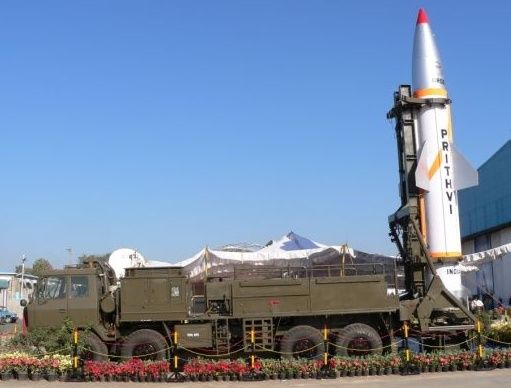
Prithvi missiles to be replaced by more-capable Prahar: DRDO

June 30, 2013 idrw.org (PTI)


Seeking to enhance its precision strike capabilities, India is planning to replace its 150 km-range Prithvi ballistic missiles with the newly developed quick reaction Prahar missiles.


“We are withdrawing the tactical 150 km-range Prithvi missiles and will replace them with the Prahar missiles, which are more capable and have more accuracy,” DRDO chief Avinash Chander told PTI in new Delhi.


The tactical versions of the Prithvi missiles would be withdrawn from service and will be upgraded to be used for longer ranges, he said.


The DRDO chief said after the withdrawal of the tactical ballistic missiles from service, there would be a gap in strike capabilities in the range of 100 to 150 km-range.


“The Prahar missile would be used to fill up that gap,” he said.


The 150 km-range ‘Prahar’ is a single-stage missile and is fuelled by solid propellants. It was first test-fired by DRDO in mid-2011 from its range in Odisha.


The uniqueness of the missile system is that it can be fired in the salvo mode also from one launcher vehicle in which four missiles can be fired in one go.


This short-range missile would be an ‘excellent weapon’ which would fill the gap between the 90 km-range of the Smerch multi-barrel rocket launchers and guided missiles like ‘Prithvi’, which can strike at 250 km to 350 km range.


The under-development Prahar missile would be offered to the Army for user trials very soon and after its acceptance, it is planned to be part of its Corps of Artillery.


The Prithvi missiles were developed by India under its Integrated Missile Development Programme in the 1980s. The ballistic missile was developed with multiple strike ranges from 150 km to 350 km.


The longer ranges are planned to be in service with both the Army and the IAF.

Partager cet article
Repost0
10 juin 2013 1 10 /06 /juin /2013 07:35
India developing robotic soldiers to replace humans in warfare

Jun 09, 2013 brahmand.com


NEW DELHI (PTI): With futuristic warfare in mind, India is working to develop robotic soldiers as part of efforts to boost unmanned fighting capabilities, joining a select group of countries in this endeavour.


Under the project being undertaken by DRDO, robots would be developed with very high level of intelligence to enable them to differentiate between a threat and a friend.


These can then be deployed in difficult warfare zones, like the Line of Control (LoC), a step that would help avert the loss of human lives.


"We are going to work for robotic soldiers. We are going to look for very high level of intelligence in it than what we are talking today... It is a new programme and a number of labs are already working in a big way on robotics," DRDO chief Avinash Chander told PTI in an interview.


The newly-appointed DRDO chief listed the project for development of robotic soldiers as one of his "priority thrust areas" saying that "unmanned warfare in land and air is the future of warfare. Initially the robotic soldier may be assisting the man."


He said in the initial phase of the project, the robotic soldier would be required to be told by the human soldier to identify an enemy or a combatant but "slowly in due course of time, the robotic soldier would be at the front end and the human soldier would be assisting him."


Chander said the need for a robotic soldier is felt to save precious human lives and already robots are used in areas where humans do no want to venture such as defusing bombs or getting inside a high-radiation territory.


"Robotic soldier is one step further. It will have multiple technologies in terms of communication with team members, ability to recognise an enemy," Chander said.


"Today, you have neural networks, whenever the soldier tells him (robotic soldier) that this is a human solider, he will derive his own logic as to what is the difference between him and others (civilians). That learning process will keep building up," he said.


Asked if it would be capable of being deployed in areas such as the Line of Control, Chander said, "In due course of time but not before a decade in any way."


He said many new technologies have to be developed such as "miniature communication, materials, cognitive technologies, self-learning processes and interaction with human."


Chander said "already five to six countries are actively working. They have not yet developed it fully but they are in fairly advanced stages. This is one of my priority areas."

Partager cet article
Repost0
2 juin 2013 7 02 /06 /juin /2013 11:35
Su-30MKI photo Livefist

Su-30MKI photo Livefist

Jun 02 2013 indianexpress.com (PTI)


New Delhi - By the end of next year, Indian fighter planes could be equipped with indigenously-developed 'glide bombs', which will be guided to their targets for precision attacks.


The first-of-its-kind bomb in the country, being developed by the DRDO, will boost India's strike capabilities as targets can be hit even beyond the range of a fighter aircraft.


The DRDO is working on developing glide capabilities on the existing bombs of various payloads including 100 kgs, 250 kgs and 500 kgs.


"We are developing glide bombs which can be directed towards their intended targets using guidance mechanisms after being dropped from aircraft of the IAF," outgoing DRDO chief V K Saraswat said.


"Such a capability will allow the IAF pilots to drop the bombs at their intended targets from stand-off distances as the glide capabilities will help in enhancing the range of the bombs," he said.


The DRDO has already carried out two trials of such bombs successfully and plans to hold more trials this year for proving the capabilities of the ammunition.


"By the end of the next year, we want to complete all the development trials of the glide bombs before offering it to the IAF," he said.


The outgoing DRDO chief said the organisation is also in the process of developing an anti-radiation missile, which will multiply the strike capabilities of the armed forces by destroying the enemy's advance warning system.


Such missiles can be mounted on Sukhoi fighter planes Su-30 MKI.


These missile can detect a radar by tracking its electro-magnetic radiation and pulses generated and these would be independent of the radar wavelength and be able to destroy it.


Such missiles, currently in use of some major powers like the US, can detect and attack a radar antenna or transmitter with minimal aircrew input.


The proportional guidance system that homes in on enemy radar emissions has a fixed antenna and seeker head in the missile's nose.


The ARMs are used by the US Air Force and they move at the speed of over Mach 2, propelled by a smokeless and solid-propellant rocket motor.


The US Air Force introduced High Speed Anti-Radiation Missiles (HARM) on the F-4G Wild Weasel and later on specialised F-16s equipped with the HARM Targeting System (HTS).


Listing the successful test-firing of the over 5,000 km range Agni-5 missile as the "crowning glory" of his tenure as DRDO chief, Saraswat said more lethal versions of the missile would be developed.


He said the DRDO was working on producing a variant of the missile with Multiple Independently Targeted Re-entry Vehicle (MIRV) warheads.This MIRV capability would make the missile capable of carrying multiple warheads to destroy several targets in one go.


Terming it as a "force multiplier", he said, "I will be able to do force multiplication with this... where I was using four missiles, I may use only one missile."


He said a few more tests of the missile would be done before it is ready for induction into the armed forces.


On the joint venture programmes to develop Medium-range Surface to Air Missile (MR-SAM) and Long-range SAM (LR-SAM) with Israel, he said the programme has been delayed by two years due to some technological problems.


India and Israel have formed a joint venture under which the IAF and the Navy would get these missile systems.

Partager cet article
Repost0
2 juin 2013 7 02 /06 /juin /2013 11:35
Dr Avinash Chander – source Livefist

Dr Avinash Chander – source Livefist

 
India's Defence Research & Development Organisation (DRDO) has a new chief! Have interviewed him several times on the Agni programme of which he is considered creator. I'll allow the organisation itself to introduce him to you in this full press statement:
 
Dr Avinash Chander has been appointed as the new Scientific Advisor to Defence Minister, Secretary Deptt of Defence R&D and DG DRDO. “I feel honoured to take up this new responsibility. Dr Saraswat  has set DRDO on a good course, I have to continue and take it to the next level” said Dr Avinash Chander on his appointment.
 
In recognition of his immense contributions towards strengthening the National Defence, Government of India has recently honoured him with the prestigious PADMA SHRI Award.
 
Dr Avinash Chander, is an eminent Missile Scientist and the Chief Architect of the Long Range Ballistic Missile System AGNI. He  Envisioned and evolved the Strategies for Long Range Missiles and led the design and development of AGNI series of Missile Systems – AGNI A1, A2, A3, A4 and A5 providing cutting edge, decisive Strategic Weapon systems to the Armed Forces, leading to the Successful development of the Nation’s pride, ‘5000+ Km range AGNI 5 Strategic                        Weapon System’ propelling India to join the elite club of five advanced nations. Development of Agni Range of missiles in highly restrictive International Control Regimes was possible only out of his technology forecast, perspective planning and relentless efforts. He created the infrastructure, industry base, production lines, and integration facilities to produce different classes of AGNI Missile Systems. Today, the AGNI A1, A2, A3 Missiles occupy the pride of place in the inventories of the Indian Armed Forces
 
His pioneering research in the Innovative Energy Management Guidance Scheme has enabled utilization of Solid Propulsion, the main thrust and the backbone of Long Range Missile System. Under his leadership, DRDO carried out extensive Research and indigenously developed the critical technologies such as Composite Rocket Motors, Re-entry Carbon Composite Heat Shield, Advanced High Accuracy Navigation Systems, Flex Nozzle Control System, High-end Real-time computing techniques. His long term expertise has been providing the necessary thrust for the Programmes of National importance such as Underwater Missiles, BrahMos Cruise Missiles, Nag, Air Defence systems etc. He laid the Technology Roadmap for Missile Complex Laboratories and led the R&D in the advanced Navigation Systems, Onboard Computers, Servo Valves and Seekers.
 
Dr Avinash Chander had joined DRDO in 1972 after completing graduation in Electrical Engineering from IIT Delhi. He obtained M.S in Spatial Information Technology from JNTU, Hyderabad. He is a Fellow of Indian National Academy of Engineers, Fellow of Systems Society of India, Fellow of Andhra Pradesh Academy of Sciences and Vice-President of Astronautical Society of India.
 
The distinguished scientist has received numerous awards and honours including DRDO Scientist of the Year, Astronautical Society of India Rocketry and related Technologies Award, Dr. Biren Roy Space Science and Design Award, Agni Self-reliance Award, Path Breaking Research/Outstanding Technology Development Award, Outstanding Technologist Award by Punjab Technical University, Technology Leadership Award,  Distinguished Alumnus Award of IIT, Delhi.
Partager cet article
Repost0
2 juin 2013 7 02 /06 /juin /2013 07:35
Agni architect is new DRDO chief

Jun 1, 2013 timesofindia.indiatimes.com


HYDERABAD: Scientist Avinash Chander, programme director, Agni and chief controller (missiles & strategic systems) has been elevated as scientific advisor to raksha mantri, secretary of department of defence R&D and director general of DRDO from June 1, 2013 for a period of three years. He succeeds Dr V K Saraswat following his superannuation.


"I feel honoured on being entrusted with such a responsible position. Dr Saraswat has set a good course for DRDO and I will continue to steer the organization to higher levels," he said after taking charge on Friday.


Avinash Chander, an eminent missile scientist, is the chief architect of the long range ballistic missile system Agni. He envisioned and evolved strategies for long range missiles and led the team in the design and development of the Agni missile systems (Agni A1, A2, A3, A4 and A5), thus providing cutting edge and strategic weapon systems to the armed forces. He played a key role in the development of the 5,000 km range Agni-V, propelling India into an elite club of five advanced nations.


Avinash Chander joined DRDO in 1972 after completing graduation in electrical engineering from IIT Delhi. He did MS in spatial information technology from JNTU, Hyderabad. The development of Agni range of missiles under highly restrictive international control regimes was possible due to his technology forecast, perspective planning and relentless efforts.


Partager cet article
Repost0
31 mai 2013 5 31 /05 /mai /2013 12:35
tejas source Livefist

tejas source Livefist

30/05/2013 by Paul Fiddian - Armed Forces International's Lead Reporter


The Indian Air Force's newly-inducted HAL Tejas combat aircraft should reach final operational status by late 2014, according to defence minister A.K. Antony's statement.


In early 2011, the HAL Tejas achieved IOC (initial operating clearance) status but, since then, ongoing issues have delayed its full introduction into service. "To achieve this [final operational status] objective, all stakeholders including the Defence Research and Development Organisation, Hindustan Aeronautics Limited and IAF must put their energy together in a focused manner", Antony urged.


Referring to the Tejas' indigenous background and the need for India to start working on other home-grown military technologies, he added: "We continue to be the largest importer of defence equipment. The share of indigenous content in defence procurement is low. Our experience has been that foreign vendors are reluctant to part with critical technologies.


"There are delays in the supply of essential spares [and] there are exorbitant price increases. The services [need] to realise that we cannot be eternally-dependant on foreign equipment and platforms."


Indian HAL Tejas


The Indian HAL Tejas story dates back to the 1980s. At that point, India launched its LCA (Light Combat Aircraft) programme, which aimed to develop a new fighter type to take over from the Indian Air Force's elderly MiG-21s.


The resultant prototype Tejas design made its first flight in January 2001, followed some seven years later by the first production model. Since 2011's IOC award, the IAF Tejas fleet has carried out many sorties but, in August 2012, a three-month grounding was imposed, on account of issues involving the aircraft's ejection seat configuration. Ultimately, the Indian Air Force is set to be equipped with a maximum of 180 Tejas fighters, while the Indian Navy will get up to 50 examples.


Powered by a single F404-GE-IN20 turbofan, the Tejas has a top speed of Mach 1.8, an unrefuelled range of 850 kilometres and a service ceiling of 50,000 feet. Eight weapons hardpoints can carry up to 4,000 kilograms of ordnance, including air-to-air missiles, air-to-surface missiles, anti-ship missiles and bombs. These are supplemented by a 23mm twin-barrel GSh-23 cannon, complete with 220 ammunition rounds.

Partager cet article
Repost0
30 mai 2013 4 30 /05 /mai /2013 11:35
LCA Tejas photo India MoD

LCA Tejas photo India MoD

30.05.2013 Pacific Sentinel
 
 
The Defence Minister Shri AK Antony today expressed optimism that the country’s indigenously developed fighter aircraft- LCA TEJAS- will get Final Operational Clearance of the Indian Air Force by the end of next year. Speaking at the Annual Awards Functions of DRDO here, he said, all stakeholders including the DRDO, IAF and HAL must put their energy together in a focused manner to achieve this objective. 
 
Shri Antony said countries that depend on imported arsenals cannot become great nation. Shri Antony said we continue to be the largest importer of Defence equipment. The share of indigenous content in Defence procurement is low. “Our experience has been that foreign vendors are reluctant to part with critical technologies. There are delays in the supply of essential spares. There are exorbitant price increases. The Services too realize that we cannot be eternally dependent on foreign equipment and platforms”, he said. 
 
Referring to the expansions of domestic defence industry, Shri Antony said this has to be achieved through public and private sector initiatives. He said there is ample scope for joint ventures also. “All the stakeholders in the defence sector- DRDO, Armed Forces and the industry must work in tandem and develop trust and confidence in each other’s capabilities.” Cautioning against time and cost over runs in projects Shri Antony said Indian Companies must compete with global players in developing state- of- the art technologies of acceptable commercial parameters and must meet customer satisfaction. 


The Minister complimented DRDO for their magnificent achievements in 2012. He referred to the first flight of Agni-V, two successful tests of our Ballistic Missile Defence programme in February and November 2012, first flight of LCA Navy, establishment of a cyber-forensics laboratory, initiation of production of NBC systems, ToT for composite armour for helicopters and investment casting of aero engine components and said these are just some of the many accomplishments. 
 
He, however, asked the scientists not to be complacent. “The DRDO must keep its focus trained on the areas of core competence and not fritter away its energy and resources. In today’s world of cut-throat competition, the choice is very clear-‘perform, or perish’. From designing stage to the stage of final production, timelines must be strictly adhered to and satisfaction of the end user is the litmus test of achievement”, he said. 
 
He said, the security environment in our neighbourhood; civil strife and turmoil in the Middle East; terrorism and threats to cyber security; piracy; illegal seabed mining in Indian Ocean and space-based threats present complex challenges to our defence capabilities. These require both conventional, as well as latest technological responses. 
 
Expressing happiness the Minister said, it is heartening to note that a large number of major systems are under production and the cumulative production value of all the DRDO developed systems has crossed Rs. 1,55,000 crore. ‘I am sure in the coming years, this figure will go even higher. DRDO must make relentless efforts to accelerate the pace of self- reliance’, he further said. 
 
The function was attended among others by the Minister of State for Defence, Shri Jitendra Singh, Chief of Air Staff Air Chief Marshal NAK Browne, Chief of Naval Staff Admiral DK Joshi and Director General DRDO Dr. VK Saraswat. 
 
On the occasion, Shri Antony gave away DRDO Awards to several scientists, technologists and DRDO laboratories in fourteen categories for their outstanding contributions in different areas. 
 
Partager cet article
Repost0
9 mai 2013 4 09 /05 /mai /2013 07:35
INS Arihant nuke reactor to be activated in 2-3 weeks: DRDO

May 07, 2013 brahmand.com


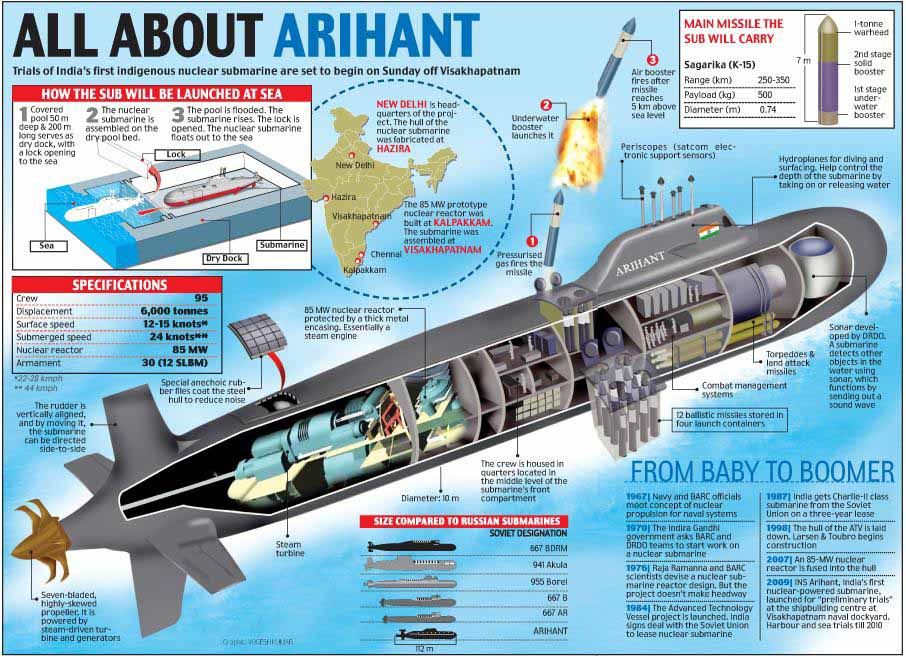
NEW DELHI (PTI): Moving towards completing its nuclear triad, India will activate the atomic reactor on-board the indigenous nuclear submarine INS Arihant in the "next two to three weeks" paving way for its operational deployment by the Navy soon.


"The nuclear reactor on-board the INS Arihant would be made critical (activated) in next two to three weeks," DRDO chief V K Saraswat told PTI on Sunday.


Nuclear triad is the ability to fire nuclear-tipped missiles from land, air and sea.


He said after the nuclear reactor is activated, the agencies concerned can work towards readying the warship for operational deployments soon.


INS Arihant has been undergoing trials at Navy's key submarine base in Vishakhapatnam and would be launched for sea trials after the nuclear reactor goes critical.


The DRDO has also readied a medium-range nuclear missile BO-5 for being deployed on the Arihant and its last developmental trial was held on January 27 off the coast of Vishakhapatnam.


The nuclear submarine will help India achieve the capability of going into high seas without the need to surface the vessel for long durations.


Conventional diesel-electric submarines have to come up on surface at regular intervals for charging the cells of the vessel

Partager cet article
Repost0
25 avril 2013 4 25 /04 /avril /2013 07:35
India's MoD Says No to Joint Heron Development With Israel


Apr. 24, 2013 - By VIVEK RAGHUVANSHI  - Defense News


NEW DELHI — India has shot down an Israeli proposal to jointly develop an advanced version of the Heron UAV in India, a rarity for projects between the two nations.


This month, India’s Ministry of Defence rejected the codevelopment and coproduction proposal by India’s Defence Research and Development Organization (DRDO) and Israel Aircraft Industries (IAI), MoD sources said.


During a meeting this month, senior MoD officials said DRDO should concentrate more on the Indo-Israeli Medium Range Surface-to-Air Missile (MRSAM) program, which is behind schedule and has technical problems.


IAI executives here were not available for comment.


This rejection illustrates the new thinking among India’s MoD, which is concentrating more on sustaining existing DRDO programs than on paying for new projects, the source said. In 2009, India and Israel agreed to jointly develop the MRSAM for use by both militaries. One prototype failed in December, the source said.


DRDO signed the codevelopment contract with IAI after the MoD failed in its efforts to procure the MRSAM through competition. No vendor was prepared to transfer technology for the system.


The Indian Air Force’s requirement is for 18 MRSAMs, estimated to cost around US $1.2 billion. The MRSAM would be a low- and medium-level, quick-reaction missile system capable of moving with mechanized forces. The system would be able to engage manned and unmanned aircraft, missiles and all types of airborne targets.


The MRSAM will have a range of more than 50 kilometers, and its warhead will have self-destruct capabilities to avoid unwanted collateral damage on the ground. The system will have an active seeker with the option of a passive seeker and an electro-optical system will be provided, which would enable the system to track targets in hostile electronic countermeasures environments.


As for the Heron, the Indian MoD has around 60 and requires more, although it hasn’t said how many.


In its proposal for the joint development of Herons, DRDO claimed it has developed a broad spectrum of knowledge on UAV subsystem technologies, including aerodynamic design, composite materials, telemetry and propulsion. The advanced Heron would have featured greater range and endurance.


The Indian Army plans to procure a variety of UAVs, including micro and nano UAVs. The Army also plans to acquire weaponized UAVs, which can be armed with precision missiles.

Partager cet article
Repost0
20 mars 2013 3 20 /03 /mars /2013 11:36
Sub-launched BrahMos Testfired For The 1st Time

March 20, 2013 by Shiv Aroor - Livefist


The submarine-launched variant of the BrahMos supersonic cruise missile was successfully testfired today for the first time in the Bay of Bengal, off the coast of Visakhapatnam. The launch and test was successful, with the missile hitting its target 292 km away. Photos shortly.

Partager cet article
Repost0
7 février 2013 4 07 /02 /février /2013 12:35
Indian Navy prepares for Trials of Submarine version of BrahMos Cruise Missile

Feb 7, 2013 Russian Radio


Trials of the underwater version of Indo-Russian supersonic ‘BrahMos’ cruise missile for submarines have been scheduled for early March, an official of the company told Russian media on the sidelines of Aero India 2013 expo, which opened in Bangalore yesterday.


According the official Russia is ready to offer India ‘Amur-1650’ submarines armed with Club and BrahMos cruise missiles. Presently the Russian submarine project is armed with Club cruise missiles launched from horizontal torpedo tubes; the Indian navy is well acquainted with theme.


BrahMos can find its place on ‘Amur-1650’ submarine in an additional compartment with vertical launch tubes. BrahMos missile jointly produced by Indo-Russian “BrahMos Aerospace” is capable of hitting targets within the range of 290 kilometres flying at the height of 10 metres over the surface. BrahMos cruise missiles have been already inducted in Indian Army and surface ships of the Indian Navy.

Partager cet article
Repost0
21 décembre 2012 5 21 /12 /décembre /2012 12:45

Prithvi_missile_-_TEL.jpg


NEW DELHI, 20 décembre - RIA Novosti


L'Inde a testé jeudi avec succès un missile Prithvi-II, capable de porter une charge nucléaire, rapporte le site Internet du journal Times of India.


Le missile a été tiré depuis un lanceur mobile terrestre, sur le polygone de Chandipur, dans l'état d'Orissa.


Développés depuis le début des années quatre-vingt, les Prithvi sont des missiles balistiques de courte portée capables de transporter une ogive nucléaire, dont la version sol-sol équipe déjà l'armée de terre indienne. Le Prithvi II a une portée de tir maximale de 350 km et il est capable de transporter une charge de 500kg.

Partager cet article
Repost0
21 décembre 2012 5 21 /12 /décembre /2012 08:45

Prithvi (P-II)


21.12.2012 Pacific Sentinel


BALASORE, ODISHA (PTI): India on Thursday successfully test-fired the indigenously developed nuclear capable Prithvi-II ballistic missile with a strike range of 350 km from a test range at Chandipur near Balasore.

The surface-to-surface missile was test fired from a mobile launcher in salvo mode from launch complex-3 of Integrated Test Range at about 9:21 am, defence sources said.

The launch of the sophisticated missile, conducted as part of operational exercise by the Strategic Force Command (SFC) of the defence services, was successful, they said.

Read the full story at Brahmand
Partager cet article
Repost0
19 décembre 2012 3 19 /12 /décembre /2012 18:35
India's Year In Defence

December 19, 2012 by Shiv Aroor - Livefist


Excerpts from the Ministry of Defence Year End Review 2012.

New Weapons Systems to Strengthen Defence Preparedness
 
 
AGNI-V – India proudly entered the exclusive club as the sixth country on 19 April 2012, when its Long-range Ballistic Missile took to sky on its maiden flight and reached the pre-designated target point over 5000 km away in the Indian Ocean with remarkable accuracy. The missile which was launched from Wheeler Island off Orissa Coast incorporates many indigenously developed technologies.  These include the composite rocket motor, state-of-the-art avionics, 5th generation 'On Board Computer' distributed architecture, highly accurate Ring Laser Gyro-based inertial navigation system (RINS), reliable redundant micro navigation system and the re-entry kit shield that withstands temperature with more than 4000 degree celsius ensuring that avionics function normally by maintaining an inside temperature less than 50 degrees celcius.
 
 
AGNI-IV – The 4000 km range nuclear capable ballistic missile Agni-IV was successfully flight tested on 19 Sep 2012.  The long-range missile propelled by composite rocket motor technology was tested for its cool capability.  Launched from road mobile launcher, it reached the predefined target in about 20 minutes.
 
 
With Agni-I, Agni-II, Agni-III and Prithvi P-II surface to surface missile and also its naval version Dhanush already in the arsenal of the Indian Armed Forces, the missile from the production lots were flight tested by the Armed Forces as part of training exercises to ensure defence preparedness. Thus, Agni-I, India's 700 km range ballistic missile had its flight tests on 13 July and 12 Dec 2012. The 2000 km range ballistice missile Agni-II and Agni-III with a range of 3000 km were test fired on 09 Aug and 21 Sept 2012 respectively. The 350 km range surface-to-surface strategic missile Prithvi (P-II) was successfully flight tested on 25 Aug and 04 Oct 2012 from ITR Chandipur, Odisha.  While its naval version Dhanush was test fired from a naval ship off the coast of Balasore, Odisha on 05 Oct 2012.  The tests were like textbook launches meeting all mission objectives and the missiles reached the target points with high accuracy. BrahMos Block III version with advanced guidance algorithm was flight tested on 28 Mar 2012 from ITR Balasore.  The missile flew through the designated 290 kms distance at Mach 2.8 and achieved high precision with steep dive.
 
 
BALLISTIC MISSILE DEFENCE (BMD)

DRDO has developed a two-layer Ballistic Missile Defence (BMD) capability against missiles with range upto 2000 km class. Both the exo and endo atmospheric interception have been demonstrated with direct hits leading to disintegration of target missile.
 
 
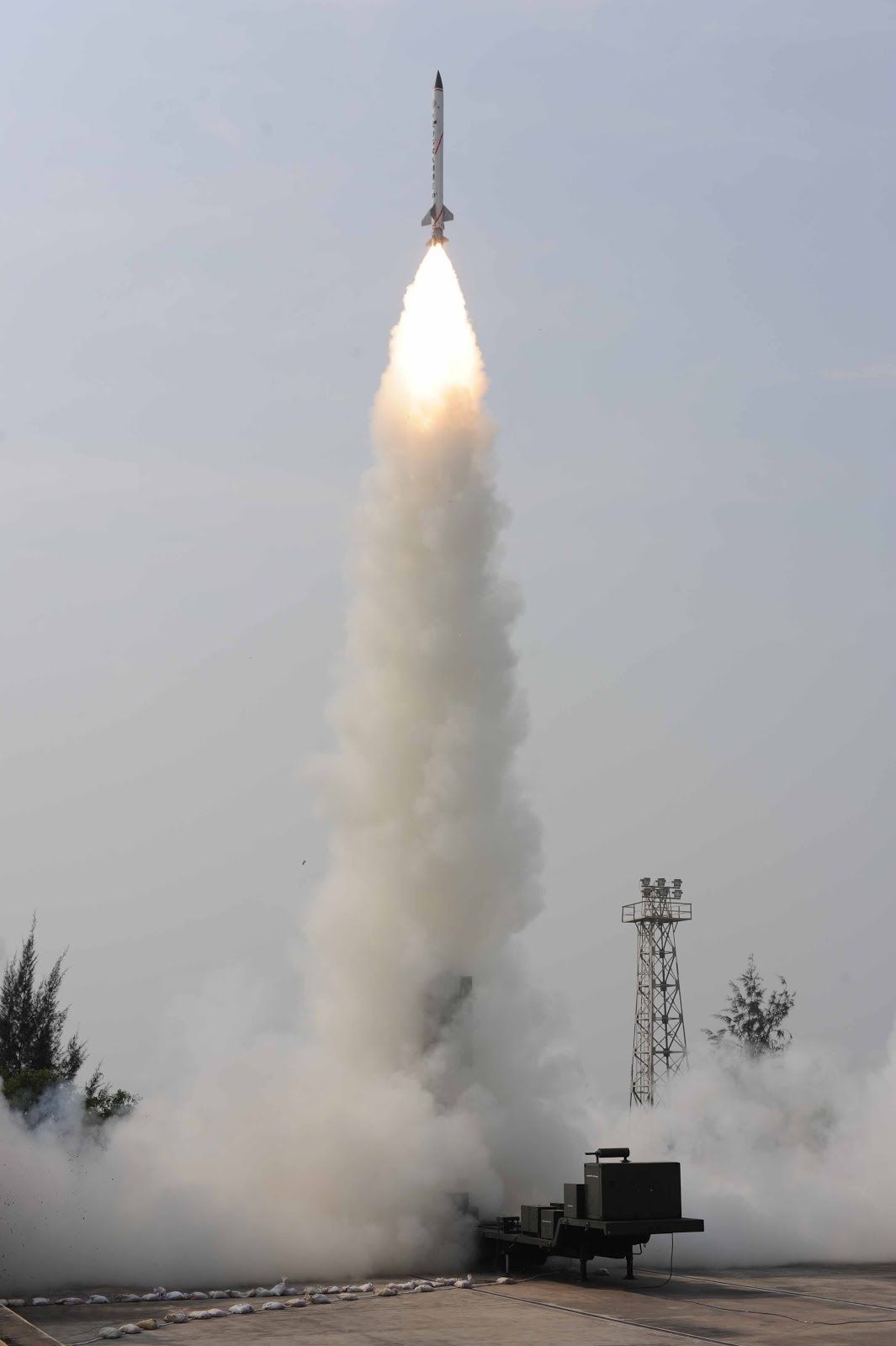
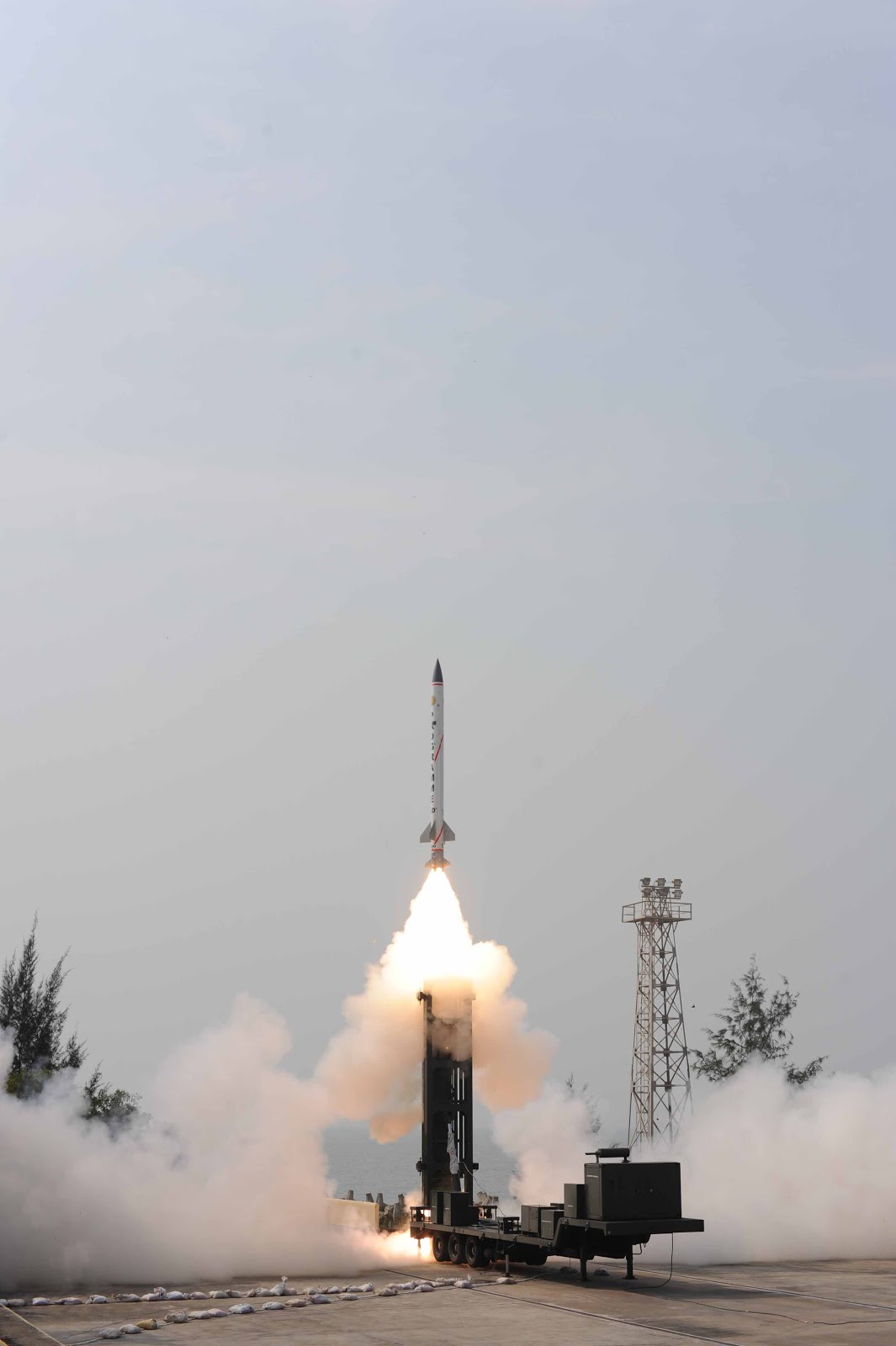
The Interceptor Missile AAD launched by the Scientists of DRDO on 23 Nov 2012 from Wheeler's Island, Odisha, successfully destroyed the incoming Ballistic Missile at an altitude of 15 Kms. The target missile, a modified version of Prithvi, mimicking the enemy's ballistic missile, was launched from Launch Complex III, Chandipur. Long Range Radar and MFC Radar located far away could detect the Missile from take-off and tracked it through its entire path. The total trajectory of the incoming Missile was continuously estimated by the guidance computer and subsequently the AAD Missile was launched at an appropriate time to counter and kill the ballistic missile.  
 
 
In this mission, a special feature of intercepting multiple target with multiple interceptor was demonstrated successfully. The complete Radar Systems, Communication Networks, Launch Computers, Target update Systems and state of the art Avionics have been completely proven in this Mission.
 
 
AKASH AIR DEFENCE SYSTEM - Induction and productionisation of Akash, the medium range air defence system with multi-target, multi directional capability is another shining achievement. The production value of Akash missile systems ordered by Army and Air Force is over Rs 23,000 crores. Orders for two Army regiments and six Air Force Squadrons are under execution.
 
 
LONG RANGE SURFACE-TO-AIR MISSILE (LRSAM) - Control and Navigation Tests (CNT) for LRSAM, a joint development Programme between DRDO and Israel Aerospace Industry (IAI), to develop an Advanced Naval Air Defence System for Indian Navy) were conducted on 16th and 18th July 2012. All Planned mission objectives were fully met in both the tests. The missiles showed good navigation and control performance. DRDO is the Prime Development Agency and IAI the design authority for supply, installation and final acceptance.
 
 
NAG ANTI-TANK MISSILE -  the fire and forget anti-tank missile with top attack capability is another important missile developed by DRDO. Its helicopter mounted version, Helina, underwent 2 successful flights from ground launcher proving full range of the missile.
 
 
LIGHT COMBAT AIRCRAFT–NAVY (LCA-Navy) - had its first flight on 27th April 2012 followed by flights during month of Jun/Jul 2012. Initial Operation Clearance of this aircraft is expected by Dec 2014. LCA, country's first indigenous modern Light Combat Aircraft with four variants (air force, Navy and their trainer versions), is a precision weapon launch platform to carry a range of Air to Air missile, unguided rockets and bombs.  The aircraft is integrated with advanced cockpit, digital avionics and weapons interface, to provide effective point and shoot capability with quick turnaround time.  A Shore based Test facility (SBTF); one of its kind in Asia and third in the world; developed by DRDO at Naval Air Station INS Hansa, Goa is now ready for use. Besides testing of LCA-Navy, the test facility will also be used for training of pilots on LCA - Navy and MiG29K aircraft.
 
 
AIRBORNE EARLY WARNING AND CONTROL SYSTEM (AEW&C) -  In a landmark event the first EMB-145I  aircraft fully modified for the indigenous Airborne Early Warning and Control System (AEW&C) landed on Indian soil at CABS (Centre for Airborne Systems, Bangalore, a DRDO laboratory) on 23 Aug 2012.
 
 
UNMANNED AERIAL VEHICLES (UAVs) - There have been significant achievements in the field of UAVs.  NISHANT, with its ground control system has been made ready for the Army after confirmatory trials.  An indigenous Wankel rotary engine has been developed by DRDO jointly with NAL, Bangalore, for powering UAVs like NISHANT. Rotary engine technology, especially suited for such applications, is the first of its kind in India.  Orders for Lakshya II pilotless target aircraft; capable of flying in sea skimming mode and tree top heights; are expected from the Services after successful demonstration to them. Similarly, UAV Rustom-I, a forerunner to Mediun Altitude Long Range (MALE) UAV Rustom-2, had series of successful trials. Indigenously designed  and  developed  RUSTOM-1 underwent series of successful test flights.  This UAV has the potential to be used for military missions like Reconnaissance, Surveillance, Target Acquisition, Target Designation, Communications Relay, Battle Damage Assessment and Signal  Intelligence.  A mini UAV -'NETRA', especially suited for Low intensity conflict operations was inducted by the Central Reserve Police Force (CRPF). 'NETRA' has four high speed propellers allowing it to take off and land vertically. Similarly a fixed wing mini UAV for low intensity conflict was demonstrated to security forces at various locations for surveillance within the range of 10 kms. It is also useful in reconnaissance over hills.
 
 
ELECTRONIC WARFARE - There has been a significant achievement in the Electronic Warfare Area which includes integration and testing of country's first indigenous active array radar, operationalisation of Combat Information Decision Support System (CIDSS) and development and testing of laser based ordnance Disposal System and advanced Laser Guided Bomb Tester.  The initial development of Indira-1, a short range 2D system has now been extended to high power 3D system like 3D Central Acquisition Radar and Weapon Locating Radar (WLR) based on phased array.  The DRDOs radar warning receivers have been selected to upgrade most of Indian Air Force aircrafts like MiG 21, MiG 29, SU 30MKI, MiG 27 and Jaguars.
 
 
MBT ARJUN MK-II - Arjun Mk-II the advanced version of India's first main battle tank Arjun, commenced its user trials in record time of 2 yrs. The Arjun Mk-II incorporates 89 improvements over the Arjun Mk-I, of which, two regiments are already in service.
 
 
Memorandum of Understanding (MOU) for Smerch Rockets - Ordnance Factory Board (OFB) signed a Memorandum of Understanding for a Joint Venture with M/s Rosoboronexport, Russia and M/s Splav "SPA", Russia to manufacture five versions of Smerch Rockets based on the technology received from Russia. The Smerch Rockets are technologically superior having a range of 70-80- kms. With formation of this Joint Venture, a new Chapter in the Indo-Russian Friendship has commenced.
 
 
Joint Venture for Multi-role Transport Aircraft (MTA) - Hindustan Aeronautics Ltd (HAL), the aerospace major, signed the Preliminary Design Phase (PDP) Contract on 12 October 2012 with the United Aircraft Corporation - Transport Aircraft (UAC-TA), the Russian partner and their JV-Multirole Transport Aircraft Ltd (MTAL) for the Multirole Transport Aircraft (MTA) project as a follow on contract of the General Contract signed between the three parties in May 2012. "With this HAL and UAC-TA will start the preliminary designwork immediately at Moscow.
 
 
CAPACITY BUILDING THROUGH INDUCTIONS/ACQUISITIONS

Mi-17 V5 helicopter was inducted into the Indian Air Force (IAF) on 17 February 2012. This helicopter falls in the category of armed helicopter, with substantial and effective firepower with the latest and more powerful engines that will greatly enhance its payload carriage capability at higher altitudes. Mi-17 V5,  an upgrade of Mi-17 in the medium-lift category, is equipped with  state-of-the-art avionics and on-board Navigation Systems.  It is a glass cockpit variant; the first of its kind to get inducted into the IAF.  It has onboard weather radar, state of the art autopilot and is compatible with the latest Generation (Gen-III) Night vision Goggles.  With this, the helicopter can undertake all-weather, day and night operations in any kind of terrain. The helicopter is also equipped with a Bambi-Bucket that can be used for fire fighting.  It is also fitted with a powerful winch–a feature useful in the Disaster Relief Operations in restricted areas where landing is not possible.

Indian Navy inducted INS Chakra to its under water fleet on 04th April 2012 at Vishakhapatnam.  Defence Minister Shri AK Antony inducted the submarine into the fleet of Eastern Naval Command.  This four plus generation Russian origin submarine is capable of fulfilling multiple roles and will go a long way in strengthening Navy's blue water operating capability.
 
 
The third of the follow-on class indigenous stealth frigate INS Sahyadri was commissioned on 21 July 2012 at Mazagaon Dock Limited, Mumbai by the Defence Minister Shri AK Antony. Conceived and designed by Indian Navy Design Team this Shivalik class frigate will be mainstay frigate of the Navy in the 21st Century.
 
 
The First and Second of the three Talwar-class stealth frigates Teg and Tarkash constructed at Yantar Shipyard, Kalinigrad Russia were inducted into Indian Navy on 27 April and 09 November 2012 respectively by the Flag Officer Commanding-in-Chief, Southern Naval Command.  These multi-role stealth frigate with advanced combat suits are fitted with formidable array of weapons and sensors onboard the Ship including the super-sonic BrahMos missile system and advance surface-to-air missile system.
 
 
To provide a boost to coastal security Indian Coast Guard Ship H-187, the first of the series of twelve Air Cushion Vehicles (ACVs), was commissioned at Okha on 11 June 2012 by Vice Admiral MP Muralidharan, DG Coast Guard.  The 21 meter long ACV (hovercraft) designed and built by Griffen Haverwork Limited (GHL), UK displaces 31 tonnes and can achieve a maximum speed of 45 knots.  The ACV is capable of undertaking multi-farious tasks such as surveillance, interdiction, search and rescue  and responding assistance to small boats / crafts in distress at Sea.
 
 
Indian Coast Guard Ship 'Samudra Paheredar', the second of the series of three Pollution Control Vessels (PCVs) being built by M/s ABG Shipyard, Surat was commissioned by Admiral Nirmal Verma, the then Chief of the Naval Staff in July 2012. The 95m long indigenous PCV displaces 4300 tonnes and can achieve a maximum speed of 20.5 knots with an endurance of 6500 nautical miles. The ship's primary role is pollution response at sea and is equipped with the most advanced and sophisticated pollution response and control equipment for mitigating oil spills, which include containment equipment like hi-sprint booms and river booms, recovery devices like skimmers and side sweeping arms. The ship is capable of unhindered oil recovery operations with storage tank capacity of 500 KL in addition to inflatable barges. The ship is installed with modern Integrated Platform Management System and Power Management System, which makes it unique for unmanned machinery operations. It is also fitted with Dynamic Positioning System for fire fighting and pollution response operations and an infra-red surveillance system for night surveillance.
 
 
The Indian Coast Guard Ship Rani Abbakka, the 1st of a series of five Inshore Patrol Vessel (IPV) built at M/s HSL, was commissioned at Visakhapatnam by the then Minister of State for Defence Dr. MM Pallam Raju, on 20 Jan 2012. The 50 meter indigenous IPV displaces 300 tonnes and can achieve a maximum speed of 31.5 Knots with an endurance of 1500 nautical miles. The special features of the ship include an Integrated Bridge System (IBS), Machinery Control System (IMCS), and an indigenously built Gun Mount with Fire Control System. The ship is designed to carry one Rigid Inflatable Boat and two Geminis for Search and Rescue, Law Enforcement and Maritime Patrol.
Partager cet article
Repost0
29 novembre 2012 4 29 /11 /novembre /2012 08:25

AAD LAUNCHED (1)-23 nov 2012 source Livefist


28.11.2012, Guéorgui Vanetsov, Rédaction en ligne - La Voix de la Russie


L'Inde développe depuis plusieurs années son programme de défense antimissile. Le lancement réussi du missile intercepteur AAD de construction indienne depuis le polygone de l'île de Wheeler en est une nouvelle confirmation. Le missile a détruit une cible à une altitude de 15 km au-dessus du golfe de Bengale.


La cible, une modification du missile sol-sol Prithvi, a été lancée depuis le polygone de l'Etat d'Orissa. Pendant les essais, les spécialistes de Defence Research and Development Organisation (DRDO) ont testé pour la première fois la configuration du vol du missile intercepteur. En outre, ils ont testé les capacités du missile intercepteur sur un simulateur électronique spécial. Ils ont simulé le vol d'un missile lancé à une distance de 1 500 km et sa destruction à une altitude de 120 km.


L'Inde, pourra-t-elle créer et déployer son système de défense antimissile en 2015, date qu'elle s'est fixée? La tâche est extrémement compliquée, estime Piotr Topytchkanov, expert au Centre Carnegie de Moscou :


« Cela nécessite des investissements immenses. D'autant plus que l'Inde ne possède pas des radars et un système d'alerte spatiale sur une attaque de missiles depuis l'espace. A l'heure actuelle, seuls deux satellites indiens se trouvent sur l'orbite, dont un seul a une vocation purement militaire. Il est peu probable que ces moyens permettent de détecter le lancement d'un missile, sans parler de plusieurs. Le système sera-t-il efficace contre une attaque depuis le Pakistan, principal sujet de préoccupation pour l'Inde? Pour l'Inde cela revêt d'autant plus d'importance que le vol d'un missile lancé depuis le Pakistan vers une cible sur son territoire ne dure que quelques minutes ».


Les Etats-Unis s'évertuent à mettre à profit les difficultés indiennes. Ils proposent avec insistance à l'Inde leur bouclier antimissile manifestant leur empressement d'aider à mettre en place un système de défense antimissile. Cependant l'Inde fait montre de réserve eu égard à une telle coopération, préférant se fier à ses propres forces en la matière. New Delhi ne veut pas être attachée aux plans géopolitiques américains en Asie. Car une tâche majeure des Etats-Unis est la dissuasion de la Chine. Dans ce cas, la coopération avec les Etats-Unis dans le domaine de la défense antimissile signifierait la destruction d'une confiance fragile entre l'Inde et la Chine à peine amorcée et à laquelle l'Inde tient vivement.

Partager cet article
Repost0
28 novembre 2012 3 28 /11 /novembre /2012 13:55

INS Arihant


27th November 2012 By Hemant Kumar Rout  - newindianexpress.com


After the successful trial of AD interceptor missile, DRDO is readying for the developmental trial of submarine- launched ballistic missile K-15 from an underwater platform off the Andhra Pradesh coast in the second week of December.


The much awaited test, scheduled for the last week of November, was postponed owing to inclement weather triggered by a deep depression in Bay of Bengal early this month. DRDO scientists are reportedly contemplating two trials of K-15, one from a pontoon (replica of a submarine) and another from a submarine.


Defence sources said the nuclear capable missile will be tested for the first time from a submarine positioned undersea off  Visakhapatnam coast. If everything goes as planned, the missile will be fired any time between December 6 and 8.


The DRDO is eyeing for the successful trial of the missile as few countries have the triad of firing nuclear-tipped missiles from air, land and undersea. The other countries, which have the capability include Russia, the USA, France, Britain  and China.


 “Scientists are working over time and constantly cross-checking the system, including the launch platform. We want to achieve near-zero circular error probability (CEP) accuracy,” said a defence scientist.


The indigenously developed K-15 missile is about 10 metres in length and about a metre in diameter. Its launch weight is about 10 tonnes. This missile uses solid propellant and can carry a conventional payload of about 500 kg to one tonne and also be fitted with tactical nuclear warhead. After its induction, the missile will equip the country’s first nuclear-powered submarine ANS Arihant.


Reports said the K-series missile programme formally began in 2004 as PJ-08 as a tribute to the then DRDO chief and former President APJ Abdul Kalam. The solid-fuel missile had a modest 150-km range but over the years, the missile steadily grew to achieve its desired 700-km range.


“The hybrid K-15 combines aspects of both cruise and ballistic missiles, which use multiple-stage rockets to exit the atmosphere and re-enter in a parabolic trajectory. It flies in hypersonic speed. Launched underwater, the K-15 surges to the surface and is the world’s best weapon in this class,” the scientist said.


The K-15 is one of the most ambitious projects of the DRDO. After its successful induction, the DRDO would go for the developmental trials of its longer-range K-4 missile to strengthen its undersea attacks. Apart from the K-15, India has the submarine version of BrahMos supersonic cruise missile in its arsenal.

Partager cet article
Repost0
23 novembre 2012 5 23 /11 /novembre /2012 17:45

http://2.bp.blogspot.com/-agSeD0s4qpw/UK9r3uUe2DI/AAAAAAAARqQ/Ov0pIz-KMaQ/s1600/AAD%2BLAUNCHED%2B%25282%2529-794430.JPG


November 23, 2012 by Shiv Aroor - LIVEFIST


DRDO Statement: The Interceptor Missile AAD launched by the Scientists of DRDO from Wheeler's Island, Odisha successfully destroyed the incoming Ballistic Missile at an altitude of 15 Kms. The interception took place at 12.52hrs. The target missile, a modified version of Prithvi, mimicking the enemy's ballistic missile, was launched from Launch Complex III, Chandipur. Long Range Radar and MFC Radar located far away could detect the Missile from take-off and tracked it through its entire path. The total trajectory of the incoming Missile was continuously estimated by the guidance computer and subsequently the AAD Missile was launched at an appropriate time to counter and kill the ballistic missile.


The Ring Laser Gyro based Navigation System in Target, Fibre Optic Gyro based INS in Interceptor, Onboard computers, Guidance systems, Actuation Systems and the critical RF Seekers used for the terminal phase have performed excellently. The AAD Missile system initially guided by Inertial Navigation system was continuously getting update of the target position by the Radar through a data link.  The Radio Frequency (RF) seeker tracked the Missile & Onboard computer guided the Missile towards the Target Missile and hit the target. The Radio Proximity Fuse (RPF) exploded the warhead thereby destroying the target missile completely.


In this mission, a special feature of intercepting multiple target with multiple interceptor was demonstrated successfully. An electronic target with a range of 1500 Kms was launched and the Radars picked up the target missile, tracked the target missile subsequently & launched an electronic interceptor missile. This electronic interceptor missile destroyed the electronic target missile at an altitude of 120 Kms. All the four missiles were tracked by the Radars and all the guidance and launch computers operated in full operational mode for handling multiple targets with multiple interceptor.  All the four missiles were in the sky simultaneously and both the interceptions took place near simultaneously.  This has proved the capability of DRDO to handle multiple targets with multiple interceptors simultaneously. The complete Radar Systems, Communication Networks, Launch Computers, Target update Systems and state of the art Avionics have been completely proven in this Mission.

Partager cet article
Repost0

Présentation

  • : RP Defense
  • : Web review defence industry - Revue du web industrie de défense - company information - news in France, Europe and elsewhere ...
  • Contact

Recherche

Articles Récents

Categories