Overblog Tous les blogs Top blogs Entreprises & Marques Tous les blogs Entreprises & Marques
Suivre ce blog Administration + Créer mon blog
MENU
30 septembre 2013 1 30 /09 /septembre /2013 11:20
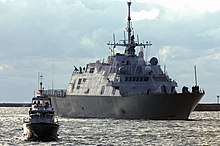
Navy Accepts Delivery of the Future USS Coronado (LCS 4)

Sep 27, 2013 ASDNews Source : US Navy


The Navy accepted delivery of the future USS Coronado (LCS 4) during a ceremony at the Austal USA shipyard here Sept. 27.


Coronado is the fourth littoral combat ship (LCS) to deliver to the Navy, the second of the Independence variant - noted for its trimaran hull - to join the fleet.


Read more

Partager cet article
Repost0
17 septembre 2013 2 17 /09 /septembre /2013 12:20
Surface Warfare Mission Package Concept. Government Accountability Office Graphic

Surface Warfare Mission Package Concept. Government Accountability Office Graphic

BETHPAGE, N.Y. – Sept. 16, 2013 – Northrop Grumman Corporation


Northrop Grumman Corporation (NYSE:NOC) has received a $25.2 million contract from the U.S. Navy for additional Littoral Combat Ship (LCS) Mission Modules. The company will deliver three mission module packages - two for surface warfare missions and one for mine countermeasures.


"Northrop Grumman continues to demonstrate that, as the mission package integrator, we are delivering high quality, fully integrated mission modules," said Doug Shaffer, director of information operations and electronic attack, Northrop Grumman Aerospace Systems. "With this procurement, we will work with our customer to capture synergies across the mission module production base, enhance production and supplier base stability, and reduce cost to the Navy."


The littoral combat ship has three primary missions – mine warfare, antisubmarine warfare and surface warfare. Each of the mission packages involves the integration of manned and unmanned systems operating across the air, surface and subsurface domains.


"I continue to be impressed with the Northrop Grumman-led teams' performance as they deliver high quality mission modules on cost and schedule," said Capt. John Ailes, Navy littoral combat ship mission module program manager.


Each mission package comprises a specific set of subsystems such as data processing equipment, vehicles and sensors, and others. The capabilities contained in each mission package focus on mine countermeasures, littoral antisubmarine warfare or littoral surface warfare operations. The mission modules being delivered under this contract facilitate efficient modular mission package embarkation, mission package operations and debarkation that is central to the LCS modular Mission Package concept.


To date, Northrop Grumman has delivered two surface warfare mission modules and one mine countermeasures mission module for LCS. The second and third Northrop Grumman-produced mine countermeasures mission module and the third surface warfare mission modules are currently in production. Northrop Grumman performs the final integration work at the Mission Package Support Facility located at Naval Base Ventura County, Port Hueneme, Calif.


Northrop Grumman is a leading global security company providing innovative systems, products and solutions in unmanned systems, cyber, C4ISR, and logistics and modernization to government and commercial customers worldwide. Please visit www.northropgrumman.com for more information.

Partager cet article
Repost0
10 septembre 2013 2 10 /09 /septembre /2013 11:20
Both variants of the LCS class at sea photo USN

Both variants of the LCS class at sea photo USN

Sept. 09, 2013 defense-aerospace.com

(Source: Congressional Research Service; issued Sept. 3, 2013)


Navy Littoral Combat Ship (LCS) Program: Background and Issues for Congress Ronald O'Rourke


The Littoral Combat Ship (LCS) is a relatively inexpensive Navy surface combatant equipped with modular “plug-and-fight” mission packages for countering mines, small boats, and diesel-electric submarines, particularly in littoral (i.e., near-shore) waters.

Navy plans call for fielding a total force of 52 LCSs. Twelve LCSs were funded from FY2005 through FY2012. Another four (LCSs 13 through 16) were funded in FY2013, although funding for those four ships has been reduced by the March 1, 2013, sequester on FY2013 funding. The Navy’s proposed FY2014 budget requests $1,793.0 million for four more LCSs (LCSs 17 through 20), or an average of about $448 million per ship.

Two very different LCS designs are being built. One was developed by an industry team led by Lockheed; the other was developed by an industry team that was led by General Dynamics. The Lockheed design is built at the Marinette Marine shipyard at Marinette, WI; the General Dynamics design is built at the Austal USA shipyard at Mobile, AL. LCSs 1, 3, 5, and so on are Marinette Marine-built ships; LCSs 2, 4, 6, and so on are Austal-built ships.

The 20 LCSs procured or scheduled for procurement in FY2010-FY2015 (LCSs 5 through 24) are being procured under a pair of 10-ship, fixed-price incentive (FPI) block buy contracts that the Navy awarded to Lockheed and Austal USA on December 29, 2010.

The LCS program has become controversial due to past cost growth, design and construction issues with the lead ships built to each design, concerns over the ships’ ability to withstand battle damage, and concerns over whether the ships are sufficiently armed and would be able to perform their stated missions effectively.

Some observers, citing one or more of these issues, have proposed truncating the LCS program to either 24 ships (i.e., stopping procurement after procuring all the ships covered under the two block buy contracts) or to some other number well short of 52. Other observers have proposed down selecting to a single LCS design (i.e., continuing production of only one of the two designs) after the 24th ship.

In response to criticisms of the LCS program, the Navy has acknowledged certain problems and stated that it was taking action to correct them, disputed other arguments made against the program, and maintained its support for completing the planned program of 52 ships. Reported comments from some Navy officials suggest that the Navy might be open to changing the design of one or both LCS variants after the 24th ship or perhaps down selecting to a single LCS design after the 24th ship.

A September 2, 2013, press report stated, “The office of the Secretary of Defense (OSD)
reportedly supports the idea of limiting total purchases of littoral combat ships to only 24.... The Navy, according to sources, is countering with proposals for higher numbers, but strongly advocates going no lower than 32 ships.... The OSD proposal to limit LCS to 24 ships is understood to be part of” an alternative Department of Defense (DOD) budget plan that assumes reduced levels of DOD spending and includes “severe reductions in purchases and programs.”

Issues for Congress concerning the LCS program include the following:
• the impact on the LCS program of the March 1, 2013, sequester on FY2013 funding and unobligated prior-year funding for the program;
• the potential impact on the LCS program of a possible sequester later this year or early next year on FY2014 funding and unobligated prior-year funding for the program;
• whether to truncate the LCS program to 24 ships or some other number well short of 52;
• whether procurement of LCS sea frames and mission modules should be slowed until operational testing of the sea frames and mission modules is more complete and other acquisition-process milestones are met;
• whether to down select to a single LCS design after the 24th ship;
• technical risk in the LCS program; and
• what defense-acquisition policy lessons, if any, the LCS program may offer to policymakers.


Click here for the full report (94 PDF pages) hosted on the Federation of American Scientists website.

Partager cet article
Repost0
3 septembre 2013 2 03 /09 /septembre /2013 07:20
Both variants of the LCS class at sea photo US Navy

Both variants of the LCS class at sea photo US Navy

Sources say officials in the Office of the Secretary of Defense want to cut the total LCS buy from 52 to 24. Here, the first-in-class LCSs Freedom, left, and Independence maneuver off San Diego in May 2012. (Lt. Jan Shultis / Navy)


Sep. 2, 2013 By CHRISTOPHER P. CAVAS  - Defense News


WASHINGTON — The office of the Secretary of Defense (OSD) reportedly supports the idea of limiting total purchases of littoral combat ships to only 24, far short of the US Navy’s goal of 52 ships, sources have told Defense News.


Stopping at 24 ships would end LCS procurement with the fiscal 2015 budget.


The Navy, according to sources, is countering with proposals for higher numbers, but strongly advocates going no lower than 32 ships — a number that would continue production another one or two years.


The positions are part of ongoing deliberations to formulate the fiscal 2015 defense budget, due to be submitted to Congress in February. The annual budget process has been heavily disrupted due to sequester cuts, and the White House’s insistence on producing two versions of the budget — a non-sequestration version, called the program objective memorandum (POM) — and an alternative POM (ALT POM), incorporating the mandated cuts and hence, far more severe reductions in purchases and programs.


Pentagon budget officials have focused primarily on the ALT POM, and in late August began switching to the POM. The OSD proposal to limit LCS to 24 ships is understood to be part of the ALT POM discussions.


Asked for comment, both OSD and Navy officials emphasized that no final decisions have been made.


“Until the FY15 President’s Budget request is submitted to the Congress in February 2014, and becomes part of the public record, all decisions are pre-decisional and it is inappropriate to discuss specific details,” said Lt. Caroline Hutcheson, a Navy spokeswoman at the Pentagon.


“We continue to evaluate the future demand for forces and will maintain a balance between force structure requirements while managing fiscal and operational risk,” she added. “We remain committed to a 52-ship LCS program —this number accurately and appropriately captures the requirement for capacity and capabilities.”


One defense official noted a mandated $52 billion cut is coming at the end of fiscal 2013, Sept. 30.


“You can’t cut force structure that quickly,” Maureen Schumann, a Pentagon spokeswoman, said Aug. 28. “We’ve already cut the readiness accounts to a bare minimum. So the investment accounts will take an inordinate part of those cuts for 2014 on.”


In addition to supporting a reduction to 24 ships, OSD also reportedly is insisting the Navy place a top priority on fielding the mine countermeasures (MCM) module, one of three major mission packages under development for the LCS.


The Navy already has prioritized the MCM module in order to fulfill its most pressing operational need for the ships — three developmental packages have been delivered — but the effort has seen significant issues that have pushed back its operational readiness.


Sean Stackley, the Navy’s top acquisition official, noted during a July 25 appearance before Congress that, “sequestration, combined with recent congressional marks and rescissions, will impact the operational test schedule for the mine countermeasures mission package.”


Stackley did not say during that hearing what the revised initial operational capability (IOC) date was for the MCM module, but he noted the surface warfare and anti-submarine warfare packages are scheduled to reach IOC in 2014 and 2016, respectively.


What 24 Means


While LCS has been controversial since its inception more than a decade ago, the Navy’s top leadership has never wavered in its support of the full program. Navy Secretary Ray Mabus and Adm. Jonathan Greenert, chief of naval operations, have remained adamant in their support, testifying before Congress in defense of the program and proclaiming it in multiple public addresses.


Vice Adm. Tom Copeman, commander of the Navy’s surface forces, noted in an internal memo produced in November that with 24 ships — half devoted to mine warfare — the Navy will have exceeded the current minesweeping capacity of its ships and aircraft. While the modules are required to be interchangeable between the two LCS variants, only the Independence-class ships have been used in developmental MCM testing.


Four littoral combat ships have been delivered, while construction contracts or contract options have been awarded for 20 more. The numbers are evenly divided between the Freedom class, built by Lockheed Martin at Fincantieri Marinette Marine in Marinette, Wis., and the Independence class, built by Austal USA in Mobile, Ala. Construction contracts have been awarded for LCS hulls five through 16; four more are in the 2014 budget, while hulls 21 through 24 are planned to be funded and awarded in 2015.


The Navy’s program of record shows two ships scheduled for 2016, and two more in 2017. A minimum of 32 ships would extend production another one or two years — enough, perhaps, for the sequestration restrictions to be relaxed or eliminated.


Meanwhile, Pentagon budget deliberations continue on a wide scale. But time is growing short. Under OSD deadlines, budget proposals are to be presented to the deputy’s Management Action Group in late September, followed by briefings to Frank Kendall, the Defense Department’s top acquisition official, in late September or early October. A full budget brief to Defense Secretary Chuck Hagel isn’t expected until November.


Sam Fellman and Marcus Weisgerber contributed to this report.

Partager cet article
Repost0
29 août 2013 4 29 /08 /août /2013 07:20
Fourth Austral LCS completes acceptance trials

MOBILE, Ala., Aug. 28 (UPI)


The fourth Independence class littoral combat ship has completed acceptance trials, the last significant milestone prior to delivery to the U.S. Navy.


The Navy said the future USS Coronado's acceptance trials lasted four days, during which time the ship demonstrated the performance of its propulsion plant, handling and auxiliary systems.


Launch and recovery operations of rigid hull inflatable boats, surface and air self-defense detect-to-engage exercises, and ship maneuverability at speeds faster than 40 knots also were demonstrated.


"Coronado encompasses lessons learned from the construction and operation of its predecessor USS Independence. The value of those changes was evident in the strong performance of the ship during her trial," said Capt. Tom Anderson, the LCS program manager. "It's a very exciting time in the LCS program."


Following its delivery and commissioning by the Navy, the USS Coronado, built by Austral, will be home-ported in San Diego with its sister ships USS Freedom, USS Independence and USS Fort Worth.


The littoral combat ship class is designed to defeat threats in coastal waters. The Navy plans an LCS fleet of 52 ships.

Partager cet article
Repost0
12 juillet 2013 5 12 /07 /juillet /2013 16:20
LCS: Latest Update

July 11, 2013 Source: US Navy


Littoral combat ships remain one of the top priorities for Navy leadership. The program has had stable requirements since the capabilities definition document was first approved by the Joint Requirements Oversight Council in 2004.


There is and continues to be discussion on changes to the ships and mission packages. This is by design; the program is fundamentally about the ability to deliver changes and improvements to fielded capability. However, the key performance parameters and the requirements have been fundamentally unchanged and stable for a decade.


LCS fills current capability gaps for the Joint Force in the littorals and is a balanced force, structured to defeat adversaries in times of war and maintain a sizeable, continuous naval presence across the globe. Upon reaching full operational capability, LCS will deliver more mission capability in mine countermeasures, surface warfare and anti-submarine warfare than our current mine countermeasure, coast patrol and frigates ships with the added advantage of being rapidly reconfigurable across the three mission areas at a reduced cost.


Procurement


The Navy plans to buy 52 LCS in accordance with our long-range shipbuilding plan – continuing the remainder of the block buy ships through FY 2015 (up to hull number 24) and then starting the next procurement contract in FY 2016. To date, the Navy has taken delivery of USS Freedom (LCS 1), USS Independence (LCS 2) and USS Fort Worth (LCS 3).


Both LCS shipyards have invested considerable resources into facility improvement and have rapidly incorporated lessons learned from construction of Freedom, Independence and Fort Worth. LCS 4 (Coronado) is scheduled to be delivered in September 2013. LCS 5 through 8 — Milwaukee, Jackson, Detroit, and Montgomery — will be delivered by the end of FY15.


Operations


Freedom continues to perform well on her deployment to Southeast Asia. Instead of working out the kinks near her homeport of San Diego, this first-of-class ship has been conducting purposeful, forward presence while her crew of 91 captures valuable lessons learned for incorporation in future LCS construction and deployments.


Despite initial maintenance issues, Freedom has met every deployment milestone including departing San Diego and arriving in Singapore on time, debuting at the International Maritime Defence and Exhibition conference, hosting visitors during the Shangri-La dialogues, and participating in the Malaysia phase of the Cooperation Afloat Readiness and Training exercise series.


During CARAT Malaysia, Freedom accomplished many firsts for the ship and the LCS program:


-- During the underway phase, Freedom operated alongside USS Curtis Wilbur (DDG 54) to complete a series of maneuvers and exercises with the Royal Malaysian Navy’s guided missile frigate KD Jebat, as well as the offshore patrol vessel KD Kelantan.

-- A Malaysian navy helicopter became the first foreign aircraft to land on Freedom during deck qualifications.

-- The ship’s embarked visit, board, search and seizure team – part of the maritime security module – boarded KD Jebat during maritime security drills.

-- Freedom and her embarked MH-60R helicopter participated in a combined anti-submarine warfare exercise.


CARAT Malaysia marked Freedom’s first-ever operational experience with partner nations and the vessel’s performance at-sea drew praise from both participating navies. Capt. Abdul Halim Bin Hj Shaari, KD Jebat’s commanding officer, said, “The ship itself is fantastic. My boarding team went aboard and they learned a lot. The opportunity to command that type of ship would be great.”


LCS 2 and 3 Fleet Testing and Evaluation


LCS 2 conducted two iterations of calm water trials, which are high-speed maneuvers to test the ship’s stability. The crew also supported a human systems integration study, conducted to determine the ease of shipboard equipment and how Sailors respond in a combat environment to include crew rest/sleep time. They exercised detect-to-engage scenarios, and were certified in their proficiency to land helicopters and conduct crash and salvage operations. In May, the ship underwent a week-long planned maintenance availability. The ship also is preparing for INSURV special trials and had the ship’s engineering systems verified for proper alignment/operation and technical documentation.


USS Fort Worth (LCS 3) Photo Lockheed Martin

USS Fort Worth (LCS 3) Photo Lockheed Martin

Fort Worth is the next LCS slated to deploy, planned for mid-to-late 2014. After almost two months in drydock undergoing a planned shakedown availability, LCS 3 returned pierside July 2 and will complete the planned shakedown availability by the end of the month. Following sea trials, she will enter a regimen of underway periods for testing and proficiency. Prior to the planned shakedown availability, LCS 3 embarked Freedom’s Blue Crew for deployment training in preparation for this summer’s crew swap in Singapore with LCS 1 Gold Crew.


Mission Packages


Production of LCS mission packages continues to pace LCS ship construction and meet needs associated with mission package testing, crew training and operational deployments of LCS ships. Developmental testing is underway for the mine countermeasures and surface warfare mission packages. Testing performed to date on individual mission systems and the mission package has shown that the Increment I Surface Warfare – which will reach Initial Operating Capability aboard Forth Worth in spring 2014 – and the mine countermeasures mission package will meet their requirements. The Mine Countermeasures Mission Package Increment I already provides approximately twice the coverage rate of legacy systems.

Partager cet article
Repost0
10 juillet 2013 3 10 /07 /juillet /2013 16:20
USS Freedom (LCS 1) vessel conducting mission at sea. Photo US Navy

USS Freedom (LCS 1) vessel conducting mission at sea. Photo US Navy

10 July 2013 naval-technology.com


Mikros Systems has received a contract from the US Navy to provide new condition-based maintenance capabilities for radars and electronic systems installed onboard littoral combat ships (LCS).


Under the $2.8m contract, Mikros will extend adaptive diagnostic electronic portable test-set (ADEPT) systems capabilities to the ADEPT distance support sensor suite (ADSSS) to the US Navy.


Mikros chief technology officer (CTO) Henry Silcock said the new project would complete the initial LCS's ADEPT engineering effort, which started in 2012.


"The ADEPT distance support sensor suite on LCS will provide a complete and integrated data collection, diagnostics, prognostics, and data transfer solution for four key combat systems on both variants of the LCS," Silcock said.


Mikros president Tom Meaney added: "Once this project is complete, we expect to begin installing ADSSS on all LCS ships."


The ADEPT intelligent, automated, programmable electronic test tool will enable technical personnel to maintain, align, calibrate, and error diagnosis of radar and other complex electronic systems.


In addition to helping in detection and troubleshooting of error and out-of-alignment conditions, the ADEPT improves system readiness and operational performance, as well as reduces equipment downtime and lifecycle support costs through enhanced automation, distance support and interactive training.


More than 100 ADEPT systems have been delivered over the past three years to the US Navy for installation on to Aegis-equipped vessels to reduce shipboard maintenance and deliver new distance support solutions.


The US Navy's LCS vessels have been designed to support a range of missions such as defeat asymmetric anti-access threats including mines, quiet diesel submarines and fast surface craft in near-shore environments.

Partager cet article
Repost0
2 juin 2013 7 02 /06 /juin /2013 17:35
Electronics Technician 1st Class Rachel Preston, left, assigned to USS Freedom (LCS 1) talks with Defense Secretary Chuck Hagel on June 2 during his trip to Singapore for the 2013 Shangri-La Dialogue. Freedom is in Singapore as part of a deployment to Southeast Asia. (MCS 1st Class Cassandra Thompson/Navy)

Electronics Technician 1st Class Rachel Preston, left, assigned to USS Freedom (LCS 1) talks with Defense Secretary Chuck Hagel on June 2 during his trip to Singapore for the 2013 Shangri-La Dialogue. Freedom is in Singapore as part of a deployment to Southeast Asia. (MCS 1st Class Cassandra Thompson/Navy)

Jun. 2, 2013 - By MATHIEU RABECHAULT – Defense News (AFP)


ABOARD USS FREEDOM, SINGAPORE — US Defense Secretary Chuck Hagel Sunday visited the US Navy’s Littoral Combat Ship deployed in Singapore, a symbol of Washington’s strategic “pivot” towards Asia.


The LCS is designed as the Navy’s ultimate multitasking vessel despite significant development problems.


The USS Freedom, the first of 52 LCS vessels which the Navy plans to build at a total cost of $37 billion, arrived in mid-April in Singapore for its first deployment.


Four LCS, which are designed to operate close to shore, will eventually be forward-deployed at the city-state’s Changi naval base as part of Washington’s military “rebalancing” towards the Asia-Pacific.


The aim is to increase the US military presence in the region by avoiding a two-week voyage from the US West Coast before deployment.


Hagel gave the deployment his strong backing in remarks to the crew from the Freedom’s bridge.


“You’re making history out here,” he told them. “What you represent to our partnerships in the Asia-Pacific can’t be overstated.”


The 120-meter (396-foot) USS Freedom is a whole new type of ship. Like a Lego model, it can be adapted for specific missions through a system of interchangeable modules and crew.


“We see it as like a truck, you can put different things inside,” said its captain, Lt. Cmdr. Clayton Doss.


The ship currently has a “surface combat” module including a helicopter, two 30 mm cannon and two powerful Zodiac speedboats for its Southeast Asian role.


The deployment of the USS Freedom came at a time of heightened tensions on the Korean Peninsula and as China publicly flexed its naval muscle in the South China Sea, where it has competing territorial claims with some Southeast Asian states.


There are also still cases of piracy in the Strait of Malacca.


Out of the hundred-strong crew, 38 of them are dedicated to the surface combat module. They will be replaced by others if the ship is reconfigured for an anti-submarine or anti-mine role, said Doss. Replacing one module with another takes no longer than 96 hours, he said.


The aim of the design is to keep the ship light and speedy — the LCS can sail at more than 40 knots — and avoid having to carry equipment and crew to perform different tasks.


“The other reason that modularity is so helpful is that it’s very hard to know what types of combat systems you need to deal with the challenges in the future,” Doss said.


“We have three mission packages now, it doesn’t mean those are the only three, we’ll continue to create new ones.”


The US Navy believes so strongly in the concept that the LCS ships, of two different classes, will eventually make up almost 20 percent of its entire fleet.


Apart from the four to be berthed in Singapore, eight others are expected to be based in Bahrain.


But the programme has suffered some troubling teething problems.


“The LCS program has become controversial due to cost inflation, design and construction issues with the lead ships built to each design, concerns over the ships’ ability to withstand battle damage, and concerns over whether the ships are sufficiently armed,” said a Congressional Research Service report in April.


After about 30 months of operations, the Navy discovered cracks in the superstructure and hull of one ship along with corrosion.


Doss said the problems were being solved.


“We will come across problems and we will make discoveries before it (LCS) enters the fleet in full operational capability,” Vice Adm. Allen Myers, deputy Chief of Naval Operations, said last month.

Partager cet article
Repost0
20 mai 2013 1 20 /05 /mai /2013 11:35
crédits LOCKHEED MARTIN

crédits LOCKHEED MARTIN

May 17, 2013 By Zachary Keck - Flashpoints


Despite growing questions concerning cost overruns and survivability in conflict, the U.S. Navy plans to send 11 littoral combat ships (LCS) to the Pacific region by 2022, the U.S. Navy’s Chief of Naval Operations, Jonathan Greenert, said this week, Xinhua and Jane’s reported.

Speaking at the International Maritime Defence Exhibition and Conference (IMDEX) in Singapore on Tuesday, Greenert told reporters that the Navy ultimately hopes to deploy four LCS to Singapore by 2022, with the remaining seven heading to Sasebo, Japan, where they will replace the mine countermeasures ships currently stationed there.

The LCS is a fast, maneuverable, and multi-mission surface ship that is designed most immediately to enable the U.S. Navy to operate a shallow vessel in coastal waters to deal with a number of different emerging asymmetric threats, including anti-access challenges.

The Navy first ordered LCS in 2004 and under the most recent 30-year shipbuilding plan will ultimately procure 52 vessels, down from the 82 it planned to purchase in early 2005. They come in the Freedom variant and Independence variant, which are being built by Lockheed Martin and General Dynamics, respectively.

The first LCS, the USS Freedom (LCS 1), left its home port in San Diego in March of this year and reached Singapore in the middle of last month to begin an eight-month deployment, its maiden overseas voyage. It was expected to participate in the IMDEX conference this week.

At the conference Greenert said that nations in the region had been impressed with the USS Freedom’s capabilities. Meanwhile, Lockheed Martin used IMDEX to pitch a multi-mission ship similar to the LCS to Southeast Asian nations, including Singapore.

Inside the U.S., however, the LCS program has lately come under increasing scrutiny. An internal U.S. Navy report written last year but leaked to the press this month questioned whether it was too lightly armed and manned to fulfill its declared missions. A report by Bloomberg News, which obtained a copy of the report, said:

“This review highlights the gap between ship capabilities and the missions the Navy will need LCS to execute. Failure to adequately address LCS requirements and capabilities will result in a large number of ships that are ill-suited to execute” the warfighting needs of regional commanders.

The report went on to note that the ship’s width may prevent it from utilizing certain ports and judged the decision to procure two LCS variants as creating unnecessary logistical and maintenance burdens.

Compounding the ship’s troubles, many of the planned ships are now running between eight and thirteen months behind schedule. This revelation has prompted criticism from some members of Congress, including Senator John McCain (R-AZ). At a Congressional hearing earlier this month, Sen. McCain noted: “The Navy plans for the Littoral Combat Ship to comprise over one-third of the nation’s total surface combatant fleet by 2028, and yet the LCS has not demonstrated to date any adequate performance of assigned missions…. We need to fix it, or find something else quickly.”

Navy officials have continued to defend the LCS, however. Speaking on board the USS Freedom on Saturday, Secretary of the Navy Ray Mabus said the program had started out as a mess but has since become one of the Navy’s best performing programs.

Calling LCS “an incredibly capable ship,” Mabus said that the ships are “going to be one of the most important crucial platforms in the United States Navy in the future.”

Partager cet article
Repost0
17 mai 2013 5 17 /05 /mai /2013 11:20
USS Independence (LCS 2)

USS Independence (LCS 2)

16 May 2013 naval-technology.com


Austal has selected General Dynamics (GD) Advanced Information Systems to serve as the platform systems engineering agent (PSEA) in support of littoral combat ships (LCS) 14 and 16 for the US Navy.


Under the subcontract, GD will provide a core mission system, which features open architecture computing infrastructure (OPEN CI) for the ships.


The OPEN CI provides platform flexibility and enables quick configuration in response to dynamic and emerging mission requirements for the navy.


Featuring highly flexible architecture, OPEN CI provides plug-and-play capabilities to quickly integrate new technology into ship systems, and facilitates the integration of commercially available products, quickly and cost-effectively.


General Dynamics Advanced Information Systems mission integration systems division vice-president and general manager Mike Tweed-Kent said that the company aimed to ensure that the navy possessed affordable, capable and advanced systems.


"This award validates our ability to introduce new innovations quickly and easily using OPEN CI, helping to drive total ownership cost down throughout the LCS lifecycle and enabling interoperability across the fleet," Tweed-Kent said.


The LCS programme aims to fill the critical, urgent operational combat requirements gaps currently in the navy for defeating littoral threats and provide access and dominance in coastal waters.


General Dynamics is supporting Austal for the LCS programme and responsible for design, integration and testing of the ship's electronic systems for combat, networks, and seaframe control.


LCS 14 and 16 are part of the US Navy's $3.5bn contract awarded to Austal to build and deliver an additional ten LCSs in December 2010.


Work under the contract will be performed at the company's facilities in Massachusetts, Alabama, Virginia, North Carolina, New Jersey and California.

Partager cet article
Repost0
18 avril 2013 4 18 /04 /avril /2013 17:35
The littoral combat ship USS Freedom - photo U.S. Embassy Singapore

The littoral combat ship USS Freedom - photo U.S. Embassy Singapore

Apr. 18, 2013 - By Christopher P. Cavas – Defense News

USS Freedom, the U.S. Navy’s first littoral combat ship, arrived in Singapore on Thursday, just over six weeks after leaving San Diego for the type’s first major overseas deployment, the U.S. Navy announced.

“Freedom has met every milestone of this deployment on time and with the professionalism you would expect of U.S. Navy Sailors,” Cmdr. Timothy Wilke, commanding officer of the ship’s Gold Crew, said in a press release. “I’m proud of Freedom’s accomplishments to date, but I’m also looking forward to putting the ship through its paces over the next several months while deployed more than 8,000 miles from homeport.”

U.S. Navy officials said the ship arrived at Changi Naval Base around 11:00 a.m. (0300 GMT) in Singapore, a long-standing U.S. ally that is providing assistance supporting the Freedom’s deployment.

The Freedom’s arrival in Singapore is a major milestone in the development of the LCS, a new type of warship the Navy is counting on to execute several key missions, including anti-mine and anti-submarine warfare. For the planned 10-month mission to the southwest Pacific, the Freedom is equipped with a surface warfare module, including two 11-meter rigid-hull inflatable boats, two 30mm remote-controlled gun mounts, and an MH-60R helicopter.

“We plan on spending most of our time here in Southeast Asia. This will be Freedom’s neighborhood for the next eight months,” Wilke said. “We are eager to get out and about, work with other regional navies and share best practices during exercises, port visits and maritime security operations.”

In May, the ship will take part in the International Maritime Defence Exhibition and Conference in Singapore. Operating with the U.S. Seventh Fleet over the spring and summer, the Freedom will take part in Cooperation Afloat Readiness and Training (CARAT) and Southeast Asia Cooperation and Training (SEACAT) exercises with international partner navies. Both series of exercises have multiple phases.

The 378-foot-long, 3,300-ton Freedom is considerably smaller than the U.S. Navy’s next-larger surface combatants, 9,500-ton destroyers of the Arleigh Burke class. The U.S. has been looking forward to having the LCS operate with comparably-sized ships of other nations, which are far more typical of many navies in the western Pacific.

Midway through the deployment, the ship will conduct a crew swap, and the Blue Crew commanded by Cmdr. Patrick Thien will take over.

Commissioned in November 2008, the LCS has spent the past four years training, being modified and refitted. She left San Diego on March 1 and called at Guam and Manila, Philippines before reaching Singapore.

After the Freedom returns to San Diego early in 2014, the U.S. expects to base four more LCSs in Singapore.

U.S. officials have said another eight LCSs are to be based in Bahrain by 2020. All told, the Navy plans to buy 52 of the high-speed craft.

Partager cet article
Repost0
7 juin 2012 4 07 /06 /juin /2012 11:39

USS Fort Worth crédits LOCKHEED MARTIN


07.06.2012 By Galrhan - informationdissemination.net


Today's guest is Christopher Cavas, Journalist at Defense News and Navy Times.

"You have covered the Littoral Combat Ship program from inception to present, and know the history of the program as well as anyone. You have written a story on virtually every newsworthy event related to the Littoral Combat Ship from the beginning. You are one of a handful of people outside the Navy and Industry who has both a deep history and familiarity with the program. Some suggest the LCS program should be canceled. Others say the LCS program has merit. What is the Littoral Combat Ship in your words, and what should LCS be looking to the future?"

The Littoral Combat Ship is, in a word, a challenge. A challenge to understand, a challenge to develop, a challenge to build. The program is a challenge to manage, to defend, to get to sea. To train for and crew, to support, to maintain. To develop mission modules for, to perfect and operate dozens of new technologies in those modules, to control those technologies in an operational environment. A challenge to develop a concept of operations for, to convey to the fleet what it should be used for, to keep from being misused.

For a decade now, the program has struggled to explain its purpose. It remains an incomplete story, constantly threatened, continually under attack, and desperately anxious to prove itself. The challenge to validate the program is repeated with every annual budget cycle, inside the Pentagon and to Congress.

The political challenge is constantly repeated as lawmakers come and go. Recently, several politicians relatively new to the program or to Capitol Hill have called for stronger oversight and more government reports.

But LCS has never suffered from a lack of oversight. Questions about the program’s progress were a regular feature of every Navy posture hearing beginning in 2004. The House Armed Services Committee, particularly Seapower subcommittee Rep. Roscoe Bartlett (R-Md.) and his successor Rep. Gene Taylor (D-Miss.), routinely held LCS hearings featuring not only Navy and industry reps, but all the strongest LCS critics, including government oversight experts from the Congressional Budget Office, Congressional Research Service, and the Government Accountability Office, along with a host of think tank witnesses (including Bob Work, then a Washington analyst, now, as Navy under secretary, the ship’s cheerleader-in-chief). A series of Pentagon oversight entities constantly reviewed the program’s purpose and performance, usually with strong criticisms and guidance. For years, every budget bill report from the House and Senate appropriations and armed services committees has contained strong language expressing concerns about the program’s performance, even while continuing to support the LCS concept.
 

US Navy Photo

Most of this discussion centered on the two LCS ship designs. Yet the mission modules -- the key to the LCS concept of a platform able to change missions with a swap of equipment -- continue to be a problem area, often poorly articulated by presenters and misunderstood by listeners. LCS discussions still focus on the ships, something perhaps not hard to understand given that the makeup of the mine module has changed, the equipment and the very concept of the anti-submarine module has been fundamentally altered, and the surface module lost its surface-to-surface missile -- the most powerful element it had going. All of this compounded by the fact that none of the modules is in service, or even been operationally demonstrated.
With two ships in commission, another about to be delivered, and more on the way, the LCS is now moving into an entirely new phase, transitioning from a development, acquisition and shipbuilding program into an operational mode. The center of LCS discussion is moving outside Washington to Norfolk and San Diego. Next year it will jump across the world’s largest ocean and drop squarely in Singapore, where the western Pacific press, from a variety of viewpoints, will be taking great notice.

The fleet is only tentatively picking up the LCS drumbeat. Inside the beltway, Work is today the type’s primary champion, staunchly and often emotionally defending and explaining the ship to any and all comers. The Navy’s top leadership and the flags at NAVSEA continue to talk up the program and the Pentagon’s surface directorate is joining in. U.S. Fleet Forces commander Adm. John Harvey in Norfolk has been a key advocate, particularly in his admonitions last year to fleet commanders not to use the ship in roles for which it isn’t intended. Vice Adm. Richard Hunt, commander of naval surface forces in San Diego, now is speaking about the Freedom’s potential to be an effective fleet unit.

But years of over-reaching promises followed by long production delays have eroded confidence among mid-level officers and experienced sailors in the program’s future. O-4s and O-5s, E-7s and E-8s seem to be routinely advising their juniors to bypass LCS and aim for more established programs. O-6s who five years ago were enthusiastic LCS supporters have turned away.

Even the voice of industry has become somewhat muted. Lockheed Martin remains out in front in many LCS promotion efforts, joined now by the Italian firm Fincantieri, which purchased the Marinette Marine shipyard that builds LockMart’s ships. But General Dynamics has gone virtually silent, a consequence of a 2010 decision to split from its Austal USA shipbuilding partner to position itself for future LCS ships, only to see that possibility slip away with yet another Navy change-of-concept for the program’s construction. Austal USA, a small-time operation compared with the GD behemoth, has not come close to matching its former partner’s PR efforts.

Adding to a lack of cohesiveness, both LCS primes still convey a sense of competition, even though the Navy is committed -- for the moment -- to building equal numbers of each type. The “ours is better than theirs” attitude might be good for one or other of the designs, but it is not helping the overall LCS effort.


US Navy Photo

This is a frustrating time in the program’s development. The two prototype ships have yet to take effective mission modules into action. The adolescent concept is starting to look real -- both LCS ships finally joined together at the beginning of May in San Diego -- but it will still be some time before an LCS is doing something the Navy really needs it to do.

From the mid-2000s when the LCS construction schedule started to slide and zoom up in cost, the program acquired a widely-acknowledged reputation as a troubled (that’s a nice word for it) effort. Navy mismanagement, changing priorities, overzealous and unrealistic expectations, shipyard and contractor inexperience all piled on to give the program an aura of unrelenting chaos. People might not understand what it was, but lots of folks -- particularly on Capitol Hill -- knew it was a mess. It took years for the service to work its way through numerous issues. Many problems remain, but it seems now the worst has been overcome, at least from a programmatic standpoint. In fact, from many aspects -- steady schedule, fixed pricing, stable design, increasing shipbuilding experience -- the LCS program is entering into a new era of maturity.

But widespread negative perceptions remain, and everyone involved in the effort remains challenged to demonstrate it can do what it is supposed to do. Still without any concrete missions accomplished, the LCS continues to be the target of often withering criticisms. The past few months in particular have seen a dramatic rise in the number of negative media stories, followed by attention-craving Congressmen calling for more oversight and more hearings and more reviews.

Problem is, none of these recent negative reports has offered anything new. More information about old problems, in some cases, but no new issues. Eternal hand-wringing about old problems is fun for some, but is it productive? Who is questioning the questioners? Or is it just a familiar tune that everyone’s used to?

Junior lawmakers new to the game or those who never sat on the relevant committees calling for new hearings about things they missed is nothing new. But that they do so is not always related to good oversight -- sometimes it’s just good old-fashioned grandstanding. (Imagine, politicians trying to call attention to themselves!)

Reporters writing shallow or repetitive stories, and editors calling for similar stories because everyone else is doing them, is not good journalism, even when it comes from leading publications. Sometimes it’s an honestly elusive story, sometimes it’s just plain lazy.

Leakers who offer deeper information about situations already reported don’t always have great new stuff, sometimes they just have more stuff.

Think tanks who jump on these reports as indicators of true developments, rather than media and political frenzies, don’t help by granting an aura of learned pretentiousness to the discussions.

Critics who simply don’t like the LCS concept – and aren’t going to change their minds -- aren’t always describing real problems. Sometimes they’re just talking about their personal preferences. Sometimes they just don’t want to take the time to really find out what’s happening, repetitively recycling great rants from yesteryear.

On the other side of the argumentative aisle, Navy leaders describing the LCS as a mature, well-thought out and operationally proven system do the entire effort a disservice by getting ahead of the game. Talking about four ships in Singapore, eight ships in Bahrain, or meaningful contributions to the art of mine sweeping and anti-submarine warfare and surface actions and drug hunting isn’t very helpful when you try and make it sound like you’re out there right now doing that sort of thing.
 

US Navy Photo

With the primary acquisition challenges now dealt with, with the Navy beginning to focus on the effort to get these ships into service, here’s the crux of LCS from here on out: change.

To be sure, there are plans in place for everything the Navy’s planners can think of. But chances are exceptionally high that everything will change as the ships and their crews take them to sea.

LCS is not a done deal. It is not a mature, final design. It does not have a fully proven concept of operations. It is not clear how many sailors should crew the ship, or if a group of manned and unmanned off-board vehicles can be simultaneously and effectively operated, or if those systems will work, or what effect having an LCS with any particular module will truly have on an operation. It is not known whether either of the combat systems will be completely effective (probably not), what specific changes should be made, or how they can be made to both ships. It is not clear which module handling system work efficiently and not break down when you need it. It is not known if the networked communications, computer and control systems will work effectively. It is not known what the final costs will be to buy the modules and operate the ships on a forward-deployed basis. It is not known if the supply, maintenance and parts support systems will be effective. Heck, it is not known if they should begin painting the aluminum superstructures and hulls. It is not known -- well, you get the idea.

Anyone calling for a halt in the program while definitive answers are found to any of these questions is demonstrating a deep absence of understanding what the program is about. That is not the point, sir. Yes, there is a plan, there is a concept, there is a certain direction, but the end result in many cases may well not be what is currently envisioned.

The ships were designed with a main battery unlike anything ever carried by a combatant ship: empty space. Big, empty mission bays ready to accept large containers of equipment and systems, along with flight decks much larger in proportion to other surface fighting ships.

Will some of the mission equipment not work well? Probably. Have something better? No problem. Change it. Bring stuff in and install it, ship stuff out, bring in different stuff.

You can’t do that on other warships. Can’t do it on Arleigh Burke or Zumwalt destroyers, or new British or French or Italian or Chinese or Russian destroyers and frigates. Forget about other 3,200-ton frigates or corvettes, they’re already packed with gear. When those systems age or become obsolescent, the ships will age with them. But an LCS is designed to grow, change and morph over time, adapting to changing requirements and priorities in -- it is hoped -- an efficient and effective manner.

No navy has ever had a ship like this. The Danes tried the modular concept on a much lower level, but the LCS takes the idea significantly further. If it works, it will mean the Navy has gotten a new minesweeper, a new inshore ASW ship, a new brown water surface combatant, a new special operations platform, a new maritime interdiction ship, all in one platform. If it doesn’t work -- well, it won’t be the first time a type of ship entered service and then faded away after a few years. That’s not good, but it certainly happens.

A little history. In 1927, two of the biggest ships in the world were commissioned into the U.S. Navy. The huge aircraft carriers Lexington and Saratoga dwarfed the fleet’s battleships and represented an enormous investment, particularly in a peacetime Navy that faced no urgent threat. One might have presumed the Navy had really thought out this aircraft-carrier thing, knew how to design the ships, operate the systems and planes, fit them into fleet battle concepts and tactics. But that might be presumptuous.

Many people know that the Navy designation for an aircraft carrier is CV. What many people don’t know is what that originally stood for -- cruiser, heavier-than-air. Those enormous aircraft carriers were cruisers, or scouts. They had eight-inch guns to fight off the other guy’s scouts, and their aircraft were largely intended to scout the enemy so the big battlewagons could move into position.

It was another 16 years or so before the modern concept of an aircraft carrier matured. Years of experimentation, trial-and-error work, technological development, a huge tactical leap demonstrated by a skilled enemy, and the loss in five months of four of the fleet’s seven fleet carriers produced lessons learned that resulted in a combat system far removed from 1927. But many of those matured concepts of 1943, through many technical evolutions, are still at the core of today’s carrier strike group concepts.

Hopefully it won’t take that long, or cost that much in blood and bucks, to mature the LCS concept into an effective naval unit. But the challenge facing today’s Navy is to make the system work, to find its weak points and come up with changes, to find out what it can really do and stay away from what it won’t. To adapt what you’ve got to what you need.

And yes, government testers, oversight committee members, critics and reporters, there won’t be final answers to many of these questions for some time. Get used to it. Roll with it. That’s the idea.

NOTE: All views expressed herein are my own, and are not connected to, nor do they represent in any way, Defense News or Gannett Government Media.

Partager cet article
Repost0
12 septembre 2011 1 12 /09 /septembre /2011 07:00

http://images.defensetech.org/wp-content/uploads/2011/09/reapernose.jpg


09.09.2011 DEFENSETECH


Being part of Military​.com, it wouldn’t be right if we here at DT didn’t do something to recognize the ten-year anniversary of 9/11. We figured we’d list off some of the most significant advances in weaponry that have occurred over the last decade — some driven by the wars spawned by that day, some independent of them. We gradually saw a shift away from extremely high-end weaponry designed to defeat major armies in favor of tech that could be fielded quickly and rapidly adapt to the needs of “low intensity” warfare. Case in point; the F-22 Raptor buys being cut while buys of relatively low-tech drones and propeller-driven ISR planes were dramatically increased . However, now that those wars are winding down, we may see a return to high-end tech at the cost of low-end tech.


You’ll find our list below, set up in no particular order. We’ve kept it to major weapons systems that have become operational in the last decade. Feel free to add your own suggestions in the comments.


The rise of unmanned vehicles: Yes, UAVs existed before 9/11 but the wars in Iraq and Afghanistan saw them pressed into mass production as full-on spy planes and attack aircraft that are in the process of replacing manned aircraft. When the U.S. invaded Afghanistan in November, 2001, the Pentagon had less than 100 of the early model MQ-1 Predators and it had yet to master the art of using them in combat. By early February 2002, Predators armed with Hellfire missiles were killing al Qaeda operatives, the beginning of the controversial drone bombing campaign that garners so much attention today. Soon after, the Pentagon would unleash the Predator’s bigger brother, the MQ-9 Reaper and field the RQ-4 Global Hawk — though, the Global Hawk still hasn’t replaced the U-2 Dragon Lady as Air Force planners had hoped would have happened by now. Don’t forget the dozens of micro-UAVs operated by small units of troops on the ground giving them unprecedented situational awareness. Hundreds of UAVs of all sizes have now joined the fights in the Middle East and are seen as one of the most important weapons in the U.S. arsenal. A few years ago, the demand for UAVs in Iraq and Afghanistan became so high that the Air Force began pulling pilots from fighter planes to fly UAVs. As the second decade of the 21st Century begins, we’re seeing the development and fielding of stealthy, jet-powered drones like the Navy’s X-47B  and UCLASS planes that are designed to perform high-end strike and reconnaissance missions that were always the domain of the manned-aircraft. Keep in mind that the robot planes have been joined by thousands of ground robots that are doing everything from explosive ordnance disposal to scouting for bad guys. Just recently, the Army announced that it is sending robotic jeeps to Afghanistan to haul soldiers gear on patrols.


Advances in electronic warfare: As U.S. troops began to fall victim to Improvised Explosive Devices in Iraq, the Pentagon scrambled to find ways to defeat the insurgents weapon of choice. While up-armored Humvees and eventually MRAPS were fielded in the fight against IEDs military officials began applying electronic warfare in ways they had never planned. Hundreds of millions were spent developing a range of vehicle-mounted and handheld IED jammers (some worked others were notoriously bad) that were carried on the deadly Middle Eastern roads. Navy EW personnel were put in land billets to share their expertise with troops on the ground in Iraq and Afghanistan. Even the Air Force’s big spy planes were brought into the effort. The RC-135 Rivet Joints helped intercept insurgent communications. The E-8 Joint STARS used their powerful ground-scanning radars, originally designed to spot Soviet tank columns, to find disturbances in the earth where insurgents had buried bombs. Even the EC-130 Compass Call was pressed into service using its electronic attack gear to prematurely detonate IEDs. All sorts of new EW technology has been developed with the aim of identifying enemy signals,  hacking insurgent communications and disrupting electronic IED detonation tech. This surge of EW gear and a steep learning curve led to the Pentagon eventually dominating the electronic landscape of Iraq — eventually, special operators, the CIA and the NSA were able to listen to all communications in the country as they systematically dismantled bomb making networks and insurgent groups. Not surprisingly, the success of EW in targeting insurgents and defeating IEDs in Iraq has led to Afghan insurgents moving toward more low tech bombmaking techniques.  Still, you can bet the advances made in EW over the last decade (many of which are classified) will no doubt continue to influence the ways wars are fought. Don’t forget that work on high-end jammers, like the F-35 Joint Strike Fighter’s Next Generation Jammer built for the 21st century also continues.


The MRAP: As we mentioned earlier, the fight against IEDs led to the fielding of an entirely new class of ground vehicle for the U.S. military when the thin-skinned yet highly-mobile Humvees proved far too vulnerable to explolsives to use on patrol. A vehicle was desperately needed that could carry infantry troops yet provide them levels of protection normally afforded by heavy armored vehicles like tanks. Enter the MRAP. As you know, they’re big trucksvcentered around blast deflecting hulls and lots of armor. Now, we’re  seeing the design scaled down to accommodate the terrain in Afghanistan that limits the use of big trucks.  We’ll see how many of them the military hangs on to after the Iraq and Afghan conflicts end — though, many of the lessons learned from fielding MRAPs are being incorporated into the Joint Light Tactical Vehicle, one of the trucks that will replace the Humvee.


Cyber warfare: We write about it all the time here at DT. It’s gone from something no one talked about to becoming a universally fretted about topic. We see new reports of cyber espionage, hacking and full on attacks every week. The Stuxnet virus unleashed against the Iranian nuclear program is a great example of a full on cyber attack that had physical results. With technology so widely available, many worry that almost any rouge group or a nation state will be able to cripple a nation’s critical infrastructure. Before 9/11, heck before 2006–7 it was hard to get senior leaders at the Pentagon to take the cyber threat seriously. However, in the last few years, we’ve seen all four services establish cyber fighting arms and watched as the Pentagon stood up U.S. Cyber Command.


Fifth generation fighters: On 9/11 the USAF’s most potent fighter was arguably the F-15 Eagle. In 2005, the F-22 Raptor became operational ushering in a new era in manned aerial combat. Many believe it’s hands-down the best fighter ever built. However, with the last decade’s focus on irregular warfare, the Raptor came under fire as a jet that was built to meet threats that never materialized and former Defense Secretary Robert Gates cut the Raptor buy to 187 jets. Adding insult to injury, the plane has yet to see combat and has been grounded for months now due to problems with toxins seeping into its oxygen system. Still, opened the door for the development of not only the F-35 Joint Strike Fighter but fifth gen planes around the world like Sukhoi’s T-50 PAK FA and China’s J-20. It remains to be seen how all of these planes with their stealth designs, high-speeds and maneuverability and most importantly their advanced sensors and EW gear will change air warfare around the globe.


Tiltrotor tech: Like the Raptor, the V-22 Osprey wasn’t out of testing on 9/11.  However, by the end of the decade, the Osprey has become an integral part of the U.S.’ vertical lift fleet after decades of development troubles that garnered it a ton of critics. The revolutionary birds can fly at near-C-130-speeds to targets far beyond the range of most helicopters and then swoop in for a vertical landing. This has opened up a range of options to mission planners that were never before available. Since their first combat deployments in 2008, Marine Corps MV-22s and Air Force CV-22s have been used to do everything from CSAR missions in Libya to special operations raids in Afghanistan, carrying bin Laden’s body to the U.S.S. Carl Vinson and even ferrying the Secretary of Defense around the ‘States. And yes, they’ve seen real combat. Still, the Ospreys have experienced teething problems, particularly with dust and sand seeping into their massive engines, leading to higher than normal maintenance rates.


The Littoral Combat Ship: Yup, these little ships have finally come on line and the Navy is going to buy both classes of LCS for a minimum of 22 ships. We’ll see how the prove themselves since they have yet to  recieve their full weapons suites or work out all the problems with their plug-in mission modules. Oh, and they’ve had some issues with corrosion. Still, Navy officials have high hopes for the controversial vessels which they see as extremely flexible platforms for fighting close to shore.


Soldier tech: From more advanced body armor and flame resistant uniforms and sweet mountain boots (for troops in Afghanistan) to better radios and the XM-25 counter-defilade grenade launcher, ground troops have received numerous and often life-saving advances in their individual gear over the last decade. For more on how the grunt’s gear has evolved since 9/11 check out this piece at sister site, Kit Up!


We could go on about everything from the Small Diameter Bomb and the M982 Excalibur guided artillery round to new blue force tracking tools and data sharing devices (we should also mention the Army’s Stryker armored vehicle that came online very soon after 9/11), and we’re sure you can too, so please do in the comments.

Partager cet article
Repost0
19 avril 2011 2 19 /04 /avril /2011 17:30

http://upload.wikimedia.org/wikipedia/commons/thumb/e/e3/USS_Freedom.jpg/220px-USS_Freedom.jpg  http://upload.wikimedia.org/wikipedia/commons/thumb/3/37/USS_Independence_LCS-2.jpg/220px-USS_Independence_LCS-2.jpg

LCS 1                                                                LCS 2


April 19, 2011: STRATEGY PAGE


Now that the U.S. Navy has decided to put its new "Littoral Combat Ship" (LCS) into mass production, it faces years of uncertainty and experimentation as this radical new combat ship design seeks to find out what works, to what degree, and what doesn't. There is some nervousness about all this. The U.S. Navy has not introduced a radical new design for nearly a century. The last such new design was the aircraft carrier, which required two decades of experimentation, and a major war, to nail down what worked. Even the nuclear submarines of the late 1950s and early 60s were evolutionary compared to what the LCS is trying to do.


In the last five years, two different LCS designs were built, and put into service. Problems were encountered. The much smaller crew required some changes in how a crew ran a ship, and how many sailors and civilians were required back on land to support an LCS at sea. It was found that, so far, the interchangeable mission modules take far longer (2-3 days instead of 2-3 hours) to replace. The LCS has still not seen combat, and the navy wants the first violent encounter to be successful, or at least not disastrous. It is expected that there will be surprises, which is about all that can be guaranteed at this point.


The navy surprised everyone last year by choosing both designs, and requesting that the fifty or so LCS ships be split between the two very different looking ships. It was only recently, after over a decade of development, construction and delays, that both versions of the LCS entered service. Both were worked hard, to determine which model should become the standard design. Both ships delivered impressive performance. But the navy also believes that having two suppliers, even with different designs, will provide the kind of competition that will keep costs down and quality high. If one of the builders began to screw up, they would lose some, or all, of their orders. Such an incentive program has worked in the past. Current plans are to place an initial order for to 20 LCSs, to be built between 2011-15.


While both ships look quite different (one is a traditional monohull, while the other is a broader trimaran), they both share many common elements. One of the most important of these is the highly automated design, and smaller crew. Both ships have accommodations for only 75 personnel. Normally, a ship of this size would have a crew of about 200. The basic LCS crew is 40, with the other 35 berths occupied by operators of special equipment. But that is already being exceeded on one LCS, which has a detail of 15 sailors for handing special equipment and another 23 to take care of a helicopter. Another shortage encountered is time. Although sailors work a typical six hours on/twelve hours off routine, there are plenty of miscellaneous jobs that cut into off duty hours (taking on supplies and fuel while underway, standing fire/safety alert during aircraft or small boat operations and so on). At times, some sailors were only getting 5-6 hours sleep a day. Fortunately, the LCS uses a two crew system, with each crew being on the ship (at sea or in port) for 40 days, and then the other crew takes over. In addition to a second crew, there are more maintenance personnel available back at the LCS home port, to help with needed repairs and upgrades the crew would normally handle. But with the smaller crew, these chores will be taken care of in port, using additional personnel.


Built using "smartship" technologies, that actually do greatly reduce personnel requirements, the LCS was expected to get by with a crew of about 40-50 in basic configuration. The sea trials and three years of operations gave the militarized smartship features a workout. These sea trials were very important, because the LCS is over budget, behind schedule and, worst of all, an untried new concept. Many of the operations in the last two years have been of the sort LCS will encounter during its 30 year career. But the strain on the crew makes it clear that heavy combat operations might be more than current crew size can handle. An additional chore is the refueling at sea. The LCS was not built for long voyages, but these have to be undertaken to get the ships overseas, or moved to a different theater once there. Fuel replenishment ships must be available, and the crew has to be ready for a heavy workload.


The LCS crews are also modularized, so that specialized teams can be swapped in to operate specific modules. Thus about 40 percent of the ship is empty, with a large cargo hold into which the mission package gear is inserted (and then removed, along with the package crew, when it is no longer assigned to that ship.) Thus the LCS has two crews when underway, the "ship" crew and the mission package crew. The captain of the ship crew is in charge, and the officer commanding the mission package is simply the officer in charge of the largest equipment system on board. There are a variety of interchangeable modules (e.g., air defense, underwater warfare, special operations, surface attack, etc.), which allow the ships to be quickly reconfigured for various specialized missions. Crews will also be modularized, so that specialized teams can be swapped in to operate specific modules. The design and crew requirements for these module is still a work in progress, but also shows a need for more people, or more automation.


So far, the heavy workload has not hurt morale. The small crew means that everyone knows everyone, and it's standard for people to handle a number of different jobs. Even officers pitch in for any task that needs to be done. This kind of overworked enthusiasm is actually typical of smaller naval craft. These included World War II era PT boats, with crews of up to 17, and current minesweepers (with crews similar to an LCS) and larger patrol boats. There's also the "new" factor. In addition to being new ships, there is a new design and lots of new tech. This gets people pumped. But the experience of using the LCS has to be used to develop changes that will make these ships viable for the long haul.


The two different LCS designs are from Lockheed-Martin (monohull) and General Dynamics (trimaran). The first LCS, the monohull USS Freedom, completed its sea trials and acceptance inspections two years ago. The ship did very well, with far fewer (about 90 percent fewer) problems (or "material deficiencies") than is usual with the first warship in a class. USS Independence (LCS-2) was laid down by General Dynamics in late 2005 and commissioned in January 2010.


Both LCS designs were supposed to be for ships displacing 2,500 tons, with a full load draft of under 3.3 meters/ten feet (permitting access to very shallow "green" and even "brown" coastal and riverine waters, where most naval operations have taken place in the past generation). Top speed was expected was to be over 80 kilometers with a range of 2,700 kilometers. Basic endurance is 21 days, and final displacement was closer to 3,000 tons.


LCS is currently armed with a 57mm gun, four 12.7mm machine-guns, two 30mm autocannon and a 21 cell SeaRam system for aircraft and missile defense. The RAM (RIM-116 "Rolling Air Frame") missiles replace Phalanx autocannon. SeaRAM has a longer range (7.5 kilometers) than the Phalanx (two kilometers). Last year, the navy decided to equip LCS with a surface launched version of the Griffin air-to-surface missile. The Griffin is an alternative to the Hellfire II, which weighs 48.2 kg (106 pounds) and carries a 9 kg (20 pound) warhead and has a range of 8,000 meters. In contrast, the Griffin weighs only 16 kg (35 pounds), with a 5.9 kg (13 pound) warhead which is larger, in proportion to its size, than the one carried by the larger Hellfire missile. Griffin has a pop-out wings, allowing it to glide, and thus has a longer range (15 kilometers) than Hellfire. UAVs can carry more of the smaller missiles, typically two of them in place of one Hellfire. The surface-launched Griffin weighs about twice as much as the air launched version, because of the addition of a rocket to get it into the air, after which it can glide to the target.


Ultimately, the navy hoped to have between 50 and 60 LCSs by 2014-18, at a cost of $460 million (after the first five.) The USS Freedom ended up costing nearly $600 million, about twice what the first ship in the class was supposed to have cost. The navy believes it has the cost down to under $450 million each as mass production begins.

Partager cet article
Repost0

Présentation

  • : RP Defense
  • : Web review defence industry - Revue du web industrie de défense - company information - news in France, Europe and elsewhere ...
  • Contact

Recherche

Articles Récents

Categories